AUSTRALIAN CAPITAL TERRITORY, Australia - Eyes widened as corpsmen lined up with three damaged automobiles all with simulated victims inside. Across from them was a parking lot with a massive simulated wreck site.
The corpsmen with Company F, 2nd Battalion, 3rd Marine Regiment, 3rd Marine Division, III Marine Expeditionary Force, and shock trauma platoon, 3rd Medical Battalion, 3rd Marine Logistics Group, III MEF, participated in a remote pre-hospital trauma and disaster course Aug. 22-23 taught by a combination of Australian firefighters and medical staff.
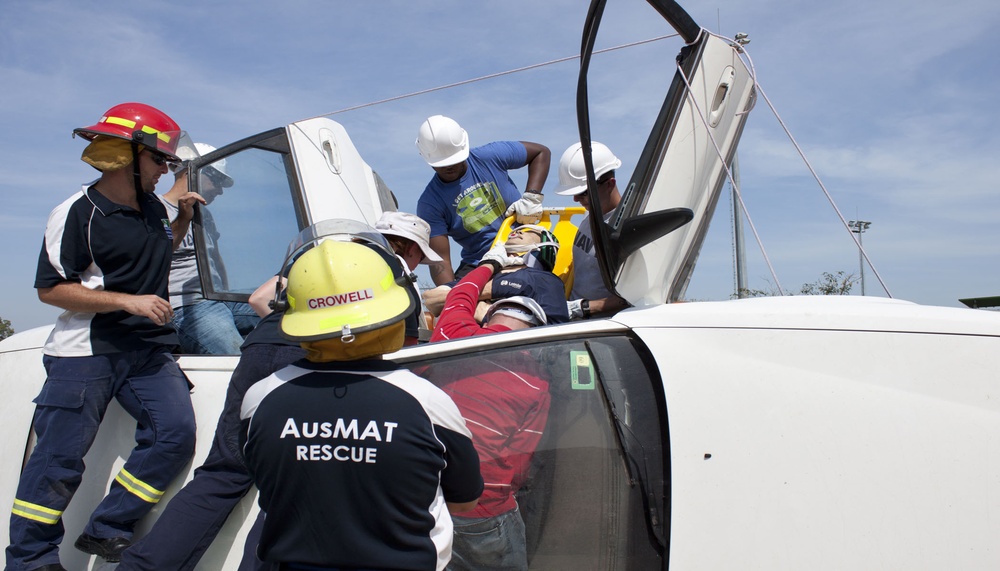
The mock scene looked tragic; one car was upside down, apparently T-boned by another. The corpsmen faced the challenge of using their previous training to treat and extract all victims in less than two minutes.
After the chief firefighter yelled “Go!,” the corpsmen ran to their assigned vehicles and started working on saving the victims. The group assigned to the overturned car faced the biggest challenge: stabilize the car, find a way inside to treat the patient, and find a method to extract the patient safely.
“It was new to me but really cool because a lot of us have never had any extraction training,” said Seaman Dylan Nelson, a corpsman with Company F. “The training application and classes were different from what we usually receive in the military, but I feel like what we learned is important for us to know and really makes us more efficient at our jobs.”
During the two-day course, the corpsmen received classes in practical airway and head injury management, pelvis and long-bone trauma, chest draining, vehicle extraction, spinal injuries, fractures and managing a remote mass-casualty incident. All the classes were followed by practical application, where the corpsmen were given scenarios to test what they learned.
U.S. Navy Lt. Gregory Monk, the medical officer with Company F, said he found out about the annual course through a medical orientation at the Royal Darwin Hospital. With the help of Bronte Douglas, a trauma nurse with the hospital’s national critical care and trauma response center, Monk was able to design a course specifically tailored to the skill set of military corpsmen.
“We were happy to get a chance to work with the guys and maybe teach them something new or sharpen some skills they haven’t used in a while,” said Douglas. “I’m a reservist with the (Royal Australian) Air Force, so I understand there are different procedures and focuses when it comes to trauma care in the military.”
“Our goal is to teach and offer them different techniques to help them become more skilled at their jobs,” said Douglas.
According to Petty Officer 2nd Class Steven Urquidez, a senior corpsman with Company F, the course also gave the corpsmen more appreciation for Australian emergency techniques and procedures.
“They were definitely well-educated,” Urquidez said. “The amount of experience between our instructors, from the firefighters to the paramedic and medical staff, allowed us to connect their tactics to ours.”
Douglas said she hoped to visit the corpsmen during bilateral field-training events to see what the students took from the course.
During the remaining weeks of its deployment to Australia, Company F, as part of Marine Rotational Force – Darwin, will conduct small-unit operations and other combat training in close cooperation with the Australian Army’s 1st Brigade, based at Robertson Barracks.
| Date Taken: |
08.23.2012 |
| Date Posted: |
09.06.2012 02:39 |
| Story ID: |
94281 |
| Location: |
AUSTRALIAN CAPITAL TERRITORY, AU |
| Web Views: |
123 |
| Downloads: |
0 |
PUBLIC DOMAIN

This work, Corpsmen train with Australian responders, must comply with the restrictions shown on https://www.dvidshub.net/about/copyright.

 Subscribe






