By Capt. Marvin J. Baker
120th Infantry Brigade, Division West Public Affairs
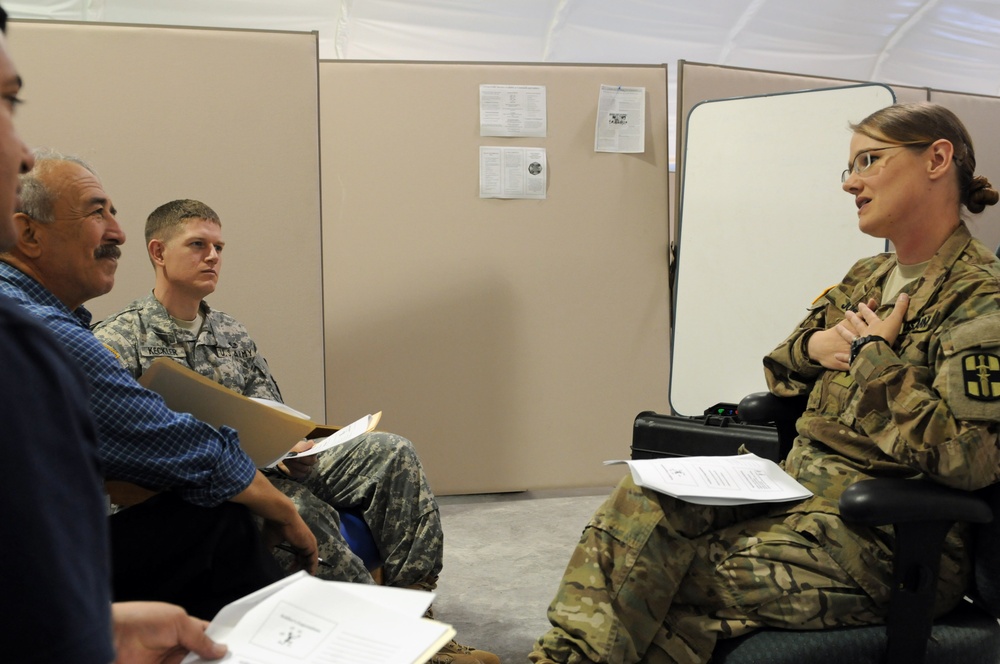
FORT HOOD, Texas — Washington-based U.S. Army Reserve soldiers of the 1972nd Combat Operational Stress Control Detachment practiced patience and empathy skills during their final training regimen here with Division West before they deploy to Afghanistan later this month.
“Our job is to help soldiers react to the high-stress situations associated with deployment,” said 1st Lt. Sarah Suniga, a clinical psychologist with the 1972nd COSC. “Some of those include home-front issues, trauma, depression and anxiety to name a few.”
The unit consists of licensed mental health professionals along with several behavioral health specialists who will work in prevention teams across military camps in Afghanistan. However, the team members aren’t committed only to working in their camps. They plan to extend their practice beyond the camps into close proximity to combat and where the fighting soldier lives and works.
They plan to gain the trust and understanding of other soldiers by spending as much time with them as possible. That means going on missions and involving themselves in the leisure activities of every soldier. Suniga, who will likely work at a restoration center in Afghanistan, said she and the other counselors will focus on two mental health strategies: resiliency and mission-focused thinking.
“Your thoughts feed into your emotions, which feed into behavior. If we can help people understand how that happens, we can show them how to choose more effective reactions to their emotions,” said Suniga.
At the 1972nd Warrior Resiliency Center, soldiers can learn coping and communication techniques to ease the effects of trauma or family separation. Therapists in the unit can assess overall mental health and provide therapy, said Col. Peggy Miller, a family nurse practitioner with the unit.
“In Afghanistan, we will work with other medical facilities to learn who and how to treat soldiers,” she said. “We also work with commanders who want to get a better feel for how their soldiers are feeling with needs assessments. Commanders want to take care of soldiers. We offer sensing sessions, sleep hygiene classes and consultations.”
In addition to the formal avenues to the services, the 1972nd soldiers will use a unique technique to reach even more soldiers. They plan to be out in the dispersed areas where the soldiers are -- similar to how Army chaplains typically work, Miller said. According to the Army Medical Department website, limited access to a care provider during deployment was the second largest barrier for soldiers to overcome when seeking services. Limited time off for treatment was the largest.
Miller will also be responsible for the well-being of the soldiers working in the WRC. “Resiliency training for our providers prepared us to get to this point. We have a big job. We will hear about others’ problems, and we will be living our own as well,” she said. “We developed short-term and long-term goals to help keep us focused on our mission.”
Division West’s post-mobilization training will go a long way to increase the resiliency of the soldiers in the 1972nd. “Replicating what the unit will see in theater will help them mentally prepare for the stressors of combat,” said Col. Paris Um, Division West Medical Training Task Force commander.
During the unit’s culminating training event, the observer-controller trainers created training events that tested the providers’ overall care-giving strategies and individual caregiver’s treatment.
“Although the soldiers in the 1972nd are well-trained in their military specialties, it is critical that the unit test and validate those skills before they deploy,” Um said. “Fort Hood is an ideal place for us to train all of the Army Reserve and National Guard medical units deploying overseas. Along with our (observer controller-trainers), we can find additional specialties and resources we might need at Fort Hood’s 1st Medical Brigade or in Fort Sam Houston’s medical units.”
Suniga said she definitely needed the training because she joined the Army just last November. She has worked nearly six years in a Portland, Ore. Veterans Administration Medical Center as a clinical psychologist and specializes in post-traumatic stress disorder, she said. “I expect this deployment to be a challenge, and I look for challenges. I hope I will gain a better understanding of where soldiers are coming from. I expect to learn a lot by being a ‘reed’ and not a ‘sponge’ as I let their stories flow through me without absorbing them as my own.”
| Date Taken: |
04.24.2012 |
| Date Posted: |
05.01.2012 11:37 |
| Story ID: |
87661 |
| Location: |
FORT HOOD, TEXAS, US |
| Web Views: |
228 |
| Downloads: |
0 |
PUBLIC DOMAIN

This work, Team trains to help soldiers react to combat stress, must comply with the restrictions shown on https://www.dvidshub.net/about/copyright.