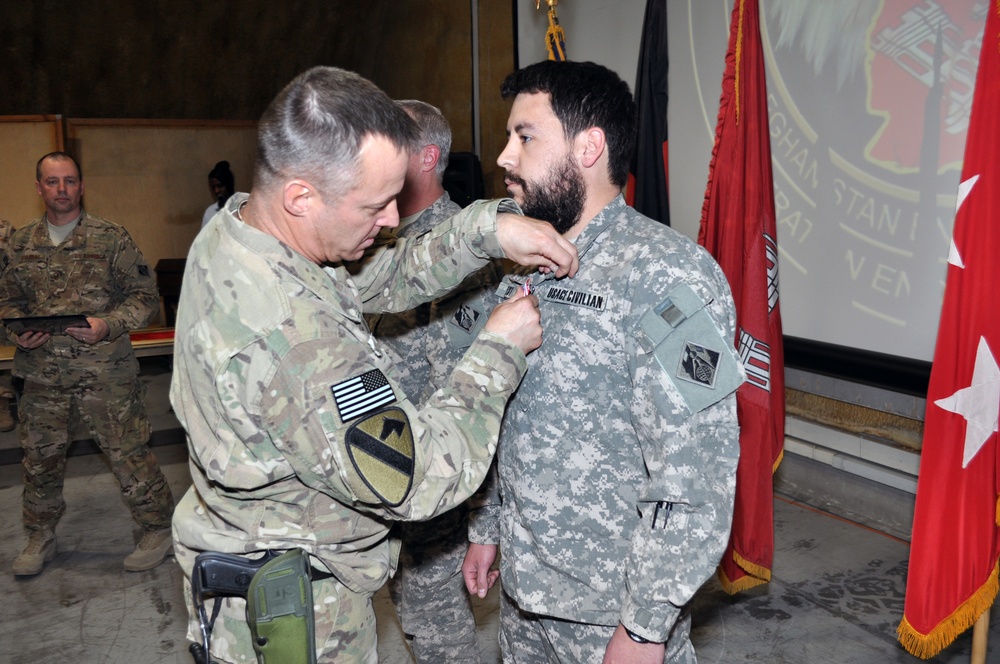
KABUL, Afghanistan – U.S. Army Maj. Gen. Kendall P. Cox presented U.S. Army Corps of Engineers civilian employees John J. Keys, of Fairbanks, Alaska, and Jacob A. West, of Fayetteville, N.C., Defense of Freedom medals, which recognize civilians who are killed or wounded during conflict, March 31.
The medal is the civilian equivalent of the Purple Heart.
Keys, 52, and West, 30, who are civil engineers, were injured during a bomb blast that killed two military personnel in the village of Yahya Khel in the eastern region of the country on Oct. 19, 2011.
At the time, the men were inspecting a two-lane gravel road through the village center. As they stepped from a raised portion of the road toward a culvert that channeled water under the road, an insurgent triggered an 80-pound improvised explosive device.
Keys and West were both standing just feet from the blast center and were thrown several yards and knocked unconscious by the explosion. The two military personnel were killed instantly.
U.S. Army Col. Christopher W. Martin (right) congratulates civilian engineers John J. Keys (left) and Jacob A. West after they were presented the Defense of Freedom medals at the Qalaa House compound in Kabul, Afghanistan, on March 31. Photo by Mark Rankin, U.S. Army Corps of Engineers.
Keys and West were treated for concussions and shrapnel wounds and still suffer from headaches and ringing in their ears. Both, however, remained on the job after the attack, and later were promoted to supervisory positions at the Corps of Engineers’ district headquarters for northern Afghanistan.
“People don’t want these awards,” Cox said while presenting the medals at the Qalaa House compound in front of about 300 civilian employees and military members.
“You shouldn’t go out there seeking something that identifies you as either being shot or blown up. It’s not a nice thing to have, but it’s important to recognize these two gentlemen for their service,” the general said.
Keys and West both said they accepted the medals in honor of the two men who were slain that day – Navy Chief Petty Officer Raymond J. Border, 31, of West Lafayette, Ohio, and Army Staff Sgt. Jorge M. Oliveira, 33, of Newark, N.J. The four men had worked together at the same base for months.
The Corps of Engineers is the leading agency rebuilding critical infrastructure in Afghanistan after three decades of war. Much of the agency’s work is focused on building police stations and military facilities for Afghanistan forces.
Keys and West, though, are involved with the Provincial Reconstruction Team program that assigns individual engineers and construction representatives to coalition military compounds in the rural regions of the country.
Provincial Reconstruction Team members develop smaller projects, such as roads, bridges and schools, which are built at the request of local Afghan officials. The projects are intended to bolster economic and humanitarian conditions for Afghan nationals.
On Oct. 19, Keys, West and the others were assessing a roughly two-mile section of road from the village of Gheybi Khel to Yahya Khel, which are about 60 miles south of the capitol city of Kabul, in Paktika Province near the Pakistan border. Village leaders asked coalition forces to resurface the road with cobblestone to reduce dust and mud.
The group had traveled from Forward Operating Base Sharana in a convoy of heavy military rigs called Mine Resistant Armor Protected carriers, or in military jargon, MRAPs. The tan-colored vehicles have V-shaped hulls that are designed to deflect blasts from bombs hidden in roads.
At the first village, Keys, West and Border, who served as a construction representative, and an Afghan interpreter named Zia, exited the rigs and walked along the center of the road the rest of the way. They took notes, photographs and videotape to document the road conditions.
They were escorted by Oliveira and other well-armed military personnel on a security detail. The security personnel positioned themselves mostly to the edges, walking ahead, behind and to the sides of the unarmed civilians, constantly checking alleys, doorways, rooftops and other spaces where insurgents could hide.
The convoy of slow-moving 14-ton MRAPs and a couple of Afghan police pick-up trucks kept pace.
Everyone in the group wore combat gear – helmets, flak jackets, fire-retardant uniforms and gloves, boots, ballistic glasses and personal first-aid kits. The military personnel were prepared for action; they carried assault rifles, grenade launchers, pistols and communication equipment.
The engineers were focused on their assignment. “We were looking at all the drainage features and what it would require to make it a proper cobblestone road,” Keys said.
The group passed about a dozen three-feet-deep craters left by previously detonated improvised explosive devices, but the group followed a mine-detecting vehicle that had not identified any unexploded IEDs.
The road was lined by an open trench along one edge, and was bordered on both sides by tall mud and brick walls that border family compounds, which are commonplace in Afghanistan.
At noon on a sunny day when the temperature reached about 90 degrees, the group reached the end of the inspection. It was about two hours after the road tour started. A few of the trucks turned around within the narrow space.
A group of five men – Keys, West, Border, Oliveira and the interpreter – paused in the road to assess a culvert that channeled a murky creek under the road. Keys snapped a few photos of the downstream side of the creek to the south. A trickle of water ran along the bottom of a 15-foot-deep gully. An orange cat crept under a drippy pipe protruding from the side of the gorge.
Then Keys snapped a photo of two craters in the road near where they stood.
Next, Keys, West and the interpreter broke off and walked to the edge of road to better assess the upstream end of the brick-lined culvert on the north. The interpreter initially walked ahead of Keys.
Keys stopped at the edge of the road, a distance of about 15 feet from where the group of five men had been standing seconds earlier. He snapped a photo of the gorge, which was lined on both sides by dirt alleys and walled compounds. About 450 yards away from the road was another walled compound, mostly parallel to the road.
Unknown and unseen at the time, two men were hiding at that compound, looking back at Keys.
The interpreter doubled back to West, who was a few steps behind Keys, walking slower as he shot video, dictating his observations as he went.
Keys looked to West and the interpreter. “I remember turning and then – it’s hard to describe – it was just pain. I remember turning and this bad pain,” Keys said.
West, who was still shooting video, panned back south at the same instant. He never saw the flash.
The road where all five men had been standing seconds earlier erupted like a “volcanic explosion,” according to a statement filed later by Navy Chief Bobby A. Long, who was 60 feet away. “I saw a massive blast of dirt and dust,” he wrote.
Keys was blown off his feet about 20 feet into the gully. West and the interpreter were knocked about the same distance to the edge of the road.
Keys awoke face down in the dirt. He was dazed and couldn’t figure out how he had gotten into the gorge. The air was thick with dust. Debris was still falling. He saw U.S. currency lying on the ground around him.
“It was weird,” he said. “Surreal.”
Still confused, he reached out to grab the closest dollar bill. “Then it popped into my head that this bill might be booby-trapped,” he said. He pulled his hand back and waited until his head cleared a bit.
Keys didn’t realize it at the time, but both his ears were bleeding, his right eardrum was blown out and a kidney was lacerated from the shock wave.
When he could, he called out for West by his nickname. “I yelled for Jake and I yelled for Chief,” he said. “I yelled for Jake and he didn’t answer right away, so I yelled for him again. Finally, he answered.”
West’s memory of that time period is nearly entirely shot. “I remember the smell. That’s the only thing I do remember. The burning dirt, chemical, plastic. Still today, if I smell that again, I know what that is,” he said.
West vaguely recalls his friend’s voice somehow wafting through the murk in his own head. West was laying face down, with dirt and bits of clothing and equipment still falling around him.
“Are you OK?” Keys called out. “I’m OK,” West responded.
“Where’s Chief?” Keys asked. “I don’t know, man. He’s gone,” West said.
Long, who’s a medic, and the security leader appeared through the dirt fog on the road above Keys.
The medic spotted Keys, asked if he was alright, then moved onto other victims. Keys heard the security leader radio for immediate military assistance. Keys heard him ask someone for ground coordinates, and he heard West, who had a global positioning device on his wrist, call out their precise location.
West remembers none of that.
Keys scrambled up the gully and found West standing, barely conscious, bleeding from his ears, face and hands. The interpreter was still on the ground. Keys led West to the closest MRAP as more military personnel secured the area from further attacks and attended to the interpreter.
With West safely inside the armored vehicle, Keys joined the search for Border and Oliveira. The group found Oliveira’s body in the gully, and Border’s body within the walled compounds, both about 100 yards away.
West’s first somewhat clear memory was sitting in the back of the MRAP, peering through a small window, watching Keys outside.
“He immediately went back to the site – unarmed – and helped the security forces team search for and recover our fallen soldiers,” West said. “He did all that without being asked. He did all that on his own without any regard for his own personal safety. He was a part of that team. I think that was significant. People should know that.”
Special forces personnel who responded to the scene discovered a wire buried in the dirt from the blast site to a triggering device about 450 yards away. The insurgents likely used binoculars to spy on the men and a motorcycle to flee after triggering the bomb.
The explosives were 12 feet deep. The size of bomb indicated that it was designed to destroy an MRAP.
The depth of the explosives probably required a couple of men three of four days to dig, which means virtually everyone in the village was aware that the bomb was in place. Many villagers watched the group as they conducted their inspection; none warned them about the bomb that awaited them.
The IED’s depth probably was the reason that Keys, West and the interpreter survived. The deep explosion created a relatively vertical blast zone.
Special forces personnel located and detained the suspected bomb-maker shortly after the attack. They identified and detained one of two suspected triggermen several weeks later. The other suspected triggerman remains at large.
Keys and West both had headaches and ringing in their ears for months after the blast, which are characteristic symptoms of IED blasts. The symptoms have subsided for both in the months since the explosion. They will receive further medical evaluations, which is standard military protocol for such events.
Keys is serving a 14-month tour and is scheduled to return in June to Alaska, where he works as a civil engineer at Fort Wainwright. He’s the father of two sons – Carson, 17, and Nathan, 15, both of Fairbanks.
He previously served active duty for the Air National Guard for 16 years. He grew up in Port Clinton, Ohio, and earned a civil engineering degree from the University of Toledo in 1988.
West, who began his employment with the Corps of Engineers in Afghanistan, is serving a two-year assignment. He’s scheduled to return to North Carolina in October. He and his wife Lauren moved to the state just months before he deployed.
He grew up in Kansas City, Kan., and earned a civil engineering degree from the University of Kansas in Lawrence in 2004.
Keys and West both chose to remain in Afghanistan after the bombing and went on similar missions within a week. They have since been promoted to run the entire Provincial Reconstruction Team program, overseeing engineers and construction representatives across northern Afghanistan.
Keys serves as the program director; West serves as the deputy director.
It’s important to note that their promotions were not tied to the explosion, said Col. Christopher W. Martin, who serves as commander of the Corps of Engineers in northern Afghanistan.
“Their selection to run the program is based on their familiarity with the Provincial Reconstruction Team, their familiarity with the program, their overall outstanding exhibition of leadership,” Martin said. “They are two separate, distinct incidents.”
Each medal, which is formally known as the Secretary of Defense Medal for the Defense of Freedom, was presented after a thorough review process that lasted months.
“It’s outstanding that we had the opportunity to recognize civilians who were injured on the battlefield, just like soldiers,” Martin said. “It’s not something you’re awarded; it’s something you’ve earned. No one can approve or disapprove it. If you’ve actually been wounded, you get this medal.”
Both Keys and West said they were honored to receive the medals, but were conflicted as well because they lost two friends that day. They remain committed to the reconstruction mission in Afghanistan.
The Provincial Reconstruction Team program in particular is vital to the cause, West said. “The job that we do – working directly with the military, supporting these operations – is very important to security. There was no way in my mind that I was going to leave these guys,” he said.
Accepting risk while working in a combat environment is a necessary part of the job, Keys said. “It’s a war zone. I didn’t take the IED personally,” he said.
| Date Taken: |
04.04.2012 |
| Date Posted: |
04.04.2012 20:31 |
| Story ID: |
86254 |
| Location: |
KABUL , AF |
| Hometown: |
FAIRBANKS, ALASKA, US |
| Hometown: |
FAYETTEVILLE, NORTH CAROLINA, US |
| Hometown: |
NEWARK AIRPORT, NEW JERSEY, US |
| Hometown: |
WEST LAFAYETTE, INDIANA, US |
| Web Views: |
1,968 |
| Downloads: |
1 |
PUBLIC DOMAIN

This work, Corps of Engineers men get civilian Purple Hearts in Kabul, by Paul Giblin, identified by DVIDS, must comply with the restrictions shown on https://www.dvidshub.net/about/copyright.