By Staff Sgt. Samantha M. Stryker
5th Mobile Public Affairs Detachment
TAL 'AFAR, Iraq -- When the brakes of a 5-ton vehicle fail while descending 4,500 feet on a switchback road, the experience can be unnerving.
Just ask Sgt. Vincente Perez, a movement transportation operator for Troop D, 3rd Squadron, 4th U.S. Cavalry Regiment, 25th Infantry Division (Light), out of Schofield Barracks, Hawaii.
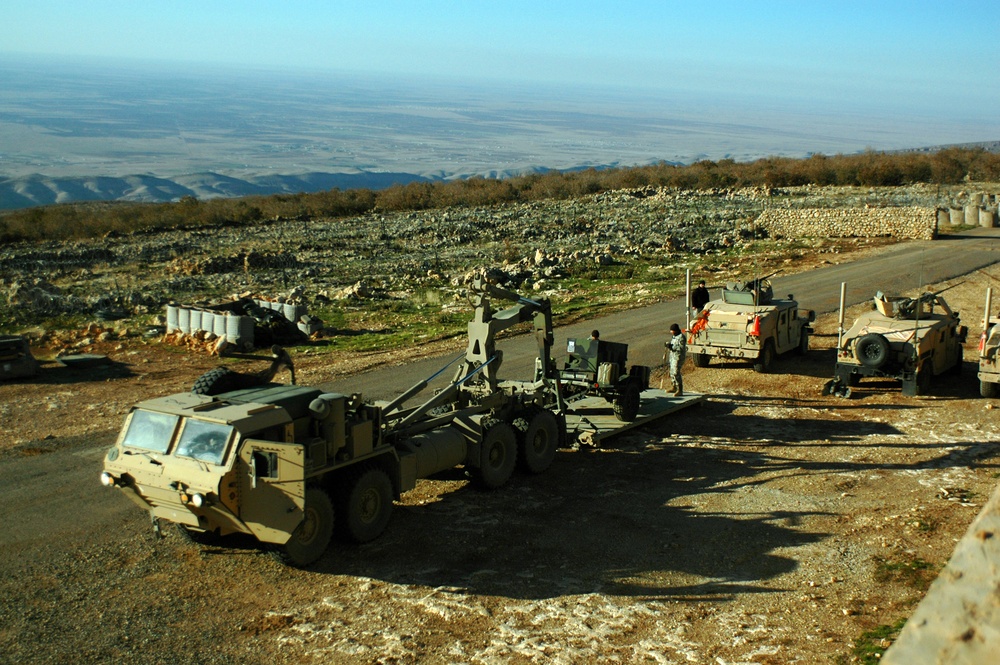
On Oct. 28, Perez and members of his unit were returning from an outpost in the mountainous region along the Iraqi-Syrian boarder. As the Soldiers prepared to descend the mountain, drivers and their assistant drivers walked around the vehicles to make routine visual checks. It was his sixth time down this route.
They joked about the brakes going out on the way down the mountain. Perez joked along with them.
As he drove his truck to the second set of hairpin turns, Perez realized there was something wrong.
"I thought about all the different things I could do...drive the vehicle into a rock wall to stop...drive off the road so that the terrain could help slow us down. But I knew we had no choice but to jump," he said.
His decision to jump out of a moving 5-ton truck cost the U.S. Army a lot of money, but saved the lives of his assistant driver and those of Soldiers in the other vehicles in front of his own.
"The truck began to gain momentum even as we tried to slow down to make the turns. The engine was revving on its own. I looked down and saw that we increased speed to 40 mph," he said.
There is no specific training for this situation, said Perez. His unit has preformed countless rollover drills and was trained to react to various mechanical failures, but reacting to a runaway truck descending a 4,500-foot mountainside is not in the training manual for convoy drivers, he said.
As his truck was barreling down the mountain, Perez ordered his assistant driver, Spc. Joshua Barnett, a maintenance Soldier, to prepare to jump.
"I had to make sure Barnett knew I was serious about jumping out," he said.
Perez had to time their exit so that the unmanned truck would not strike other vehicles in the convoy.
"I just needed to find the right time and a safe place to jump. I looked for a flat place so that when we landed we could roll away from the truck and not get crushed," he said.
Perez described how the truck cut straight across the switchback roads in two or maybe three different places before he actually made the call.
Perez received a deep gash on his right knee. Barnett landed on a slope and broke his right femur.
Units like Perez's perform countless combat logistic patrols throughout theater. These Soldiers also provide security for convoys from other units.
"If we haul it, or anyone else hauls it, we make sure it gets there," said 2nd Lt. Philip Granados, a platoon leader from Troop D.
Transportation Soldiers take risks everyday on the unpredictable roads in Iraq to carry everything, from food supplies and mail, to Soldiers heading home on mid-tour leave.
Granados said that a six-hour mission turns into a 10 or 12-hour mission when he accounts for preparation time, road and traffic conditions, maintenance issues that may develop en route, and recovery after each mission.
Since deploying to Iraq from Schofield Barracks, Hawaii, the unit has completed 116 missions in four months. To date, its convoys have been hit by roadside bombs twice, experienced an escalation-of-force incident six times, and received small-arms fire on several occasions. An escalation of force incident is a situation that requires soldiers to use progressively more force to calm a dangerous situation.
And, now, the unit has experienced one accident.
Perez talked to unit members about the accident and his decision.
"I do not regret telling him to jump," he said.
Days later, Perez walked down to the wreckage site.
"I saw that there would have been no way to get out of the truck if we had not jumped. Best case scenario would have been that Barnett's legs would have been crushed, the worst thing..." Perez voice trailed off.
Despite the incident, Perez and crew continue escorting supplies to that outpost, passing the very spot where he made his decision to jump.
Perez now is a gunner on a security vehicle. He no longer drives a truck.
"I have been up there four times since. Yeah, I hate it. I still get a bad feeling in my gut, a weird feeling," he said. "But this is a lesson for other drivers, and we all have our job to do."
| Date Taken: |
10.28.2006 |
| Date Posted: |
12.11.2006 09:56 |
| Story ID: |
8520 |
| Location: |
TAL AFAR, IQ |
| Web Views: |
91 |
| Downloads: |
31 |
PUBLIC DOMAIN

This work, Despite dangers, logistic Soldiers deliver the goods, must comply with the restrictions shown on https://www.dvidshub.net/about/copyright.

 Subscribe






