
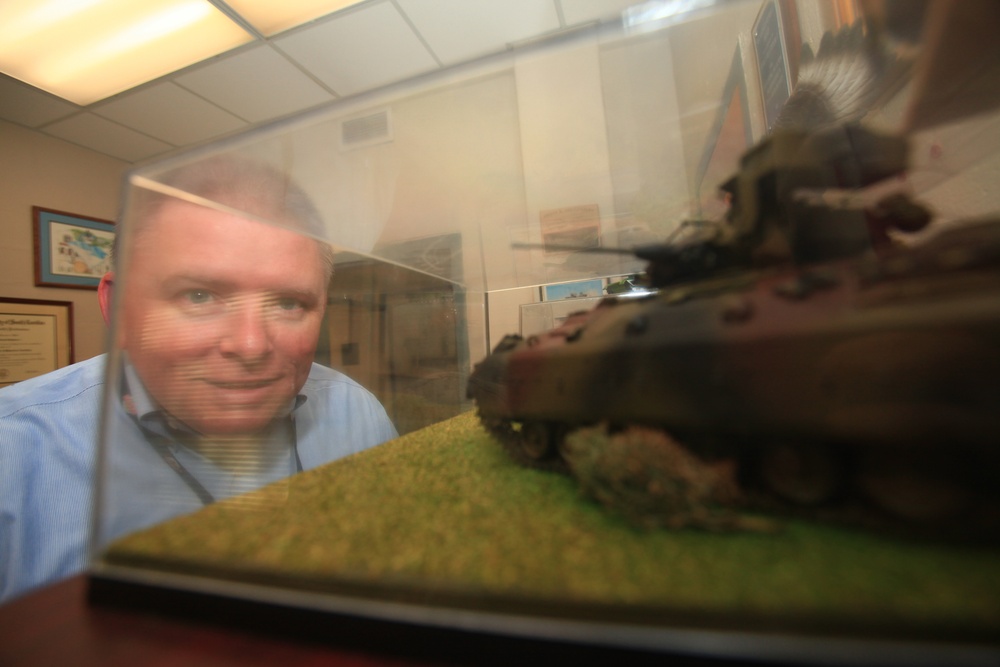
Photo By Cpl. R. J. Driver | Challenge coins collected throughout Stephens’ military career sit on his bookcase a...... read more read more
 Subscribe
MARINE CORPS AIR STATION BEAUFORT, S.C. - Beaufort and its surrounding areas are full of history.
Not many know, but Beaufort, Port Royal and Yemmassee were major strategic points for the Confederates during the Civil War. Its marshes and river ways made it difficult for not only the Union Army, but for invading British and Spanish forces in the past too.
The average student growing up is not taught about the importance of the low country during the Civil War, but for natives of the area, this history is their heritage.
For the self-proclaimed Army brat, William Stephens, a physician’s assistant at the branch medical clinic, branching out into history has helped him not only during his military career, but in the medical field as well.
Born in Fort Campbell, Ky., Stephens was brought up listening to stories from his father about military history.
“I remember my dad sharing stories about World War II and other historic events when I was a child,” Stephens said. “I always thought it was interesting, but at an early age, I found an interest in science and math.”
Stephens excelled as a student growing up in Charleston, where his new-found interest in military history led him to The Citadel on a full scholarship, where he received a bachelor’s degree in education.
“At this point in my life, I have developed my own interest in military history,” Stephens explained. “While at The Citadel, I learned more about history and tactics.”
Eventually, he made his way to Beaufort, where he currently resides.
“After serving as an infantryman, I served at the National Guard armory in Beaufort where I learned more about the local history,” he said.
Stephens’ interest in history translates into the medical field as well, where exposure to different illnesses and patient history can make a physician successful.
“I believe that it is important to understand your patient’s background, because it can speed up the diagnosis process,” Stephens explained. “For example, in medical school, one would be exposed to a person with a toe injury. One may have an arthritic toe; the next, a toe with gout; or a toe that had something dropped on it. Combine the exposure from seeing the different types of injury with the knowledge of your patient having a history of gout or knowing they dropped something on their foot, and you have a good idea of what is going on before you even examine it.”
For Stephens, medical and military history all ties into the theory of knowing where you have been to find out where you are going.
Stephens’ wealth of knowledge is not something he solely keeps to himself. He mentioned recently helping his daughter with a history assignment in which even he learned more about the area while instilling his knowledge in her.
He also said, even in passing, he has a way of working in historical facts with his coworkers, which keeps history going and never dying.
| Date Taken: | 10.28.2011 |
| Date Posted: | 10.28.2011 14:41 |
| Story ID: | 79212 |
| Location: | MARINE CORPS AIR STATION BEAUFORT, SOUTH CAROLINA, US |
| Web Views: | 45 |
| Downloads: | 0 |

This work, Meet the BMC resident ‘historian’, by Cpl R. J. Driver, identified by DVIDS, must comply with the restrictions shown on https://www.dvidshub.net/about/copyright.


No keywords found.




