MARINE CORPS AIR STATION FUTENMA, Japan - Marine Corps aviation has been a successful and essential element of the Marine Air-Ground Task Force by providing transportation and close air support to its ground forces. However, without fuel, the aircraft would not have the ability to provide these important capabilities.
For a small group of Marines and sailors aboard Marine Corps Air Station Futenma, ensuring the availability and quality of fuel is an important daily task.
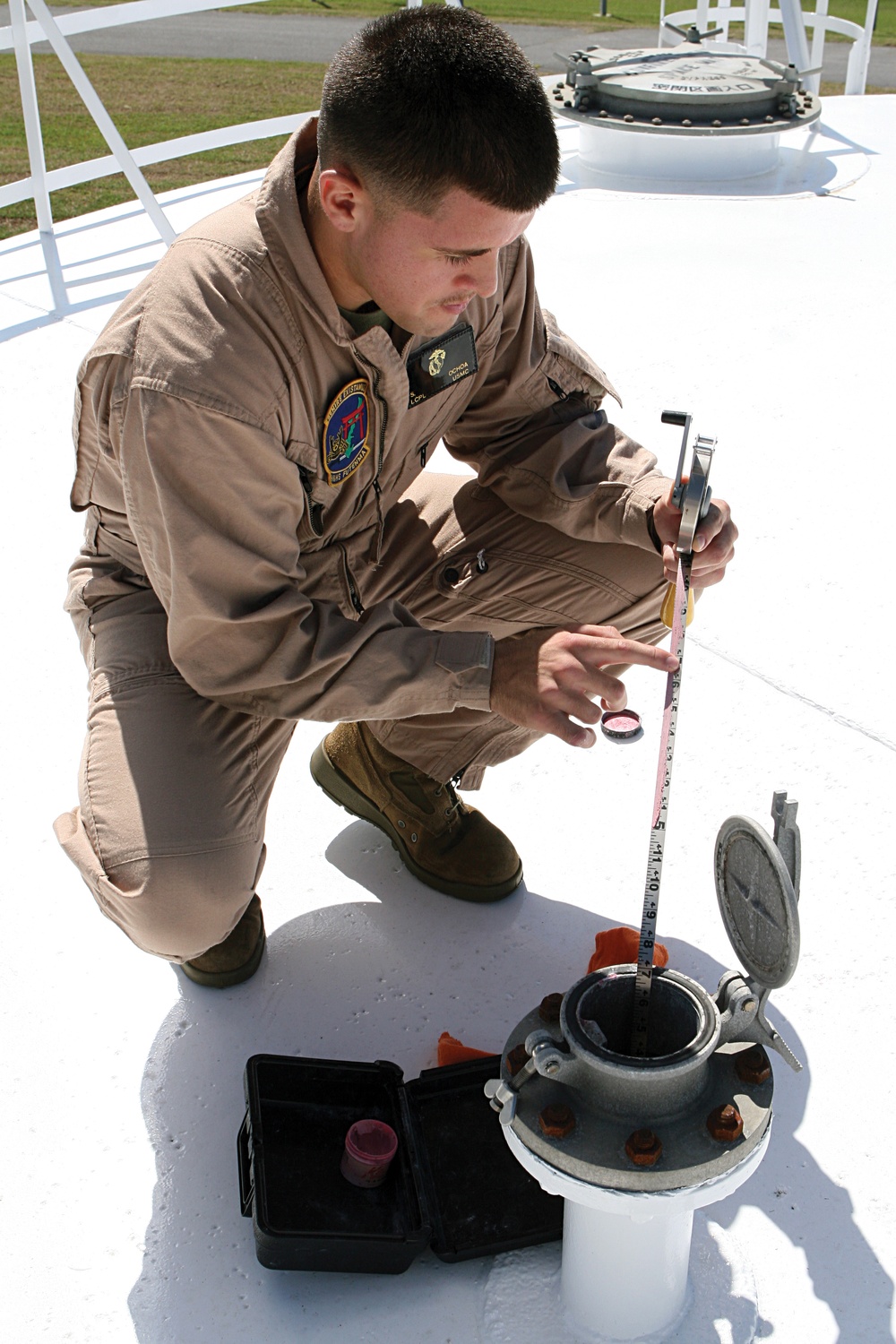
A bulk fuel specialist’s primary mission is to install, operate, maintain and repair fuel-handling units and accessory equipment, and test petroleum products.
“Bulk fuel specialists provide an essential capability to Futenma,” said Maj. Jeffrey D. Lee, MCAS Futenma airfield operations officer. “They provide fuel services to our tenant and transient aircraft via hot or cold refueling.”
Cold refueling is accomplished when the aircraft’s engines are shut down, and hot refueling is accomplished when the engines are running, according to Sgt. Nathan J. Davis, a crew leader with Headquarters and Headquarters Squadron, MCAS Futenma.
Bulk fuel specialists receive anywhere from five to 45 fuel-related requests and process about 20,000 to 30,000 gallons of fuel daily.
Along with refueling, bulk fuel specialists are also responsible for defueling aircraft by extracting unused fuel from the aircraft to be reused.
“When we defuel an aircraft, we go and get the samples from the unit first then after we know their fuel is good, we go and defuel them,” said Petty Officer 3rd Class Serafin Garcia, a bulk fuel specialist with H&HS. “We get about 500 to 800 gallons of fuel from defueling an aircraft.”
Bulk fuel specialists proved their worth during Operation Tomodachi, a combined-joint, Japan-U.S. humanitarian assistance and disaster relief operation to support Japanese victims of the Great East Japan Earthquake. During the operation, bulk fuel specialists serviced about 540 aircraft and processed more than 470,000 gallons of fuel.
“Operation Tomodachi was a lot more demanding for us because we had [KC-130J Hercules cargo aircraft] going in and out constantly,” said Lance Cpl. Sean M. Caldwell, a bulk fuel specialist with H&HS.
The Marines perform an outstanding job, working 12-hour shifts and giving 100 percent effort in what they do, said Staff Sgt. Rigoberto Ramirez, a quality control and operations chief with H&HS.
“The job these Marines perform is a supporting job,” said Lee. “Without fuels planes can’t fly.”
| Date Taken: |
09.27.2011 |
| Date Posted: |
10.05.2011 18:48 |
| Story ID: |
78079 |
| Location: |
MARINE CORPS AIR STATION FUTENMA, OKINAWA, JP |
| Web Views: |
120 |
| Downloads: |
0 |
PUBLIC DOMAIN

This work, Fueling Marine Corps aviation, by Sgt Michael Iams, identified by DVIDS, must comply with the restrictions shown on https://www.dvidshub.net/about/copyright.

 Subscribe





