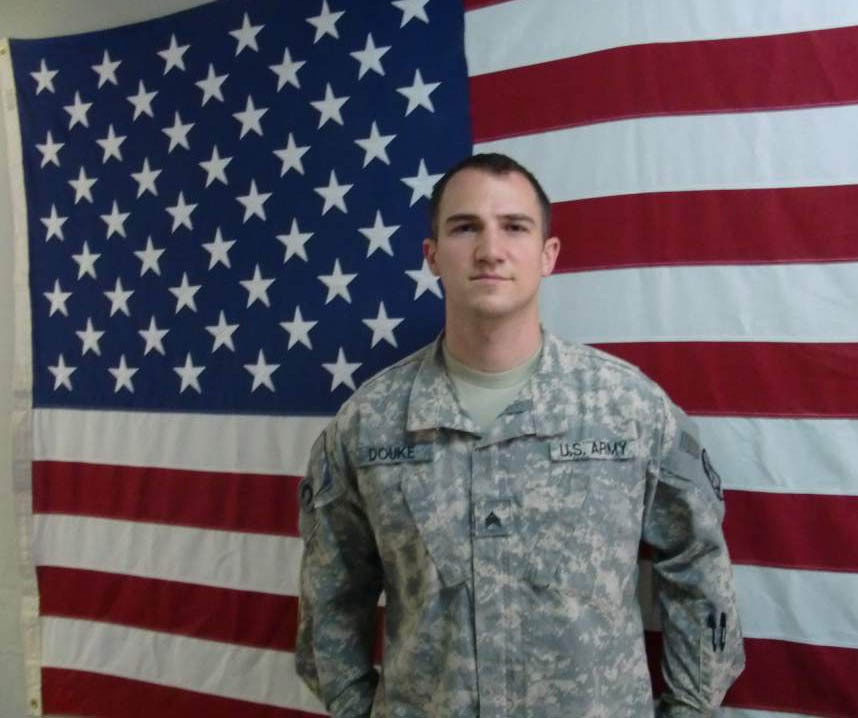
SATHER AIR BASE, Iraq - "There has been a hijacking.”
That was the wake-up call U.S. Army Sgt. Jesiah Douke heard over the intercom Sept. 11, 2001, while asleep on a military contracted commercial aircraft.
Douke, assistant non-commissioned officer in charge of Mortuary Affairs at Sather Air Base, Iraq and airman at the time, was returning home from a deployment to Southwest Asia. His initial response to the unclear announcement was panic and confusion.
He thought his aircraft had been hijacked.
Quickly, the aircrew added that a plane in New York City had been hijacked and hit a tower at the World Trade Center.
While en route to New York City, the pilots of Douke’s plane immediately diverted and landed at the nearest base -- Lajes Field, Azores, Portugal.
Upon landing, Douke was immediately escorted to temporary living quarters as the installation was at a heightened level of security. He was given a room and told he could visit a small convenience store and the bowling alley for food and supplies.
For seven days Douke, a former firefighter assigned to the 27th Fighter Wing (now 27th Special Operations Wing) at Cannon Air Force Base, N.M., lived on microwaveable food and sat in his room watching the news.
A 20-year-old with 16 months of active duty, Douke knew his life and country would never be the same.
“I remember thinking ‘this is going to be the most significant event in our history during my lifetime,’” said Douke, a native of Bellingham, Wash., and deployed from Fort Lee, Va. “I often try to imagine what it would have been like being on one of those flights where the feeling of shock and horror of being hijacked was real.”
Nothing could have prepared Douke for the site he would experience when he finally returned to the U.S.
“The pilot came over the loud speaker and made the announcement that we would be entering the New York City area shortly and they would fly over the site of the towers,” Douke said. “Minutes later there we were. Everyone huddled to one side of the plane, witnessing the huge plumes of grey smoke that still filled the air as we flew directly over the site of ground zero.”
Douke said he couldn’t imagine how after a week, there was still a large amount of debris filling the skies like the ceiling of a cigar lounge.
“I tried to imagine the thousands of people down there. All the workers, police, medical and construction, and how busy they must have been at that moment,” he said.
From that moment on, Douke’s perspective on life changed.
“The events of 9/11 helped me to realize that we as people, no matter the differences we may have, also share the most common things inside - feelings,” he said. “Complete strangers connected to each other based on mutual feelings that were shared … none of us are really strangers at all.”
As a military member, Douke’s sense of pride and honor is obvious. Recalling the events, he speaks with sincerity and passion.
“The events of 9/11 will forever be remembered as some of the most tragic in our history. The [events caused] a lot of pain for many people for the losses they endured. This event will forever shape the lives in our world.”