by Spc. Amanda J. Solitario
210th MPAD
Camp Taji, Iraq— When the U.S. Army's 4th Sustainment Brigade arrived here in October, the Iraqi 6th Motorized Transportation Regiment had to walk side-by-side with coalition forces on all missions. Today, they are on their own.
The 6th Iraqi Army Division took charge of the 6th MTR during an Aug. 3 ceremony here, officially transferring it from U.S. control.
After a harmonious Arabic prayer opened the ceremony, key leaders within the 6th MTR and the 6th Iraqi Army Division took turns addressing the soldiers in their native language. The officers commented on how far the troops have come and how hard they have worked.
The commander of the regiment told his Soldiers to be proud of what they have accomplished and asked God to protect them.
The stage was lined with a mix of Iraqi and American officers, symbolizing the unity of the two armies and the respect they have for one another.
"We have learned much from you," said Col. Gustave Perna, commander of the 4th Sustainment Brigade. "Because of our relationship, we as soldiers and as leaders will be better on both sides."
Perna said he has enjoyed watching the Iraqi unit during its transition.
"It has been my pleasure over the last 11 months to have worked with these fine soldiers and leaders, to watch their unit grow, and to witness their great success," Perna said. "The discipline and professionalism in this unit is second to none."
The transfer of the regiment is extremely important for the overall success of the Iraqi Army, said Lt. Col. William Schiek, commander of the 4th Brigade Troops Battalion from Fort Hood, Texas.
One of the responsibilities of the Iraqi unit is to disseminate supplies and equipment to its troops.
"If this regiment was incapable of doing their mission, there would be a greater price to pay in the rest of the Army," he said.
Perna said the support this unit provides has stimulated the growth of the Iraqi Army and has enhanced the morale of the entire organization.
Since the beginning of their deployments, the 4th BTB and a Military Transition Team have been coaching the 6th MTR on how to function as a unit, Schiek said.
"It has been a training process that has taken a little bit of time," he said.
The embedded transition team spent grueling hours over the months showing the soldiers basic combat skills, convoy protection, equipment maintenance, and logistical management, said Maj. Roger Glenn, force protection officer with the MITT.
Schiek said the 4th BTB was arranging and leading all the missions for the regiment at the beginning. However, the training has paid off. For the last three months, the regiment has conducted more than 40 missions on their own without losing a soldier.
The 6th MTR conducts a wide range of transportation missions ranging from supply movements to convoy security, he said. Everything is now planned and executed solely by the Iraqis.
The coalition forces still remain in the rear and monitor from a distance, Schiek said. The 4th Sustainment Brigade will stay on the sidelines to provide assistance if the unit needs it.
"We will do that until we are told not to," he said.
Schiek said the regiment's operations have taken them all over the country, and they are an extremely successful unit.
This is the second Iraqi transportation regiment to stand on its own, and more will follow Schiek said. This unit will be the model for all other Iraqi units working hard to operate independently.
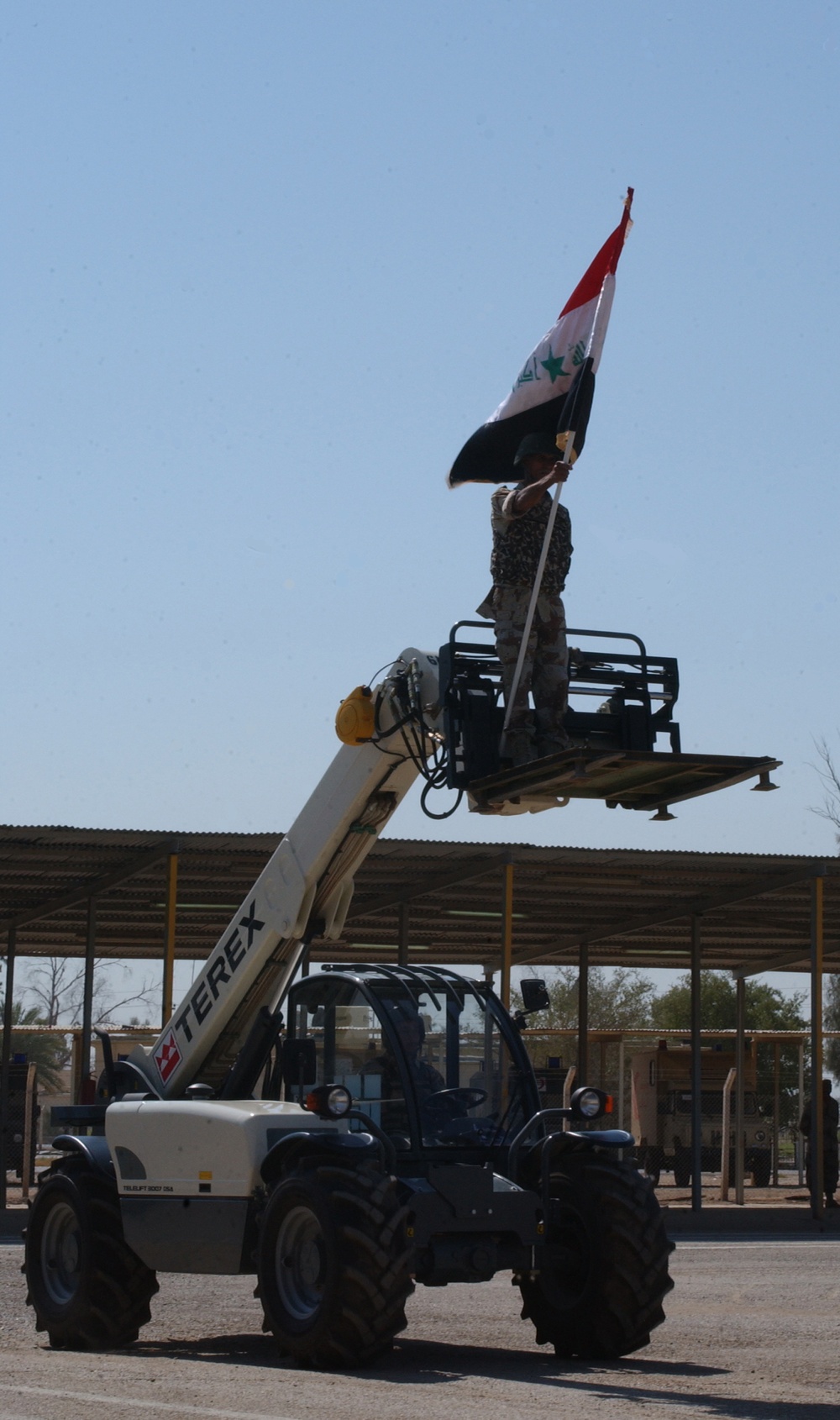
As the blistering sun shined down upon their faces, the ceremony closed with a pass and review of all the companies. Following the troops was a parade of the unit's vehicles, giving the audience a taste of the regiment's capabilities.
After the last truck rolled past, Brig. Gen. Rebecca S. Halstead, commander of the 3rd Corps Support Command, officially relinquished authority to the 6th Iraqi Division.