
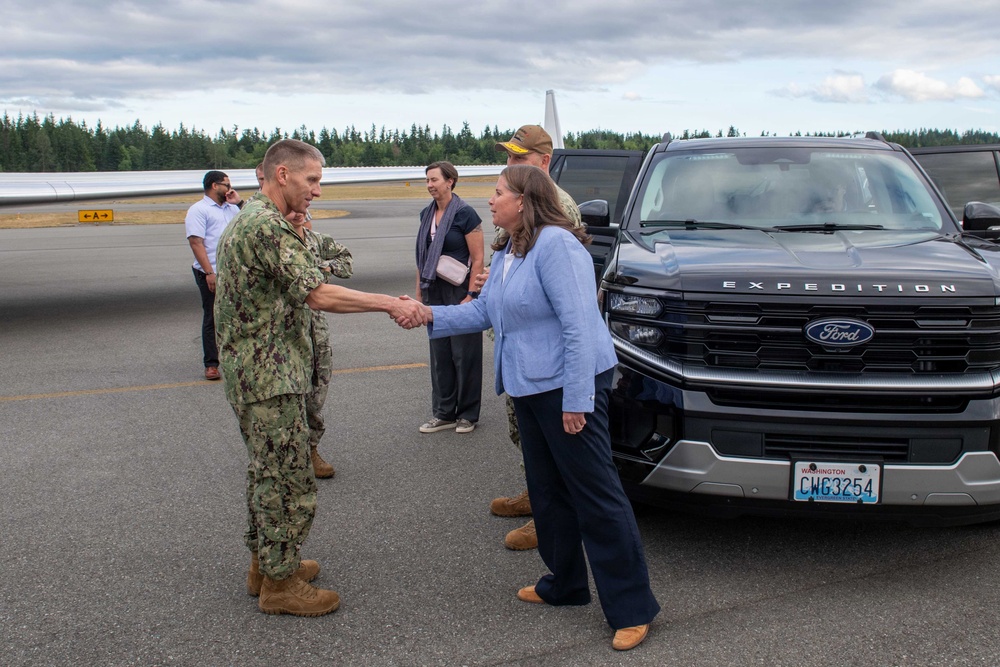
Photo By Petty Officer 1st Class Ryan Riley | Tracey Ford, protocol officer assigned to Commander, Submarine Group (COMSUBGRU) 9,...... read more read more
 Subscribe
“Resilient people, systems, and processes can respond to any situation, rapidly recover from difficulties, and maintain or regain essential functions in the face of disruption.”
“Our ability to successfully answer the call to fight and win depends on our ability to withstand and overcome challenges.”
Tracey Ford was on a Sunday afternoon hike in the mountains of Kitsap Peninsula when her phone began buzzing ominously. She took one look at the reason for the sudden influx of notifications and knew instantly that the next 12 hours were going to be vastly different than how she had originally planned to end her weekend.
The itinerary for a senior U.S. Navy leader was in flux and there were several items that needed her immediate attention if the impending visit was to be a success. An hour from her car if she hustled and daylight waning with scant time to waste, Tracey turned around and began striding faster.
For the seasoned event planner and current protocol officer at Commander, Submarine Group 9, it was yet another opportunity for her to exercise resiliency amidst tempestuous circumstances.
That Sunday afternoon, Ford did what’s made her a successful protocol practitioner for the last three decades—she took a step back and began to work through the problem logically and with intent.
“To be resilient you have to be able to look at a situation objectively,” says Ford, describing what she would tell someone struggling to build resiliency. “Remove yourself and your emotions from what’s happening and know that when a plan changes it’s not personal. If a visit gets canceled or changed, it’s not because they didn’t want to come. Being able to take a step back, pause, look at a problem objectively, then make a decision and move forward is my advice.”
That ability to look at a problem objectively is critical when juggling the demands of high-level visitors subject to last-minute cancellations or seemingly impossible requests. These are requests that Ford must manage or risk catastrophe. The protocol officer views herself as the director of a play, remaining behind the scenes but managing all the details and making sure everyone is where they need to be.
Despite her natural proclivity for organization, scheduling, and conscientiousness, military protocol wasn’t always the path Ford thought she would pursue. Her first introduction to protocol left much to be desired due to the abundance of perceived “hand-holding” that was involved. It wasn’t until she took a job with the Marine Corps that she began to realize that protocol was a niche where her skillset was deeply appreciated and one that held poignant significance given her family’s service affiliation.
Definitionally, military protocol is the set of rules, customs, and regulations that govern official life and ceremonies. For Ford, “we’re the custodians of the customs and the traditions.”
She continues, “protocol can be the grease in the gears of a well-oiled machine. I provide some oversight and take the burden off the principals regarding logistics so they can worry about the content of the meeting.”
Often overlooked, the importance of a protocol officer is difficult to quantify when things go well but remove a skilled tactician from the role and suddenly some of the most important events at a command could be jeopardized.
An important caveat is that, for Ford, her resilience does not exist in a vacuum. One example is how she finds strength and professional nourishment by engaging with other event planners through various organizations. “I find being able to talk to people who understand the environment that I’m in and I can vent to really helps when I’m going through challenging times. Finding a community of people that understand your precise circumstances makes a huge difference when I’m trying to figure out a problem.”
That team-first mentality exists outside of work as well when Ford is on the water paddling with her team during one of her favorite competitive outlets. The avid outrigger canoe paddler has found that, “you can have the six strongest people in the canoe paddling but if you’re not in sync you won’t do well. You can be the best person in the boat, but you may be paddling with five beginners, and your success is contingent on your whole team.”
She continues, “paddling has built my resilience because if I’m in a race I’m going to do the best that I can sometimes knowing I don’t have a chance to win. But being able to bounce back knowing I worked together with my team to make it across the finish line is the key.”
And for the senior naval leader visit? On Oct. 5, 2026, Acting Secretary of the Navy Hung Cao recognized Sailors during an all-hands call at Naval Base Kitsap-Bangor, with Tracey Ford working silently in the background.
“It was really a testament to the team’s resilience, being able to flex to make the event happen. Making a secretary level visit happen in less than eight hours of working time really speaks to the quality of people we have on the team here.”
| Date Taken: | 11.17.2026 |
| Date Posted: | 11.18.2026 11:12 |
| Story ID: | 579535 |
| Location: | SILVERDALE, WASHINGTON, US |
| Web Views: | 230 |
| Downloads: | 0 |

This work, Fleet Orders In Action: Resiliency, by LT Zachary Anderson, identified by DVIDS, must comply with the restrictions shown on https://www.dvidshub.net/about/copyright.


No keywords found.