Photo By Erin Thompson |
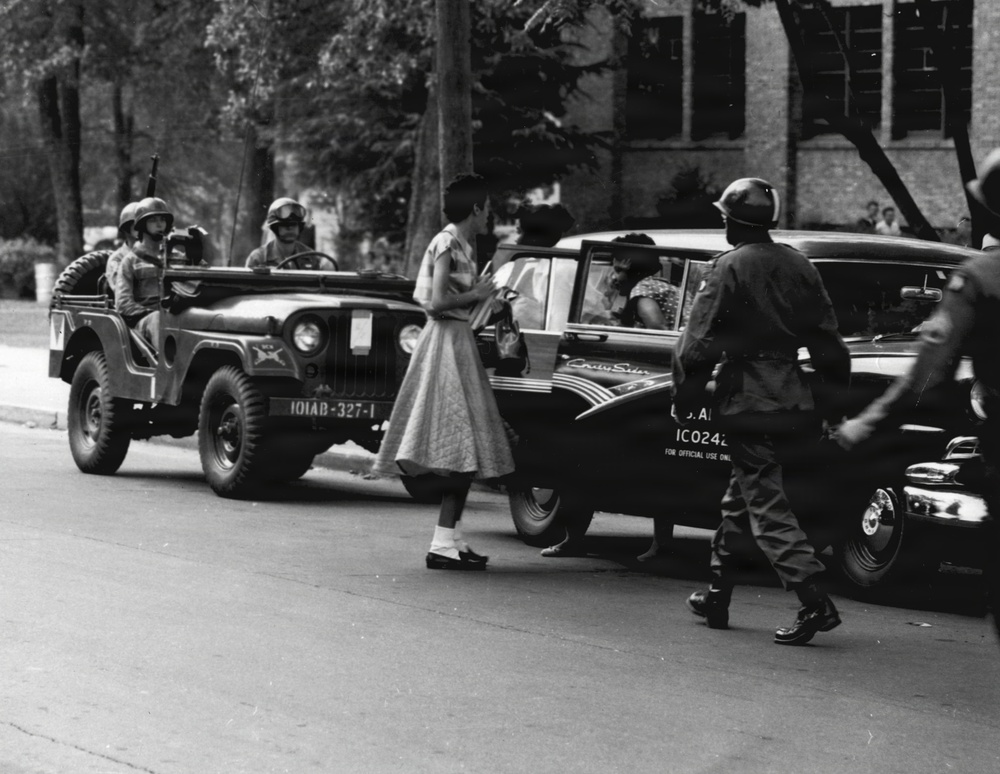
Soldiers from the 101st Airborne Division escort Black students to Central High School......read moreread more
Photo By Erin Thompson | Soldiers from the 101st Airborne Division escort Black students to Central High School in Little Rock, Arkansas, Sept. 1957 see less
| View Image Page
On Sept. 24, 1957, President Dwight D. Eisenhower signed Executive Order 10730, deploying elements of the 101st Airborne Division to Little Rock, Arkansas, to support the desegregation of the town’s Central High School. This deployment forced Army intelligence officers to scramble to map localized threats after years of neglecting domestic civil unrest planning.
The crisis had erupted following the Supreme Court’s landmark Brown v. Board of Education ruling, which declared segregation in public schools unconstitutional. In September 1957, nine Black students—the Little Rock Nine—enrolled at Central High School. Arkansas Governor Orval Faubus openly defied federal mandates by deploying the Arkansas National Guard to block the students from entering the building. Moreover, potentially violent mobs gathered, threatening a breakdown of law and order. Against this escalating threat, President Eisenhower reluctantly intervened to restore peace, protect the students, and uphold judicial authority.
Code-named Operation ARKANSAS, the military operation relied on overwhelming force to reestablish order. Maj. Gen. Edwin A. Walker, chief of the Arkansas Military District, assumed tactical control. Within an hour of Eisenhower’s order, approximately 1,000 paratroopers from the 101st Airborne Division’s 1st Airborne Battle Group, 327th Infantry, moved from Fort Campbell, Kentucky, into Little Rock. The battle group would escort the Black students through potentially hostile crowds. To ensure long-term stability and strip Governor Faubus of his military asset, the operation also federalized all 10,000 members of the Arkansas National Guard. Walker used two infantry battalions and other Guard elements to directly support the operation.
Since the 1940s, legal agreements and bureaucratic directives had severely restricted the American Army’s role in domestic military intelligence to prevent civilian monitoring. Under the interagency Delimitations Agreement of 9 February 1942, investigative jurisdiction over domestic political activism, civilian subversion, and racial dissent was reserved entirely for the Federal Bureau of Investigation. Military branches were confined to collecting only the tactical and terrain data required to support civil disturbance operations. Furthermore, in 1946, an Army Ground Forces directive expressly forbade its personnel from directly collecting domestic civilian information. Later, the Continental Army Command treated civil disturbance intelligence planning as an afterthought, leaving field commanders with no intelligence baseline.
In this complex bureaucratic atmosphere, the 112th Counter Intelligence Corps (CIC) Group, operating within the Fourth U.S. Army’s area, served as the principal regional counterintelligence element. Commanded by Lt. Col. Robert M. Reese, the 200-man group was headquartered at Fort Sam Houston, Texas. The group maintained a regional network spanning five states, including a branch office in Little Rock. Its core mission was to detect treason, sedition, subversion, and espionage directed at the Army, functioning as a fact-finding organization to provide security information for protecting personnel and installations.
Despite the broader military’s structural unreadiness, agents from the 112th CIC Group stepped into the information vacuum early. On September 3, agents began to monitor developments closely, paying particular attention to the news media. With the deployment of the 101st Airborne’s paratroopers, Maj. William J. Hammond, the group’s operations officer, marshaled agents to reinforce Maj. Thomas J. Mann’s Little Rock regional office. The agents worked to establish an emergency surveillance network. Operating under intense high-level pressure, these agents monitored and mapped shifting crowd dynamics and tracked localized agitators around the high school perimeter to build a real-time picture of the escalating friction. Agents in unmarked cars kept general surveillance over the routes the Black students traveled to and from school.
To supplement this impromptu network, General Walker deployed his own tactical reconnaissance teams. Using helicopters and radio-equipped jeeps, patrols mapped out the physical streets, located choke points, and plotted routes for the vehicles escorting the students. This visual intelligence gave Walker and his commanders immediate warnings if a mob was swelling or attempting to breach a perimeter fence. In addition, Walker actively used federal, state, and local police updates to guide his deployment.
For about six weeks, Walker and his force successfully provided security and protection for the
Little Rock Nine around Central High School. In early November, the situation stabilized
sufficiently to transition security operations to local control, and the paratroopers returned to Fort
Campbell.
***
Article by Michael E. Bigelow, INSCOM Command Historian. New issues of This Week in MI History are published each week. To report story errors, ask questions, request previous articles, or be added to our distribution list, please contact: TR-ICoE-Command-Historian@army.mil.

 Subscribe






