
 Subscribe
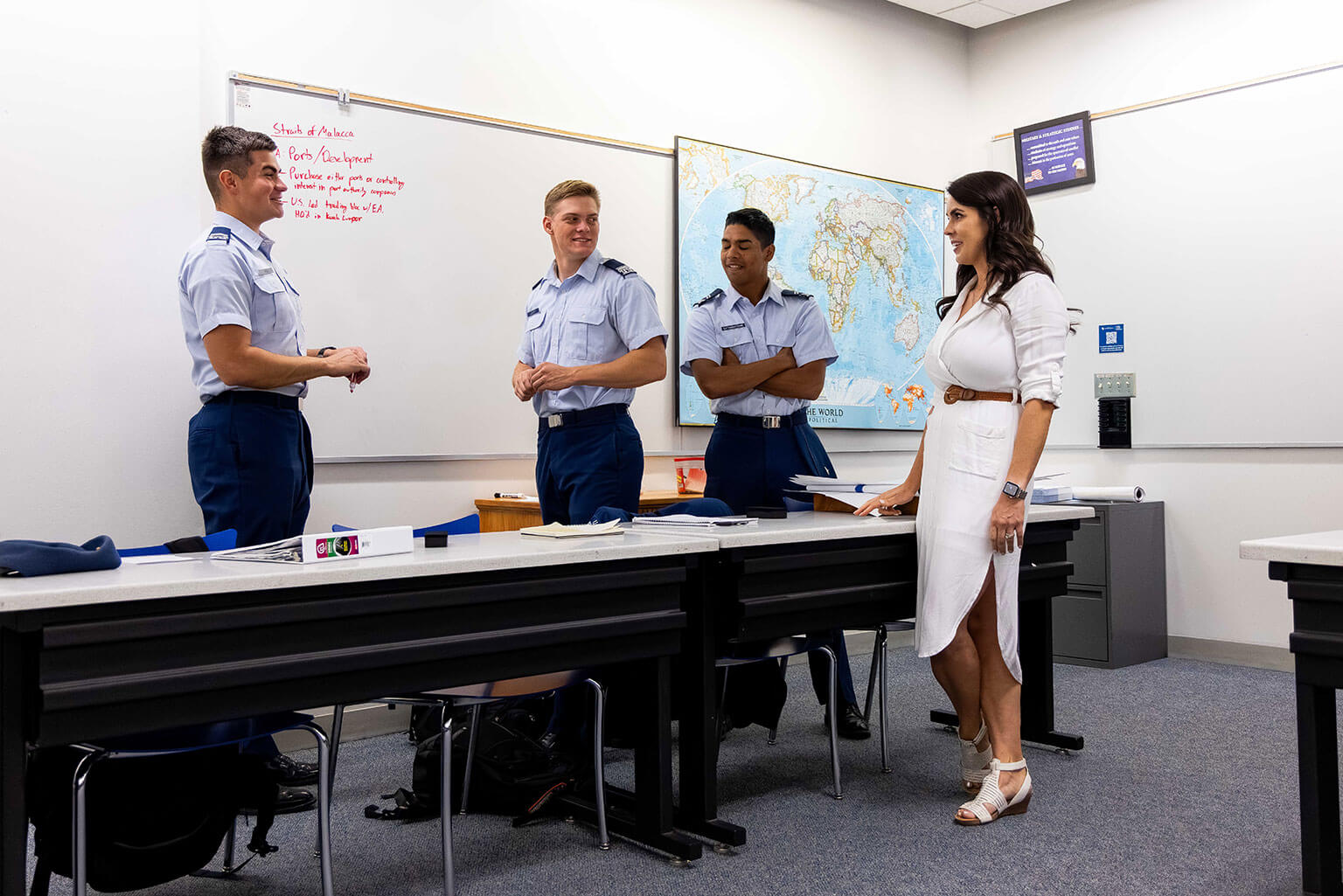 Cadet 1st Class Hunter Levett and fellow cadets participate in a Future Conflict Minor class at the U.S. Air Force Academy, Colo., Sept. 14, 2026. The interdisciplinary program develops critical-thinking skills through the study of strategic behavior, emerging technologies and complex challenges. (U.S. Air Force photo by Trevor Cokley)
By SSgt Michael Ward
U.S. Air Force Academy Strategic Communications
U.S. AIR FORCE ACADEMY, Colo. –Developing officers who can think critically, challenge assumptions and make decisions in complex environments is part of the U.S. Air Force Academy’s mission to prepare cadets for future service.
One way the Academy develops those skills is through the Future Conflict Minor, an interdisciplinary pathway open to cadets in any major who want to explore where conflict is headed and how to prepare for it.
Dr. Kerry Chavez, assistant professor with the Institute for Future Conflict and chair of the Future Conflict Minor working group, teaches two courses in the minor: Adversary Doctrine and Disruptive Tech and Future Conflict. Her courses challenge cadets to examine strategic behavior, emerging technologies and the factors that shape how nations approach conflict.
“Predicting and preparing for the future is hard. We aim to equip students with substantive knowledge, but more of the intellectual toolkit to think through complex, dynamic challenges from start to solution,” Chavez said.
Cadet 1st Class Hunter Levett and fellow cadets participate in a Future Conflict Minor class at the U.S. Air Force Academy, Colo., Sept. 14, 2026. The interdisciplinary program develops critical-thinking skills through the study of strategic behavior, emerging technologies and complex challenges. (U.S. Air Force photo by Trevor Cokley)
By SSgt Michael Ward
U.S. Air Force Academy Strategic Communications
U.S. AIR FORCE ACADEMY, Colo. –Developing officers who can think critically, challenge assumptions and make decisions in complex environments is part of the U.S. Air Force Academy’s mission to prepare cadets for future service.
One way the Academy develops those skills is through the Future Conflict Minor, an interdisciplinary pathway open to cadets in any major who want to explore where conflict is headed and how to prepare for it.
Dr. Kerry Chavez, assistant professor with the Institute for Future Conflict and chair of the Future Conflict Minor working group, teaches two courses in the minor: Adversary Doctrine and Disruptive Tech and Future Conflict. Her courses challenge cadets to examine strategic behavior, emerging technologies and the factors that shape how nations approach conflict.
“Predicting and preparing for the future is hard. We aim to equip students with substantive knowledge, but more of the intellectual toolkit to think through complex, dynamic challenges from start to solution,” Chavez said.
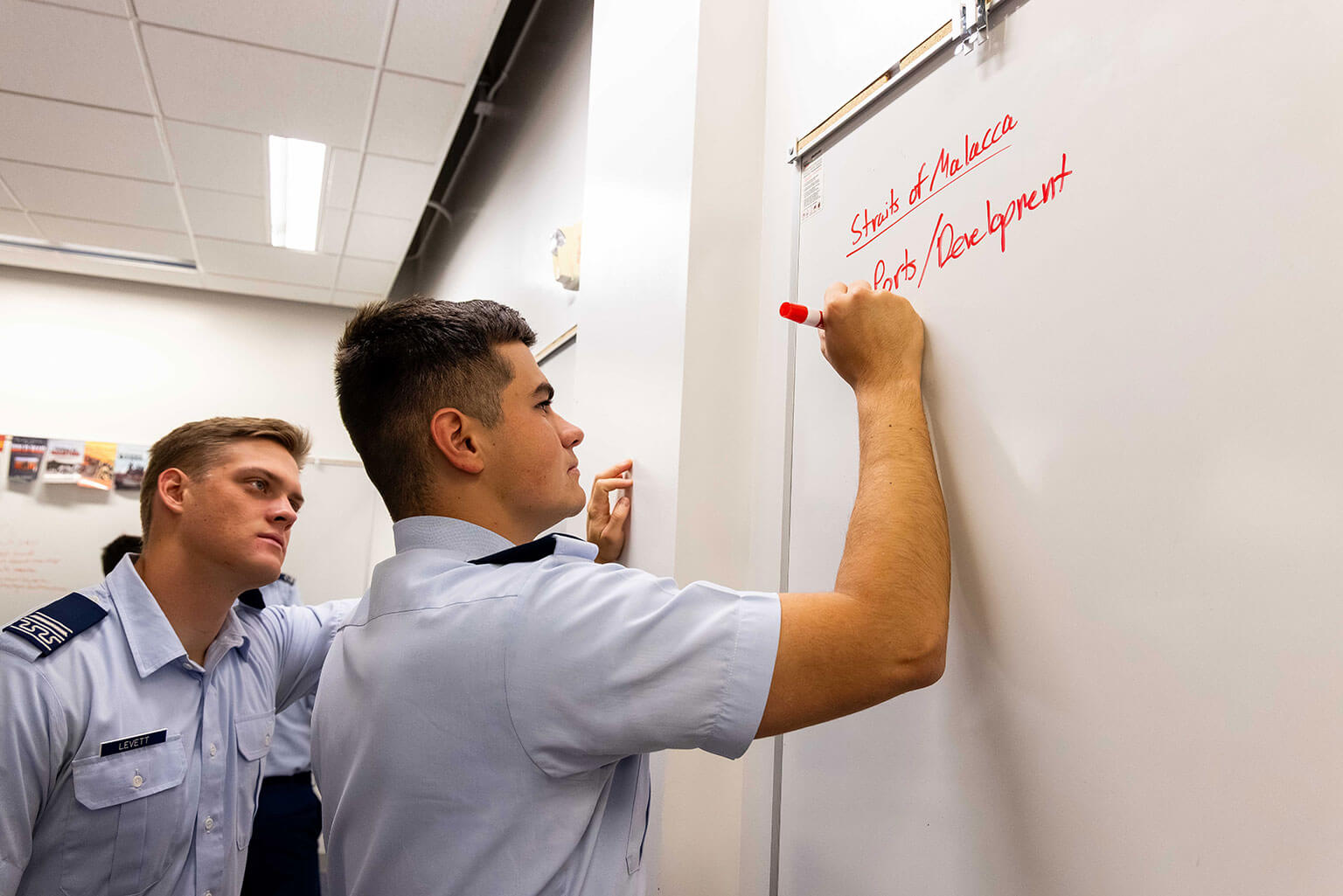 Cadet 1st Class Hunter Levett participates in a Future Conflict Minor class at the U.S. Air Force Academy, Colo., Sept. 14, 2026. The course challenges cadets to examine emerging technologies and consider how different nations employ them in conflict. (U.S. Air Force photo by Trevor Cokley)
For Cadet 1st Class Hunter Levett, the Future Conflict minor has changed how he evaluates emerging technology and its role in warfare.
“These courses have changed the way I view the development of new technologies and the ways that different nations employ them,” Levett said.
A discussion on quantum technology, for example, expanded how Levett considers the potential applications of emerging technologies..
“The discussion on quantum technology changed the way I view the possibilities of computing, data gathering and the compiling of intelligence,” Levett said.
The coursework also taught Levett to look beyond the technology itself when evaluating its potential impact on warfare and successfully applying it to gain an advantage.
“These courses taught me that technology itself is not an innovation nor does it immediately give a nation an edge in warfare,” Levett said.
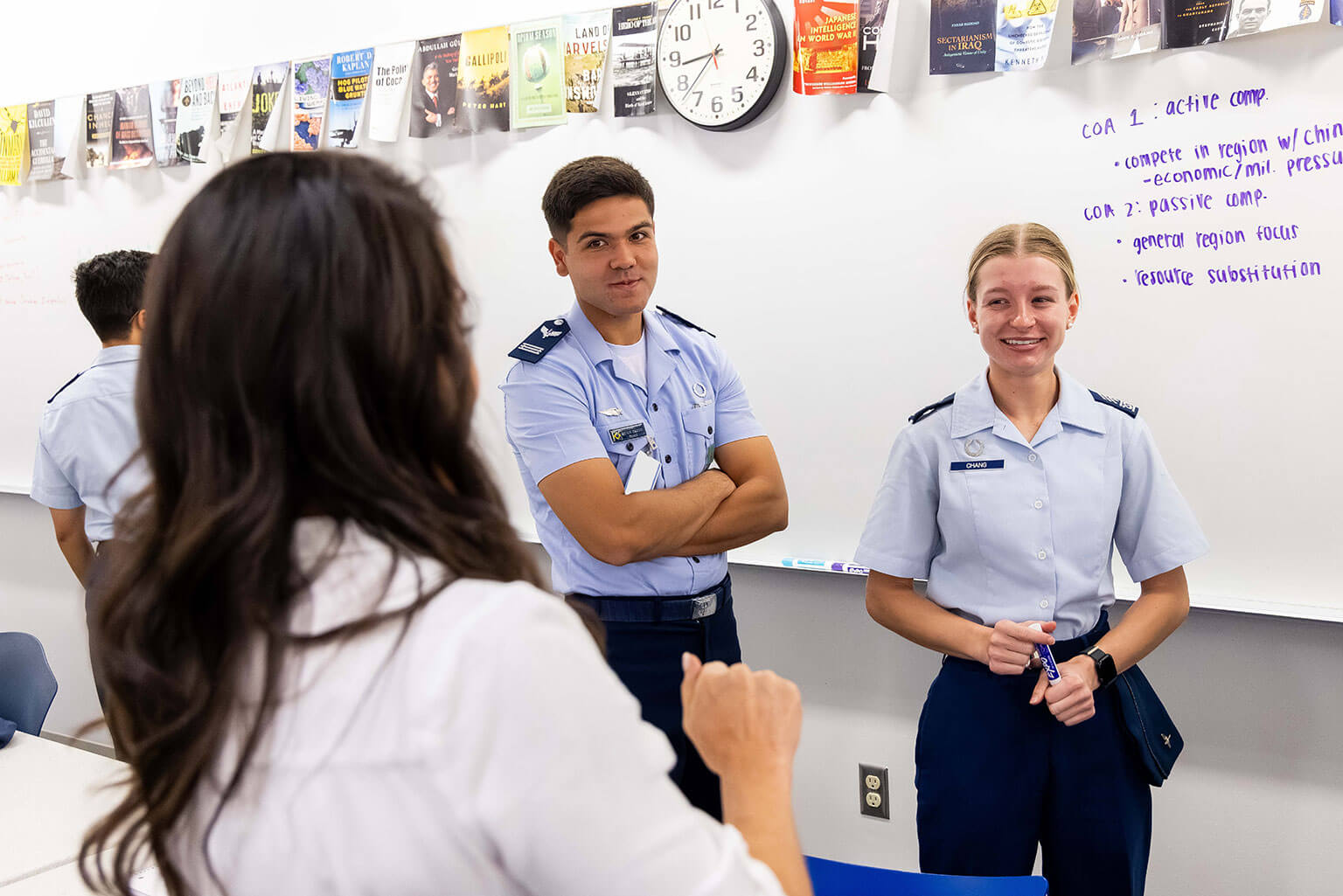 Cadet 1st Class Ruan Brito, an international cadet from Brazil, and Cadet 2nd Class Emily Chang participate in a discussion during a Future Conflict Minor class at the U.S. Air Force Academy, Colo., Sept. 14, 2026. The program teaches cadets to examine problems from multiple perspectives and consider possible outcomes before reaching a conclusion. (U.S. Air Force photo by Trevor Cokley)
Understanding emerging technologies is one part of preparing for future conflict. Cadets must also learn to apply that knowledge when facing uncertainty, competing perspectives and problems without a single correct answer.
For Cadet 2nd Class Emily Chang, the Future Conflict minor has changed how she approaches problems and prepares to lead.
“The Future Conflict Minor has changed my way of thinking by teaching me to look at a problem from multiple perspectives and consider different possible outcomes before coming to a conclusion,” Chang said.
Chang sees those lessons extending beyond the classroom to how she will lead after commissioning.
“Learning to work through problems without a clear answer will affect the way I lead as an officer by making me more confident and adaptable in uncertain situations,” Chang said. “I’ve learned that there won’t always be one right answer, so I need to use the information I have, trust my judgment and be willing to adjust when things change.”
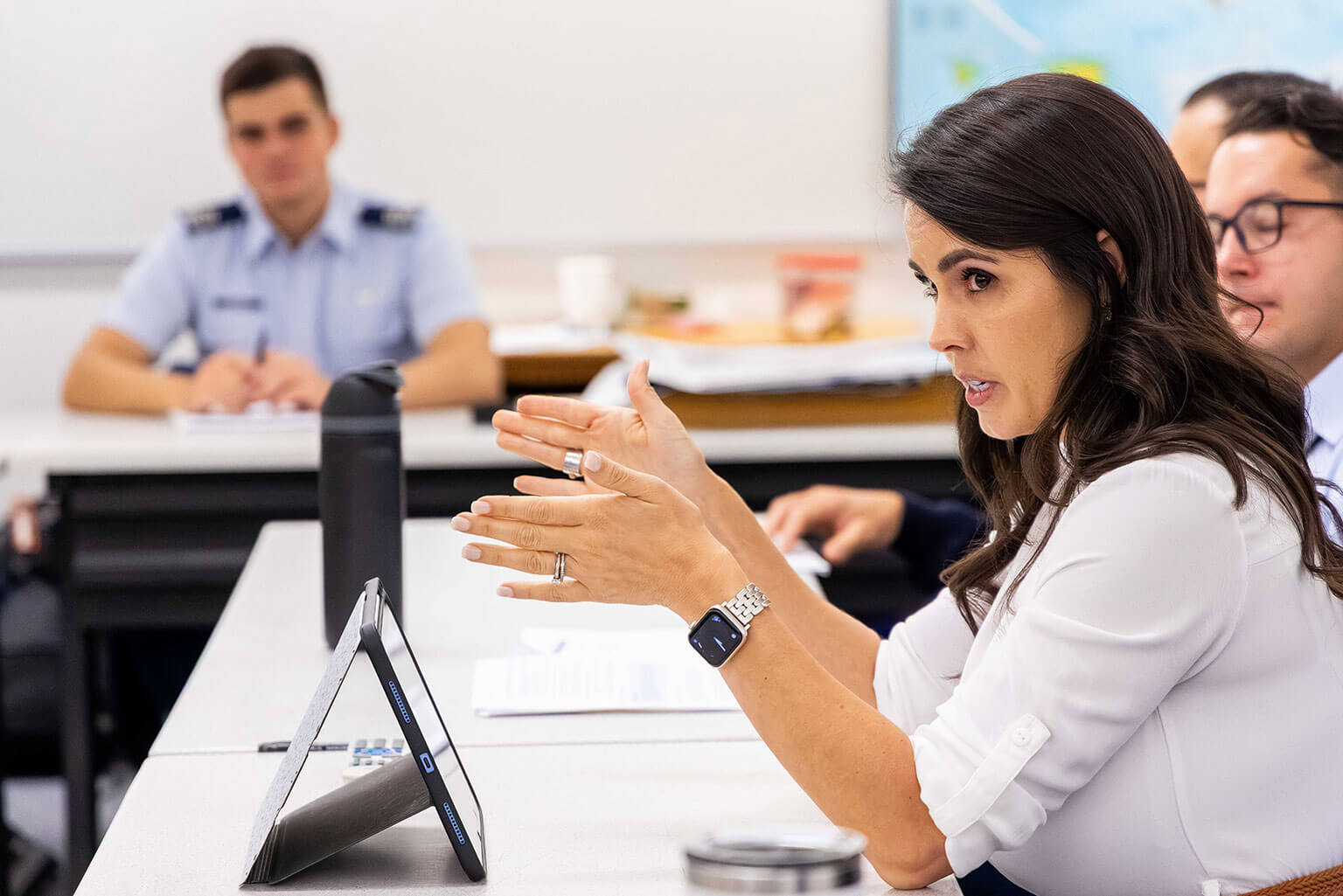 Dr. Kerry Chavez leads a discussion during a Future Conflict Minor class at the U.S. Air Force Academy, Colo., Sept. 14, 2026. Chavez teaches cadets to think critically about future conflict and develop the skills needed to operate in uncertain environments. (U.S. Air Force photo by Trevor Cokley)
Cadets in the Future Conflict Minor study adversary doctrine, strategic competition and use fiction to explore potential conflict futures. They apply what they learn through research, analysis and a classified capstone focused on real-world Department of Defense problems. The coursework develops analytical habits cadets can carry beyond the classroom and into their future careers. “Much of what cadets will face after commissioning is nascent, nebulous or entirely novel,” Chavez said. “The minor helps build the intellectual reflexes to operate without fixed answers or complete information.”
Chavez said the minor ultimately prepares cadets to confront challenges that cannot be fully anticipated in the classroom. “They aren’t necessarily teaching cadets what the future security environment will look like,” Chavez said. “It’s to give them the ability and confidence to face it effectively.” View additional photos on https://www.flickr.com/photos/af_academy/albums/72177720335631286.
| Date Taken: | 09.17.2026 |
| Date Posted: | 09.17.2026 13:40 |
| Story ID: | 575000 |
| Location: | U.S. AIR FORCE ACADEMY, COLORADO, US |
| Web Views: | 18 |
| Downloads: | 0 |

This work, Future Conflict Minor, by SSgt Michael Ward, identified by DVIDS, must comply with the restrictions shown on https://www.dvidshub.net/about/copyright.




