
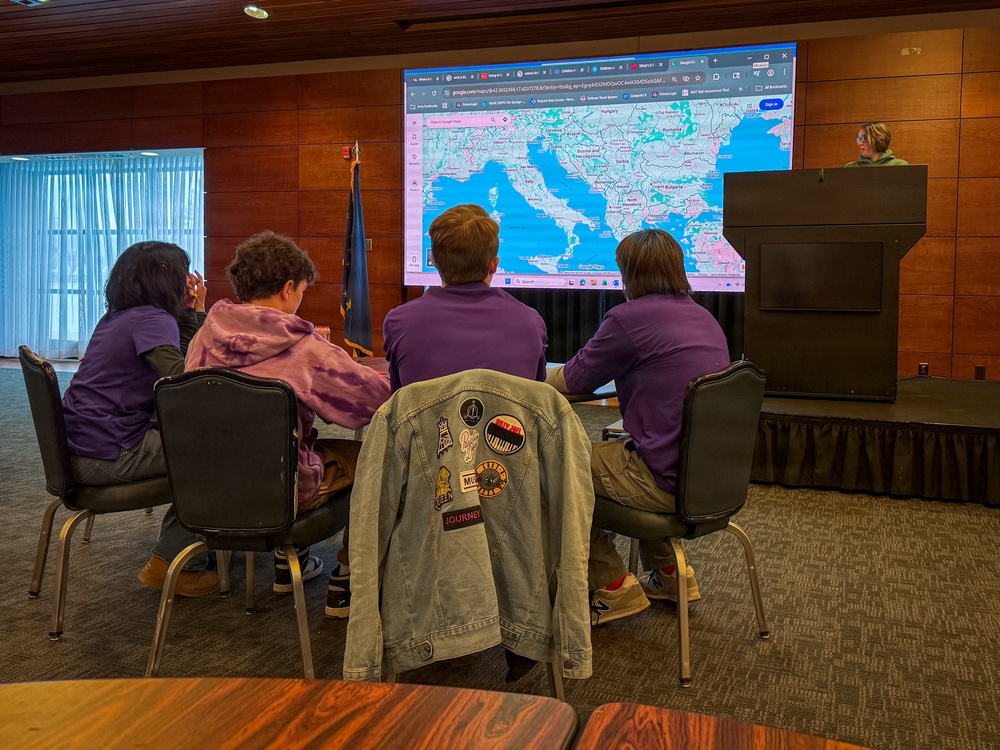
Photo By Dana Rosso | Alaska Army National Guard Child and Youth Program Youth Council members locate Kosovo...... read more read more
 Subscribe
Future School Director Festa Shabani still vividly remembers the arrival of U.S. Soldiers following the Kosovo War in 1999. Determined that future generations understand that history and the enduring friendship between the United States and Kosovo, she has spent years building relationships with Soldiers serving in the Kosovo Force.
This spring, that partnership inspired an international pen pal program connecting children in the Alaska Army National Guard Child and Youth Program with students at Future School in Gjilan, Kosovo.
The program was built upon a relationship between Future School and KFOR Regional Command-East Public Affairs that spans multiple KFOR rotations.
“We inherited an incredible partnership,” said Capt. Balinda O’Neal, commander of the Alaska Army National Guard’s 134th Public Affairs Detachment and deputy public affairs officer for KFOR RC-E. “Future School has welcomed KFOR Soldiers into their classrooms for years, and we wanted to build on that relationship in a way that would have a lasting impact.”
The partnership began after Shabani reached out to KFOR several years ago seeking Soldiers to participate in a Fourth of July celebration with her students. Since then, Future School has welcomed multiple KFOR rotations for English language activities, guest speakers, cultural exchanges and community events, creating a foundation of trust that made the pen pal program a natural next step.
Shabani’s connection to the English language began during the war in Kosovo. She was 6 years old when American forces entered her city and stayed for about a month in her uncle’s yard. With no one in the neighborhood able to speak English, her 12-year-old sister, Florida, who had taken an English course, became an interpreter.
“That experience helped me understand the importance of English as a global language that connects people and creates opportunities,” Shabani said. “For us, it also carries a special emotional meaning: it is the language of the heroes who supported Kosovo during its most difficult time. We will never forget what the United States and its allies did for us.”
As an educator, Shabani said she wants future generations to preserve that sense of gratitude and friendship while becoming more internationally connected.
Inspired by that relationship, O’Neal contacted AKARNG Child and Youth Program Coordinator Suzie Mauro with an idea to connect Alaska military children with students in Kosovo through handwritten letters. Mauro embraced the idea, and the exchange launched in April when members of the AKARNG Child and Youth Program Youth Council wrote the first letters. Before putting pen to paper, students learned about Kosovo, where Alaska Guardsmen have deployed in support of KFOR’s mission. Throughout the summer, students in Alaska and Kosovo continued exchanging letters, sharing stories about their families, schools, hobbies and communities.
“So many of my friends and family had no idea where Kosovo was or even that service members were still deployed there,” O’Neal said. “This gave Alaska youth an opportunity to learn where their parents, family and friends have served, why they are there and what daily life is like. They also experienced something many kids do not anymore, writing and receiving a handwritten letter. It also helped them understand how mail reaches deployed service members, making it easier to appreciate what it means to stay connected while a loved one is overseas.”
Alaska students wrote the first letters shortly after Kosovo’s World Cup qualifier against Türkiye, giving students an easy opening to begin their conversations. As the exchange continued throughout the summer, the letters evolved into discussions about favorite foods, music, sports, holidays, family traditions and everyday life.
Many students filled the pages with colorful drawings beneath their questions, using art to express themselves even when words did not always come easily.
“I expected the students to be excited, but I did not expect how similar the letters would be,” O’Neal said. “No matter where they lived, they asked the same questions about favorite foods, music, hobbies and pets. It was a reminder that kids have far more in common than they have differences.”
Alyssa Spaulding discovered one of those similarities when she received a letter from her pen pal in Gjilan.
“I was surprised to find out that volleyball is popular in Gjilan, Kosovo,” Spaulding said. “I was especially excited to learn that my pen pal plays volleyball because it is one of my favorite sports to play as well.”
Before the exchange, Spaulding said she knew little about Kosovo. Through her pen pal, she learned about her interests, including reading and cats, and discovered that winters in Kosovo have some similarities to winters in Alaska.
“My favorite part about getting a pen pal was learning about some of her hobbies and the things she enjoys doing,” Spaulding said. “I thought it was really cool because I didn’t know much about Kosovo before this experience. Getting to learn about her interests and what people enjoy doing there made the experience really interesting for me.”
For Shabani, the pen pal program gives her students a practical way to use the language that first connected her own family with American Soldiers more than two decades ago.
Shabani said the exchange gives students an authentic reason to use English while building their confidence and learning about American culture and everyday life. It also encourages “friendship, curiosity, and respect between cultures.”
For O’Neal, the exchange became more than a way to strengthen an already successful partnership.
“Festa’s story stayed with me,” O’Neal said. “Her appreciation for the United States made me want to do something more. This program felt like a meaningful way to build on the partnership we had already established while creating a lasting connection between children in Alaska and Kosovo.”
As the exchange continues, O’Neal hopes the friendships the students have begun will extend well beyond the final envelope.
“Programs like this remind us that meaningful relationships can begin with something as simple as a handwritten letter,” O’Neal said. “If these students continue learning from one another long after this deployment ends, then we have accomplished something truly special.”
For Spaulding, that learning has only just begun.
“I look forward to continuing to talk with my pen pal and learning more about her, her hobbies, and what life is like in Kosovo,” Spaulding said. “I’m really glad I got the opportunity to be part of this experience!”
| Date Taken: | 09.16.2026 |
| Date Posted: | 09.16.2026 20:10 |
| Story ID: | 574942 |
| Location: | JOINT BASE ELMENDORF-RICHARDSON, ALASKA, US |
| Web Views: | 32 |
| Downloads: | 0 |

This work, Alaska, Kosovo youth build friendships through pen pal program, by Dana Rosso, identified by DVIDS, must comply with the restrictions shown on https://www.dvidshub.net/about/copyright.


No keywords found.




