Earning Their Anchors: Selectees’ Journey to Chief Petty Officer
Photo By Branden Bourque |
KITTERY, Maine (August 29, 2025) New chief selectees at Portsmouth Naval Shipyard who......read moreread more
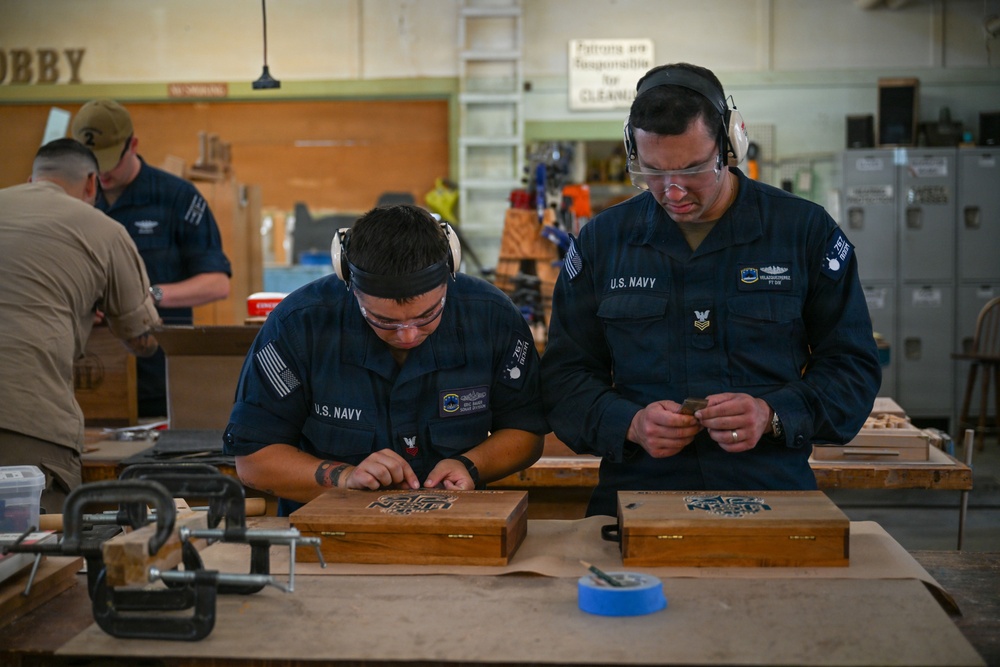
Photo By Branden Bourque | KITTERY, Maine (August 29, 2025) New chief selectees at Portsmouth Naval Shipyard who go through CPO-365 are given charge books to carry during their final stages. The book is kept inside an ornate wooden box or "vessel" as a keepsake of their tradition. (US Navy Photo by Neil Boorjian) see less
| View Image Page
Earning Their Anchors: Selectees’ Journey to Chief Petty Officer
Portsmouth Naval Shipyard hosted the pinning ceremony for the Chief Petty Officer (CPO) Selectees of Class 133 on, Sept. 16, 2026. This event marked the culmination of a rigorous, weeks-long training and initiation period—a formalized, mandatory component of the Enlisted Leader Development Continuum designed to ready first-class petty officers for their transition into the Chief's Mess.
The intensive phase prepares selectees for the responsibilities and high expectations of a CPO, testing their leadership, resilience, and mentorship capabilities, while demanding adherence to the highest standards of conduct and respect.
Known historically as Chief Petty Officer Initiation (CPOI) or Chief Season, this phase typically runs for six weeks, ending with a pinning ceremony on Sept. 16. Before earning the title, selectees spend numerous years in the training and development phase where they must first pass an advancement exam, earn superior performance evaluations, and clear a competitive selection board. Only then do they enter the demanding multi-week initiation, which tests them physically and mentally through specialized scenarios, leadership development, and deep dives into naval history and heritage.
Navy chiefs are defined by their technical expertise within their ratings, administrative acumen, and proven leadership. They play a crucial role in bridging the gap between the officers and junior-listed personnel, serving as operational supervisors and advocates for all Sailors.
“The overall purpose of CPOI is the annual recentering of our values as a CPO Mess,” said Command Master Chief Robert Schmugge. “It produces chiefs who are prepared ethically, professionally, and operationally to assume increased responsibility, and who demonstrably strengthen warfighting readiness, command climate, and Sailor development. This outcome is achieved when newly accepted chiefs consistently demonstrate competence, character, and confidence in the execution of their duties.”
For many, achieving this rank represents a profound leap in leadership and personal development. “In some cases, a Sailor may have been striving to be selected for chief for many years, while others are simply excited to cross into this next level of leadership,” said Schmugge.
According to the Naval History and Heritage Command, the rank of CPO was officially established April 1, 1893, under Navy General Order 409, creating a vital link between officers and junior enlisted personnel. The role was established across nine original ratings, including chief master-at-arms, chief boatswain's mate, and apothecary. Today, chiefs are universally recognized as technical experts, primary mentors, and the bedrock of the Fleet.
At the heart of this initiation is the Charge Book which is arguably the most vital tool in a selectee's transition. This tradition dates back to World War II, when commanding officers gained the authority to advance deserving Sailors to CPO directly at sea. Lacking access to formal libraries or leadership manuals while deployed, aspiring petty officers were instructed by existing chiefs to keep personal logs. These logs documented technical specifications, lessons in accountability, and the practical rules of deckplate leadership gathered through direct conversations with experienced chiefs.
Today, the Charge Book remains a primary vehicle for passing down generational knowledge. It serves as an icebreaker and networking tool, connecting selectees with current and retired chiefs worldwide. Each entry, or charge, is designed to spark meaningful, face-to-face conversations about leadership, expectations, and operational responsibilities.
What began as standard, government-issued green logbooks have evolved into a highly personalized rite of passage. To protect these books from the harsh elements of shipboard life, selectees crafted custom wooden boxes known as vessels.
These vessels are far more than protective cases; they are symbolic keepsakes and living records of a Sailor’s transition. Often displayed on a chief's desk throughout their career, these crafted boxes embody a connection to generations’ past. While the design and craftsmanship vary across commands and naval platforms, every vessel serves a singular, profound purpose: to protect the wisdom and personal charges passed down from one generation to the next, cementing a network of support that lasts a lifetime.
The weeks of preparation culminate in the pinning ceremony—the symbolic completion of Chief Season and the final transition into their new roles. The pinning of their anchors represents a lifelong covenant that stands as proof that the Sailor is now entrusted to uphold the timeless tradition of responsibility, where “Ask the Chief” becomes the standard for solving the Fleet’s most complex challenges.
During this ceremony, selectees are officially pinned with their gold anchors on the lapels of their crisp service khaki uniforms. It is a moment that officially reclassifies them as The Chief, a title that carries vital leadership responsibilities in the military. It is a common saying across the Fleet: as a Sailor, you will remember many leaders, but you will always remember your Chief.
As the newly pinned chiefs of Naval Support Activity Maine's Class 133 step forward to lead, they do so not just with new brass on their collars and a new title, but with the legacy of more than 130 years of naval heritage, the support of a global mess, and a renewed commitment to their Sailors. They embody the timeless truth of Navy leadership—that to lead is to serve, and to serve is to lead.