
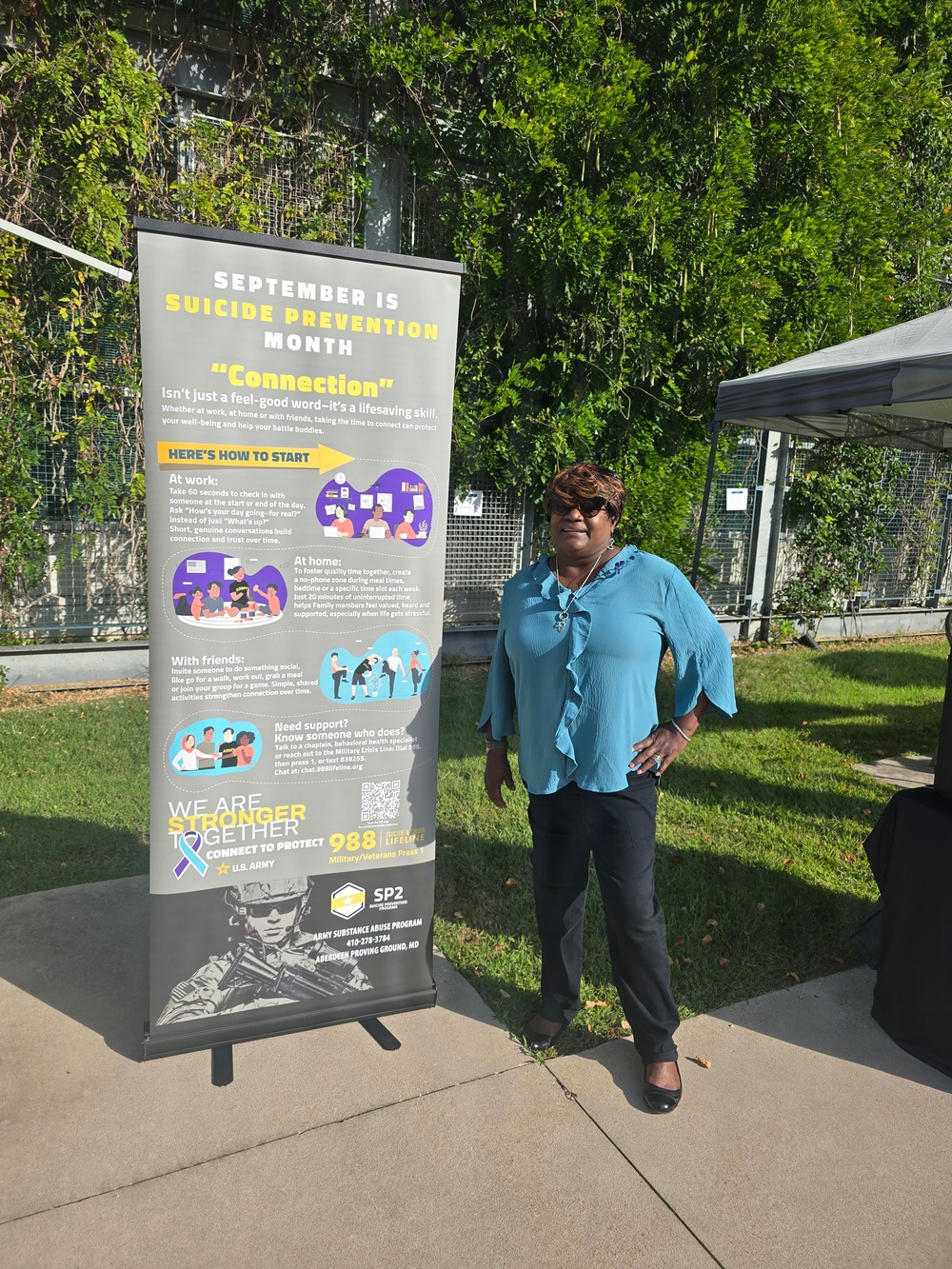
Photo By Emily Myers | APG Army Substance Abuse Program Manager, Vivian Jackson, stands next to her suicide...... read more read more
APG and Harford County Unite to Strengthen Suicide Prevention and Break Stigmas
ABERDEEN PROVING GROUND, Md. — As the military community marks Suicide Prevention Awareness Month, Aberdeen Proving Ground (APG) is taking a collaborative, data-driven approach to tackle one of the Department of War's top priorities.
By bridging the gap between installation services and local Harford County resources, APG prevention leaders are working to ensure that servicemembers, veterans, DoW civilians, and their families never have to navigate a crisis alone. The strategy focuses on upstream prevention, de-stigmatizing the act of seeking help, and addressing the root causes of harmful behaviors before they escalate.
At the center of this effort are professionals like Sean Green, APG’s Community Ready and Resilient Integrator (CR2I), and Vivian Jackson, the installation's Army Substance Abuse Program (ASAP) Manager. Together, they are redefining how the installation protects its most valuable asset: its people.
A critical piece of APG’s strategy is acknowledging that military life does not stop at the installation gates. Green was appointed by the APG Senior Commander to serve as the DoW Liaison to the Harford County Executive’s Crisis Intercept Mapping (CIM) Project, a role designed to seamlessly connect military and civilian support networks.
"One of the primary goals of the Harford County Crisis Intercept Mapping Project is to identify gaps in suicide-prevention and crisis-response services for service members, veterans, and their families across our community," Green said. "From there, the work is about bringing federal, state, local, military, Veterans Affairs, healthcare, and community partners together to close those gaps."
According to Green, suicide prevention is significantly more effective when APG, the Department of Veterans Affairs, local healthcare providers, and first responders share a coordinated approach. APG provides resources like Army Community Service (ACS) and Military and Family Life Counseling, while Harford County brings assets like the Klein Family Center and the Harford Crisis Response Team.
"A service member, veteran, or family member may live off post, receive care in the community, and need support from both military and civilian systems," Green explained. "The goal is to reduce silos and make sure no one has to navigate a crisis alone."
A major focus of this year's prevention efforts is addressing the underlying risk factors that contribute to suicide. Vivian Jackson, the ASAP Program Manager, highlighted the critical intersection between substance misuse and mental health crises.
"They are deeply connected," Jackson said. "Substance misuse is one of the most significant risk factors for suicide because alcohol and drugs act as depressants and remove natural inhibitions. When someone is dealing with severe emotional pain, relationship distress, or career pressure, substances impair judgment and make suicidal ideation far more impulsive and dangerous."
Jackson urged peers and leaders to learn the baseline behaviors of their personnel. Early warning signs often include uncharacteristically missing duty standards, withdrawing from the team, or a sharp increase in drinking, especially when paired with major life stressors like financial strain or relationship breakdowns.
Jackson emphasized that ASAP maintains operational continuity. The office is actively delivering Ask, Care, Escort (ACE) training across tenant units and working daily with installation Chaplains, Behavioral Health, and the Employee Assistance Program (EAP).
One of the greatest hurdles to suicide prevention and substance abuse intervention is the fear of career repercussions. Jackson stressed that this is the biggest misconception surrounding the ASAP program.
"The single biggest misconception is the belief that voluntarily walking through our doors will destroy your career or immediately revoke your security clearance," Jackson stated. "The reality is quite the opposite: taking proactive, voluntary steps to address substance misuse is recognized as a positive, responsible decision that demonstrates good judgment."
For DoW civilians, Dr. Jenise Bryce manages the APG Employee Assistance Program (EAP), providing free, strictly confidential counseling where command notification is not required for voluntary visits. "Seeking help early protects your career; waiting for an incident is what jeopardizes it," Jackson added.
APG’s brand-new Integrated Prevention Advisory Group (I-PAG), where Green serves as Prevention Lead, is shifting the focus from reactive crisis management to enterprise-level primary prevention. By analyzing shared risk factors—like social isolation or binge drinking—and bolstering protective factors like financial stability and strong peer connections, the team can address multiple harmful behaviors simultaneously.
"Using data to identify and reduce harmful behaviors such as substance misuse, domestic abuse, and suicide is not new to APG prevention professionals," Green noted. "What is evolving is the deliberate, collaborative way prevention partners across the installation can review and discuss data from assessments, surveys, and community engagements."
Leadership plays a foundational role in this ecosystem. Both Green and Jackson pointed to proactive leadership as the key to a resilient workforce.
Jackson recommended that leaders normalize help-seeking and create climates where unit social events do not solely revolve around alcohol. "Adopting mocktails and drinks without alcohol at organizational events, as well as providing water, makes a difference," she said.
Green echoed the need for senior leadership support, noting that it gives grassroots resilience programs "legitimacy, resources, access, and accountability."
While September serves as a focal point for awareness, APG’s prevention professionals want the community to know that help is available 365 days a year. "Challenges do not follow a calendar, and neither should prevention or support," Green said.
If you or someone you know is struggling, reaching out is the first and most crucial step. There is no wrong door to enter for support.
Immediate Crisis Support:
APG Installation Resources:
Local Community Partners:
| Date Taken: | 09.16.2026 |
| Date Posted: | 09.16.2026 13:48 |
| Story ID: | 574888 |
| Location: | US |
| Web Views: | 34 |
| Downloads: | 0 |

This work, APG and Harford County Unite to Strengthen Suicide Prevention and Break Stigmas, by Emily Myers, identified by DVIDS, must comply with the restrictions shown on https://www.dvidshub.net/about/copyright.

No keywords found.





