
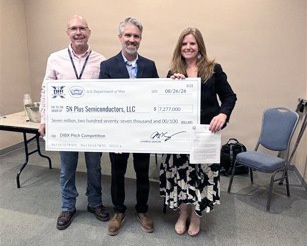
Photo By Elizabeth Glenn | Sarah Lutyens, ACC-RI agreements officer, presents a check and letter of intent to a...... read more read more
ROCK ISLAND ARSENAL, Ill. — In an era where technological superiority depends on speed, Army Contracting Command – Rock Island proved defense acquisition can match the tempo of commercial innovation during the inaugural Defense Industrial Base Exchange in Philadelphia, Aug. 25-27.
Surrounded by approximately 2,400 defense leaders, commercial innovators, and investors, the ACC-RI team took center stage by spearheading a high-stakes “Shark Tank-style” live pitch competition. The initiative culminated in more than $25 million in same-day prototype awards, demonstrating how agile contracting mechanisms can dismantle bureaucracy and deliver cutting-edge technology straight to the warfighter.
Rewriting the acquisition playbook Contracting has historically carried a reputation for being slow and risk-averse, but the ACC-RI team actively worked to reverse that perception. The live pitch competition was conceived by a current ACC-RI customer who specifically asked if this would be a tenable rapid acquisition pathway capable of converting live vendor pitches into immediate awards.
“I am really proud of the team’s efforts to reinvent and streamline acquisition, so that we are a catalyst for getting ever-evolving and cutting-edge technologies into the warfighters’ hands as quickly as possible,” said Kristin Comer, ACC-RI Futures director.
Developing the live pitch competition and achieving same-day execution required extensive preparation. Beginning in mid-May and issuing a solicitation on June 1, the ACC-RI team received nearly 200 white paper submissions. In close coordination with theU.S. Army Combat Capabilities Development Command Chemical Biological Center at Rock Island—who provided vital support managing the inbox, managing funds, and coordinating technical evaluations—agreements personnel narrowed the pool to 34 companies, evaluated 33 detailed proposals, and selected nine finalists to pitch live on the main stage.
“Instead of waiting on the government to develop a rigid requirement, we defined three focus sectors and invited industry to bring us their most innovative solutions,” said Sarah Lutyens, ACC-RI agreements officer. “We recognized that commercial industry holds deep expertise in emerging tech, and we gave them an open avenue to propose solutions.”
High-stakes competition on the main stage On the event floor, the competition operated under rapid-fire precision. Finalists had three minutes to pitch their dual-use commercial technologies to an esteemed senior defense judging panel, followed by a two-minute question-and-answer session, and 45 seconds to exit before a buzzer sounded.
The judging panel featured Hon. Michael Cadenazzi, Assistant Secretary of War for Industrial Base Policy; Andrew Magliochetti, deputy Assistant Secretary of the Navy for the Defense Industrial Base; Boyd Miller, principal deputy director J-4, Joint Staff; and Vice Adm. Stephen Tedford, director of the Defense Contract Management Agency. While an interim panel engaged the main auditorium, the operational momentum shifted backstage to the negotiation “green room.” Christina Orcutt, Cornerstone branch chief, and Lutyens joined the judges during deliberations to provide real-time contracting counsel.
Because the ACC-RI team had prepared letters of intent, also known as LOIs, and pre-priced packages beforehand, final selections by the judges were made in less than an hour. Ultimately six companies were selected for awards totaling more than $25 million through the Cornerstone Other Transaction Authority:
Strategic and critical materials - ensure secure, domestic access to materials vital to national security, reducing reliance on foreign supply chains for critical defense systems. Three awards were made addressing strategic mineral harvesting and processing:5N+ Semiconductors ($7.3 million), Graystone Resources ($6.75 million), and Kunin Technologies ($1.9 million) to mitigate critical material dependencies.
Expeditionary manufacturing of electronics -support the development and sustainment of advanced communications, sensors, and autonomous systems that are central to modern warfare. One award was made to Senra Systems ($4.4 million) for its mobile “wire harness manufacturing in a box” technology.
Fuel distribution -address a critical operational gap, enabling power projection for operational forces and equipment. Awards were made to two companies addressing autonomous distribution:Neya Systems ($5.9 million) for autonomous ground and maritime fuel transport, and Cybernet Systems ($958,000) for autonomous vehicle retrofit kits.
Winners received ceremonial checks on stage before joining Lutyens in the green room to sign formal LOIs. “Conferences often feature talk about collaboration, but it is rare to see immediate, tangible action,” Orcutt said. “Seeing the government put its money where its mouth is and deliver same-day awards created genuine excitement across industry.”
Agile contracting as a warfighting enabler The success of the DIBX competition illustrates the strategic value of other transaction authorities. Unlike traditional FAR-based contracting, OTAs executed via COTA allow ACC-RI to engage commercial firms using milestone-based performance structures. Agreements officer representatives oversee technical milestones to validate progress before funds are disbursed, creating a proven pathway from prototype to follow-on production.
“We have had multiple of these prototype awards move on to follow on production,” said Orcutt. “After we show that a prototype has been successful or that it's met the need, we can then move into a full-scale production contract to further develop that and actually start using the new technology or that new pathway without the wait.”
For the ACC-RI representatives on site, the experience underscored the power of personal engagement. Steven Claeys, agreements specialist, emphasized the value of face-to-face interaction. “Meeting the vendors in person and seeing physical demonstrations with props brought their proposals to life in ways a written document never could,” said Claeys.
Kelli Senger, agreements specialist, agreed, adding that seeing physical prototypes gave the team a clearer understanding of the capabilities they were putting on contract.
“Seeing their designs and having them talking about it rather than just reading it from a technical perspective, actually seeing what they are doing, helps when we're putting the award documents together and provides a better understanding of what they are proposing,” said Senger.
Following the success of the inaugural DIBX, ACC-RI is capturing lessons learned to refine the live-pitch format for future iterations and upcoming competitions. By blending speed, technical rigor, and commercial partnership, ACC-RI continues to prove that contracting is an essential catalyst in accelerating modern defense capabilities into the hands of the warfighter.
| Date Taken: | 09.16.2026 |
| Date Posted: | 09.16.2026 10:35 |
| Story ID: | 574856 |
| Location: | US |
| Web Views: | 18 |
| Downloads: | 0 |

This work, Speed of relevance: ACC-RI executes $25 million in same-day awards, by Elizabeth Glenn, identified by DVIDS, must comply with the restrictions shown on https://www.dvidshub.net/about/copyright.

No keywords found.





