
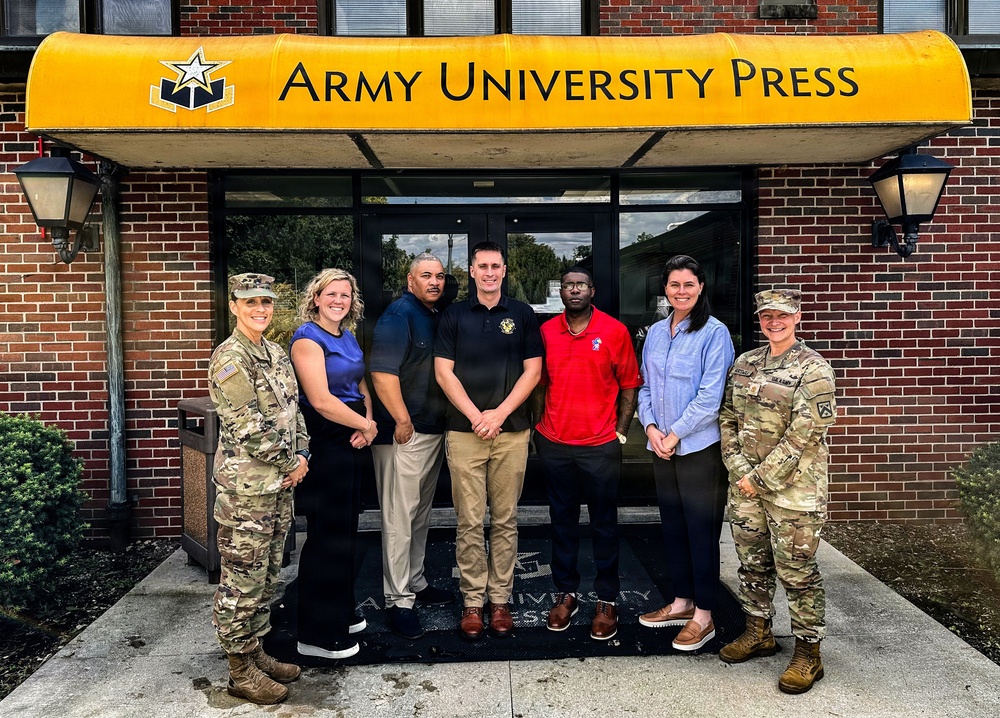
Photo By Jessica Brushwood | The second cohort of Harding Fellows attending the in-residence graduate program at...... read more read more
 Subscribe
FORT LEAVENWORTH, Kan. — Army leaders at the Harding Project workshop Sept. 9-10 challenged Harding Fellows and journal teams to strengthen professional writing across the Army, stressing its importance in sharing lessons learned, improving decisions and adapting during transformation.
Held in person at Fort Leavenworth and virtually, the workshop brought together representatives from 21 Army journals, including five first-year Harding Fellows studying at the University of Kansas, to review progress and equip Fellows and editorial teams to steward the journals.
The Harding Project is named after Maj. Gen. Edwin “Forrest” Harding, who revived the Infantry Journal between the world wars. By selecting captains, master sergeants, and chief warrant officersto serve at the Army’s branch journals, the Fellowship keeps them relevant, accessible and focused on soldiers’ needs.
Keynote speaker Lt. Gen. Jim P. Isenhower, commanding general of Combined Arms Command, said professional writing strengthens collective thinking across the Army.
“Written discourse is really important — It’s going to help us figure out what the right path is for our Army,” Isenhower said. “More minds are always better than one. When you foster that dialogue and disseminate it across the field … collectively we are going to make much better decisions.”
Sergeant Major of the Army Michael Weimer, who joined virtually, told workshop participants the progress of professional writing in the Army has been exciting to see. Weimer said the Army is seeing stronger critical thinking and debate across topics including talent management, professional development and doctrine.
“I truly do believe the Harding Project was like an EpiPen for the Army just to get us doing what we’ve always done,” Weimer said.
During the workshop, Harding Project leaders pointed to measurable growth. Since the 2024 launch of the Line of Departure website, a centralized hub for all Army journals, readership has risen from just over 11,000 to more than 70,000 views per year. The number of authors across the broader journal network has also increased about 2.5-fold.
Maj. Rose Horswill, director of the Harding Project, said Fellows are backed by a strong professional community as they work to reinvigorate professional writing, continuing a pattern she traced from the period after World War I to today’s post-Global War on Terror environment.
“Here we are, post GWOT, with a massive period of transformation going on in our Army right now and we still need those voices. We can’t let the voices from the bottom disappear,” Horswill said.
Maj. Kathleen Cylkowski, a first-year Harding Fellow and KU journalism and mass communications graduate student, said that mission drew her to the program.
“I believe in the importance of supporting Soldier professionalism. A great way to do that is by encouraging Soldiers in different branches and at different ranks to explore and write about the profession,” said Cylkowski.
Junior enlisted soldiers and NCOs must be part of that effort, said Sgt. 1st Class Indira Krager, the deputy director of the Harding Project, who asked senior leaders how more enlisted writing could be encouraged.
“Junior enlisted Soldiers need to know they do not have to wait until they are a senior NCO to have something worth saying,” Krager said. “They are often the ones closest to the problems, seeing what works and what does not every day.”
Both Isenhower and Command Sgt. Maj. Shaun Curry, Combined Arms Command, emphasized the need for increased encouragement and tangible support for continued growth of a writing culture.
Curry said fear of failure often keeps people from contributing.
“It wasn’t until I was a sergeant first class or staff sergeant that I went back to school. It was an NCO that pulled me aside that told me I had a talent,” Curry said.
In addition to keynote remarks, workshop participants developed a five-year strategy, unit engagement plans, and discussed amplifying articles for real-world impact.
Fellows also learned about Project Victor, a new artificial intelligence-powered platform that will bring the Army’s institutional knowledge into one interface and provide another venue for professional discourse.
Learn more about the Harding Project and find all U.S. Army Journals on the Line of Departure website.
| Date Taken: | 09.16.2026 |
| Date Posted: | 09.16.2026 09:09 |
| Story ID: | 574844 |
| Location: | FORT LEAVENWORTH, KANSAS, US |
| Web Views: | 18 |
| Downloads: | 0 |

This work, Army leaders urge stronger writing culture, more junior voices at Harding Project workshop, by Jessica Brushwood, identified by DVIDS, must comply with the restrictions shown on https://www.dvidshub.net/about/copyright.


No keywords found.




