
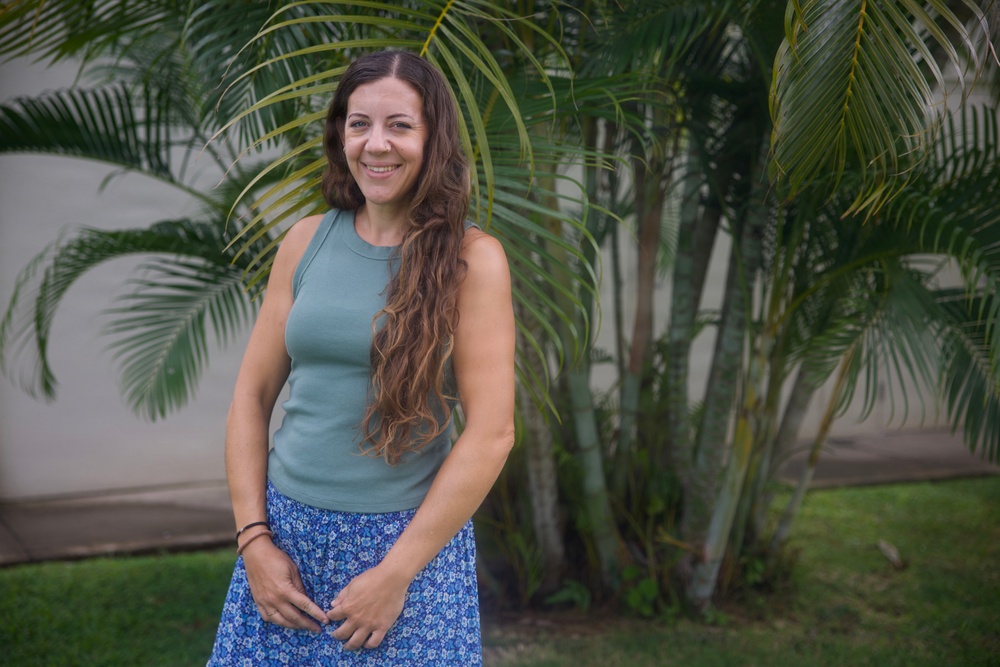
Photo By Kyler Hood | Laura Little, the Navy ombudsman program coordinator for Joint Base Pearl...... read more read more
Every September, the Navy honors its ombudsmen, the volunteers who serve as a liaison between military families and military commands during National Ombudsman Appreciation Month, a commemoration devoted to recognizing ombudsmen for their volunteerism and for their support of military families.
In June, Joint Base Pearl Harbor-Hickam ombudsmen logged more than 10,600 volunteer hours as they worked to improve family readiness by sharing command communications and providing information to families about fleet and family readiness programs. They also serve as an avenue for leadership to stay informed about the welfare of command families.
“The Navy ombudsman program is important Navy-wide and the reason why this program exists across the entire Navy at all installations and with all commands is because, in the absence of a service member [during a deployment], those families will look for any point of familiarity because a lot of times, they are in unfamiliar places,” explained Laura Little, the Navy ombudsman program coordinator for Joint Base Pearl Harbor-Hickam (JBPHH) and Commander Navy Region Hawaii (CNRH), who trains the volunteer ombudsmen.
Little likens an ombudsman to a “lighthouse” because when a Navy family is missing a Sailor during a deployment or when they experience a family emergency, the ombudsman acts as a beacon that can direct them to the relevant Navy resource.
The Navy Ombudsman program began on Sept. 14, 1970, under Admiral Elmo Zumwalt. Jr., former Chief of Naval Operations. In Zumwalt’s 24th policy directive, he recognized the vital role Navy spouses play and created a procedure that allowed spouses the opportunity to present their complaints, viewpoints, and suggestions to the commanding officer. Zumwalt described an ombudsman as an “official representative to express their views to commanding officers and base commanders.”
Zumwalt adapted this idea for the Navy from a 19th century Scandinavian custom established by the king to give ordinary private citizens an avenue to express their grievances to high government officials.
An ombudsman can be anyone who is affiliated, approved by their command, and committed to fulfilling the responsibilities of the role.
Professional Development
Ombudsmen begin their volunteer roles with Ombudsman Basic Training (OBT), a program that provides details on how to effectively execute the command ombudsman role. This training is done in a traditional face-to-face classroom setting with instruction that is coordinated by the Fleet and Family Support Center (FFSC) and the Navy Reserve Forces or can be completed online if in-person training is not available.
Each ombudsman is also required to maintain a training record including the title of training, the date of attendance, and the name of the hosting training organization to ensure that they are making progress.
Advanced Training
In addition to the initial OBT and eOBT (online training), ombudsmen must be knowledgeable about new programs and tools available to service members and families. The Navy Family Ombudsmen Program provides many virtual and face-to-face training opportunities to ensure that CNRH and JBPPH remain a vital resource for Navy families and their commands.
Little is proud to train ombudsmen for JBPHH and CNRH. These vital volunteers help strengthen the home front by maintaining confidentiality, supporting the command mission, and working within the chain of command as directed. They uphold the highest standards of professionalism and shine a light across the Hawaii community. Mahalo to our CNRH and JBPHH ombudsmen!
| Date Taken: | 09.15.2026 |
| Date Posted: | 09.15.2026 18:25 |
| Story ID: | 574814 |
| Location: | JOINT BASE PEARL HARBOR-HICKAM, HAWAII, US |
| Web Views: | 20 |
| Downloads: | 0 |

This work, Navy Honors Ombudsmen for Strengthening Fleet and Family Readiness, by Kyler Hood, identified by DVIDS, must comply with the restrictions shown on https://www.dvidshub.net/about/copyright.

No keywords found.





