
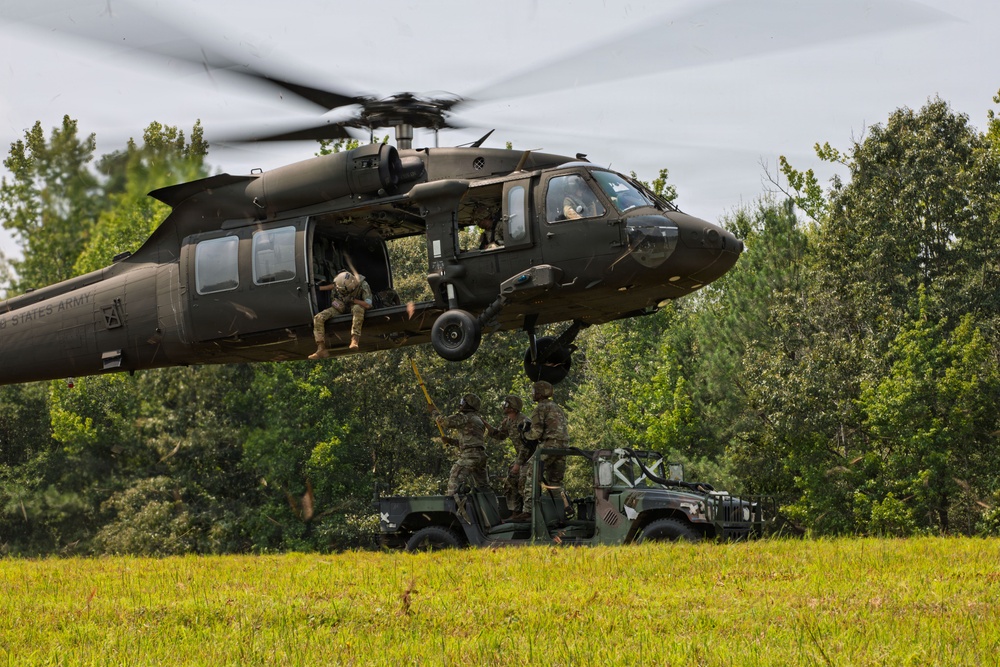
Photo By Spc. Francisco Leon | U.S. Soldiers with the 369th Division Sustainment Brigade, New York Army National...... read more read more
CAMP SMITH TRAINING SITE, Cortlandt Manor, N.Y. — Thirty New York Army National Guard Soldiers assigned to the 369th Division Sustainment Brigade teamed up with Army aviators to practice moving mobile field kitchens and rations by helicopter during annual training 2026, known as Operation Sustain Thunder.
The training exercise, conducted in partnership with air crews from Bravo Company, 3rd Assault Helicopter Battalion, 142nd Aviation Regiment, focused on rigging and airlifting rolling vehicles and bulk supplies into simulated remote battle zones.
Equipment hitched beneath transport helicopters included mobile assault kitchens, containerized food units, and pallets of field rations to replicate delivering hot meals to an isolated infantry company in contested territory. The exercise represented a major training milestone for the historic brigade, commonly known as the Harlem Hellfighters. It marked the first dedicated sling-load training and live air-delivery mission conducted in the unit's history.
“This operation required deliberate planning and close synchronization across multiple teams,” said Staff Sgt. Ethan Li, the brigade's sling load noncommissioned officer in charge. “The value of training with aviation is that it expands our supply delivery options.”
Li added that ground routes cannot always be counted on in modern conflict.
“On a modern battlefield, road networks can be blocked, damaged, or ambushed,” Li noted. “Moving supplies by air gives commanders another way to place mobile kitchens and critical supplies exactly where troops need them most.”
The aerial deliveries were coordinated with Capt. David Martin, commander of the 1501st Quartermaster Company, a dedicated field feeding company. The company's culinary specialists worked alongside the flight crews to prepare heavy kitchen trailers and supply pallets for rapid flight. “This tactical air movement provided an invaluable, hands-on training opportunity for our Soldiers,” Martin said. Martin added that aerial delivery proves how logistics units must maneuver in hostile combat conditions. “It allowed them to witness the full capabilities of our assault kitchens and demonstrated exactly how we adapt on the battlefield to sustain the warfighter,” Martin noted.
Rigging tactical equipment beneath hovering helicopters required exacting technical precision.
Ground crews spent days calculating vehicle weights, inspecting heavy-duty nylon straps and metal connection rings, and rehearsing ground safety procedures before connecting live aircraft.
“Rigging a sling load is a deliberate, standards-based process,” Li said. “When we are moving heavy trailers or rolling equipment, attention to detail becomes even more important.”
Li added that nothing can be left to chance during flight-line rigging.
“The ground team must make sure everything is secured so nothing shifts in flight,” Li noted. “If there is any discrepancy, we stop the process, fix the issue, and inspect the load again.”
To guarantee absolute safety, ground teams conducted repetitive, hands-on checks of every apex fitting, clevis hook, and tie-down chain while rehearsing static-electricity grounding procedures beneath mock hookups, he explained.
“Safety always comes first,” Li said.
Li added that rigorous discipline on the ground protects air crews and Soldiers alike.
“Those details protect the ground crew, the flight crew, and the equipment being delivered,” Li noted.
Before hooking up equipment to hovering helicopters, Soldiers completed a week-long classroom course followed by hands-on practice. The program was designed to give junior Soldiers direct experience working safely beneath the powerful rotor wash of military aircraft.
“Training junior Soldiers begins with explaining the purpose behind each step, not just having them memorize a checklist,” Li said. “We demonstrate the task, supervise them as they perform it, and correct deficiencies immediately.”
Li added that every safety check serves a critical operational purpose.
“Every strap, connection, and safety check has a purpose,” Li explained.
By qualifying 30 sustainment Soldiers in aerial delivery operations, the brigade established a vital capability that can support New York National Guard elements during overseas deployments or during domestic emergency relief operations across New York state, Li noted.
“What I am most proud of is that this was the first sling-load training and operational mission conducted within the brigade, and the team met the commander's goals,” Li said. “We built this capability from the ground up, trained 30 Soldiers through realistic field work, and proved our brigade can team up with aviation units to deliver life support anywhere it is needed.”
| Date Taken: | 09.14.2026 |
| Date Posted: | 09.15.2026 14:57 |
| Story ID: | 574787 |
| Location: | PEEKSKILL, NEW YORK, US |
| Web Views: | 28 |
| Downloads: | 0 |

This work, New York sustainers take to the skies to master sling-load operations, by SFC Sebastian Rothwyn and SPC Francisco Leon, identified by DVIDS, must comply with the restrictions shown on https://www.dvidshub.net/about/copyright.


No keywords found.





