
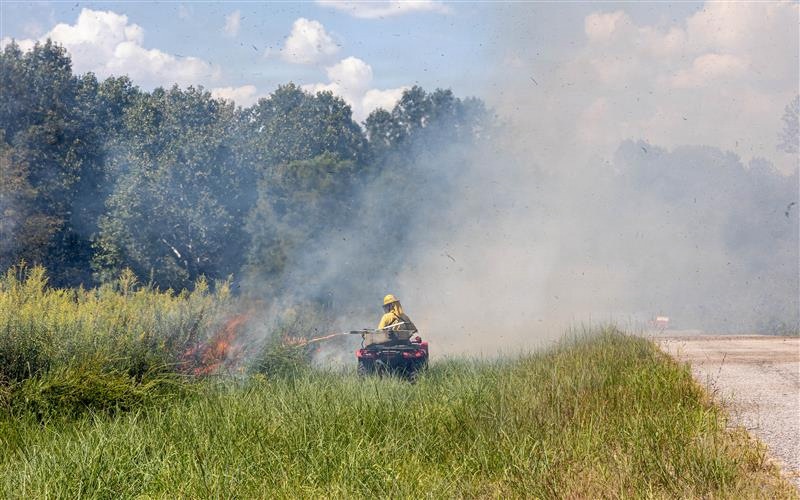
Photo By Savannah Baird | A Fort Knox Natural Resources Branch employee ignites some brush with a torch during a...... read more read more
Fort Knox, Ky. — Prescribed burns serve a dual purpose across the rolling hills of Fort Knox: sharpening military readiness while reviving some of central Kentucky’s rarest native ecosystems.
Prescribed burning is widely recognized as one of the most cost-effective land management tools available. Decades of forest fire suppression during the 20th century allowed shade-tolerant species like red maple to crowd out fire-adapted oak and hickory stands. Officials from the installation’s Directorate of Public Works Natural Resources Branch now apply strategic fire to reverse that trend, yielding immediate benefits for Soldiers and native wildlife alike.
Regular live-fire training across the installation involving a wide array of military weaponry and explosives carries with it an inherent risk of accidental ignition. By clearing accumulated leaf litter and dry brush, prescribed burns deny accidental fires the fuel required to burn uncontrollably.
"Prescribed burns help curb wildfire threats due to military training involving artillery, tracer rounds, explosives and pyrotechnics," said David Jones, Natural Resources Branch chief. "Burning away these potential fuel sources ensures that when an accidental ignition occurs, it lacks the combustible material necessary to turn into a severe, unmanageable wildfire."
Beyond fire prevention, burns clear out dense undergrowth across range footprints to improve tactical sightlines and open realistic maneuver corridors for ground troops, vehicles and equipment.
"The bulk of our burning is geared towards ecological objectives, but we also contribute to the training mission when we get requests through Range Control," Jones said.
According to Jones, the burns also function as an ecological reset button across Fort Knox’s forests and native warm-season grasslands. Combined with selective timber harvesting, fire favors deep-rooted oaks over fire-intolerant competitor species. Clearing heavy surface thatch enhances growth.
"Fort Knox is home to some extremely rare and unique habitat systems in Central Kentucky," Jones said. "We are able to utilize burns to restore and maintain these ecological systems, including the Cedar Creek glade complex and remnant prairie components."
Jones said burn timing determines specific ecological outcomes.
"We are also able to utilize growing season fires in the late summer to reduce woody encroachment within designated pollinator habitats while also promoting more desired forbs and flowering plants the following spring," Jones said. "Fire clears away heavy thatch layers, allowing sunlight to reach the soil and stimulates the native seed bank, thus attracting the native fauna to the immediate area, including monarch butterflies.
“We are able to utilize early spring burning days to consume logging debris once those materials have dried out for better combustion."
While prescribed burns benefit the local ecosystem, Jones noted they can also provide a level of temporary tick suppression within the specific areas that are burned.
Decades of fire suppression across Central Kentucky’s wooded areas have created dense, humid forest floors with thick leaf litter – ideal conditions for parasites like ticks to thrive. Fire helps manage such areas, disrupting tick populations in those immediate zones.
"While prescribed burns can be highly effective at temporarily suppressing tick populations, it must also be understood that an isolated fire is not a permanent solution," Jones said. "Our resources and staffing allow us to burn 500 to 1,000 acres per year in a scattered management fashion. While this targeted approach doesn’t eliminate ticks installation-wide, it provides some relief, albeit temporary, in the specific areas we are able to burn."
Jones said public safety dictates every prescribed burn on the installation. For instance, they are strictly prohibited near housing areas, administrative complexes, schools and medical facilities.
Burn crews also follow strict weather prescriptions before igniting a parcel. Personnel evaluate moisture levels, ambient temperature, relative humidity, and wind velocity and direction. Crews require a minimum atmospheric mixing height of 1,500 feet to guarantee smoke lifts vertically into the upper atmosphere and disperses harmlessly.
Ignitions occur only after morning moisture evaporates and are completed well before sunset. This schedule avoids nighttime thermal inversions, which trap cool air and dense smoke close to the ground, threatening motorists and surrounding civilian neighborhoods.
Bare dirt containment lines are also often created using heavy machinery, with wet lining applied in specialized situations to prevent the spread of the burn.
Jones said the current scope of burning at Fort Knox reflects modern post staffing and mission requirements.
"Fort Knox is no longer comparable to an installation like Fort Stewart [Georgia], which implements prescribed burns on 100,000 acres per year for the benefit of red cockaded woodpeckers as well as 3rd Infantry Division training missions," Jones said. "That is just the new normal with our staffing and resources. The current training mission on Fort Knox doesn’t require a lot of burning, but historically it had a huge impact when the Armor was the primary mission here."
Jones said past Armor Center training itself led to a significant lasting ecological benefit at Fort Knox.
"There were multiple wildfire events resulting from Armor Center training exercises specific to Fort Knox in the past,” said Jones “These accidental and scattered wildfires occurred somewhat regularly throughout each year on the installation for over eight decades, creating one of the most unique landscapes in Central Kentucky."
Fort Knox’s continued efforts concentrate resources on high-priority training footprints and critical natural zones while maintaining troop readiness, protecting neighboring communities, and preserving Kentucky's native natural heritage, said Jones.
"By strategically managing this landscape with fire, we ensure Fort Knox remains an elite training platform for our warfighters today while restoring native Kentucky habitats for tomorrow."
| Date Taken: | 09.15.2026 |
| Date Posted: | 09.15.2026 13:59 |
| Story ID: | 574776 |
| Location: | FORT KNOX, KENTUCKY, US |
| Web Views: | 19 |
| Downloads: | 0 |

This work, Fort Knox prescribed burns enhance training, restore native habitat, by Patrick Hodges, identified by DVIDS, must comply with the restrictions shown on https://www.dvidshub.net/about/copyright.


No keywords found.





