
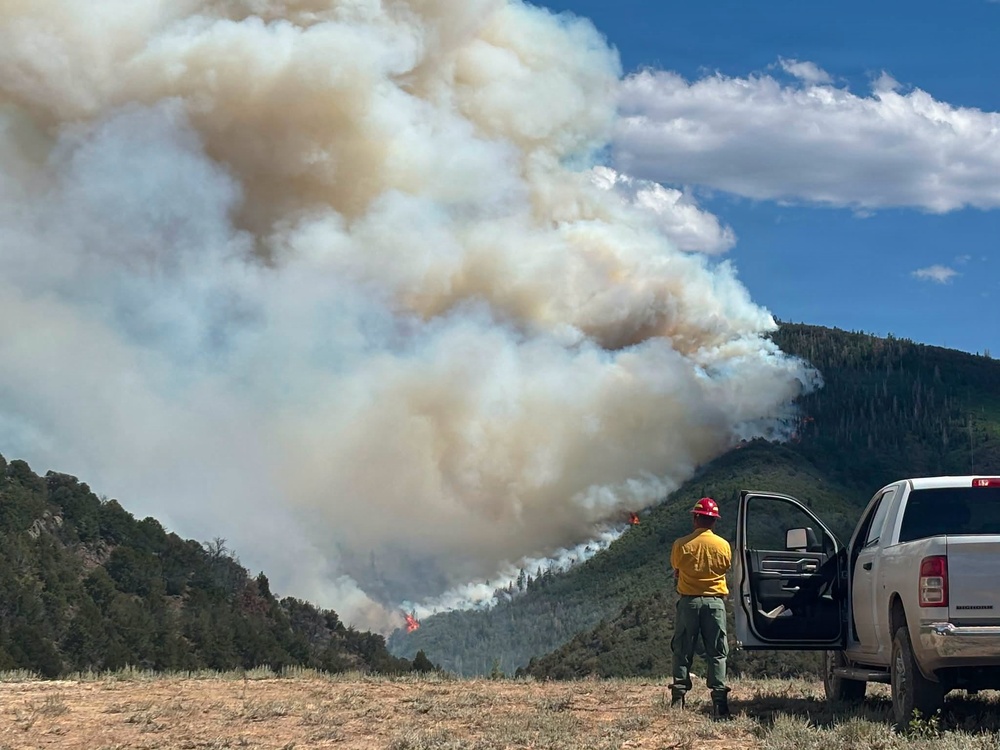
Photo By Forest Service OC | A firefighter observes distant smoke from the Cottonwood Fire. (Forest Service photo...... read more read more
 Subscribe
Editor’s note: Formal agreements between states and the Forest Service are essential for landscape scale work, and even more so in times of crisis. In Utah two wildfires and a commitment to work together shows how shared stewardship can rally resources and get the work done quicker.
Across the country wildfires have a lasting impact on communities and the surrounding landscapes.
During these times of hardship in local communities, it’s common to see neighbors helping neighbors. They help to temporarily house evacuated families. They share essential supplies and resources. Together they are stronger, resilient, and more capable than alone.
For state and federal land managers this principle also holds true, they work together to fight the flames and protect life and property. And when the smoke clears their combined efforts continue to address millions of acres of damaged land and millions of dollars in damaged infrastructure. This collaboration works especially well under shared stewardship, as is playing out now with wildfires in Utah.
Two fires in Utah provide examples of the importance of the proactive work states and the Forest Service can accomplish through shared stewardship. These relationships and ways of working together become even more important during times of disaster and hardship.
The Cottonwood Fire and the Widemouth 2 Fire are burning mostly within the boundary of the Fishlake National Forest in southern Utah.
Though our firefighters are still on the fire lines doing their jobs to fully suppress the fire, state and Forest Service personnel are working together to address the damage.
“These two fires have been very challenging and have destroyed homes, roads, structures and infrastructure,” said Dan Child, a public services staff officer for Fishlake National Forest. “It’s a significant socioeconomic impact.”
Child is familiar with the complexities an event such as wildfire can bring to a forest and the surrounding landscape. His normal duties are often complex without a disaster. Child heads multiple departments across the national forest including recreation, National Environment Policy Act planning, cultural heritage program, special uses program, and lands and realty and planning.
“Without an existing shared stewardship agreement, an already chaotic situation like this would likely be even more challenging.” said Child, “We [the agency and the State of Utah] would likely be spun up on who's who, and who needs to talk with who, and who does what. Really just trying to establish relationships rather than focused on getting the work done on the ground. It just adds another layer of complexity on top of the work at hand.”
Instead, Utah and the Forest Service have been working together under a shared stewardship agreement since 2019. In short, they agree to share in the planning, decision making, and funding and to commit to supporting each other.
Because of their shared stewardship agreement and mutual concerns, the Fishlake National Forest has been able to implement several shared stewardship projects in recent years, including thinning and removing branches from standing and fallen trees, and removing brush from inside and around the perimeter of the campgrounds in the Beaver Canyon area, where the Cottonwood Fire would later burn.
“We've got multiple developed recreation sites that we've thinned fuels around, that have survived these wildfires mostly unscathed. In some areas you can see where the fire came right down the hill, everything is black until you get to the edge of the campground,” Child said.
Little Reservoir, Kents Lake, and Tushare Lakeside campgrounds are enjoyed by approximately 8,000 visitors annually. Oftentimes these areas are where human caused fires occur, which makes treating these areas an important way of protecting these sites from wildfire.
During the Cottonwood and Widemouth 2 fires, the shared stewardship agreement has served another important function.
“Since we already had working agreements, we've been able to act quickly. The Forest Service can pick up the phone and that day or the next day, have a meeting with our state counterparts about a project and we can transfer those funds to those partners, seamlessly and easily,” Child said. “Doesn't sound like a big deal, but it really is.”
In the federal government, with its many rules and regulations guiding the procurement process, the words “seamless” and “easy” are rarely used.
But Child said that the way the state of Utah and Forest Service have worked together during these fires, and how they are already making plans for repair and recovery, is exactly what was envisioned under shared stewardship.
“Last month, the governor of Utah and the chief of Forest Service made a joint announcement that, together, we're going to commit over $18 million, for repair and recovery after that fire,” said Child. Shared stewardship is a powerful tool that allows states to create and maintain relationships, remain proactive in preventing disasters, and, if the worst does , respond effectively and collaborate on recovery efforts.
| Date Taken: | 09.15.2026 |
| Date Posted: | 09.15.2026 14:18 |
| Story ID: | 574751 |
| Location: | UTAH, US |
| Web Views: | 33 |
| Downloads: | 0 |

This work, Wildfire and shared stewardship: Before and after, by Andrew Avitt, identified by DVIDS, must comply with the restrictions shown on https://www.dvidshub.net/about/copyright.


No keywords found.




