
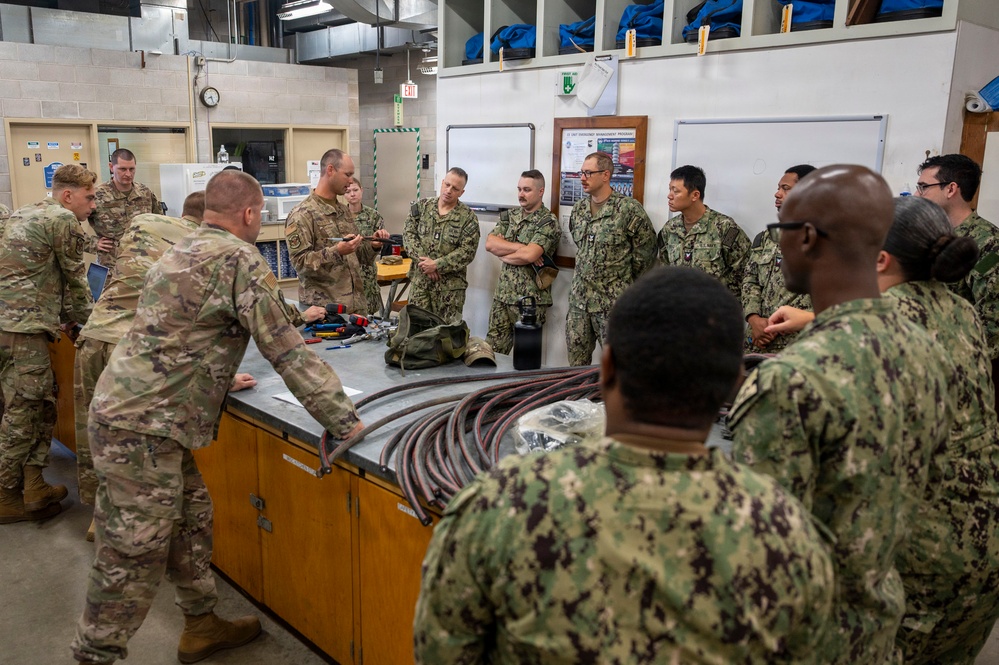
Photo By Tech. Sgt. Brooke Spenner | Airman with the 934th Civil Engineer Squadron, instructs U.S. Navy Northwest Regional...... read more read more
There was nothing glamorous about the task.
It involved a high-voltage cable, a specialized tool, and precision.
Airmen from the 934th Civil Engineer Squadron (CES) and 11 Sailors from U.S. Northwest Regional Maintenance Center (NWRMC) Minneapolis worked side by side during the September 2026 unit training assembly. The two services conducted hands-on training on electrical systems used to establish and sustain bare-base operations. For someone inexperienced with the task, preparing the cable by hand can take one to two hours.
They were surprised to learn their instructor was keeping a secret.
The same task, with the right training and a specialized tool, could take about five minutes.
Time is valuable.
At a forward operating location, where engineers may be responsible for building the infrastructure needed to support an operating force, time becomes part of the mission.
Senior Master Sgt. Kyle Sunne, 934th CES, knows that distinction well. The system the Airmen were demonstrating is designed for environments where an established electrical grid may not exist.
The Air Force is not the only service that knows what it means to build in an austere environment. “These guys work on land bases, and we work on bases at sea,” said Senior Chief Andrew McKay, NWRMC Minneapolis.
Despite the difference in typical work environments, the two services came together to strengthen their expeditionary engineering capabilities.
The training opportunity came to light when a retired 934th CES member Master Sgt. Tony Jarosz reached out to Sunne, prompting him to reach out to his Navy Reserve contacts.
“Well, you guys do pipefitting, though, right?” McKay asked.
“Well, and that’s just it. So we have all the other trades,” Sunne replied, before rattling off a list of possibilities.
“Pipefitting, I think, would be great,” McKay said. “Because everybody in the yards eventually gets voluntold to work on piping systems, pulling them apart, putting them back together.”
Sunne immediately jumped back in. “Yeah, and that would be great. Actually, we have quite a few very talented welders over here!”
While Sunne and McKay continued discussing future training opportunities, knives scraped away layers of insulation as Airmen and Sailors worked their way around the cable, carefully exposing the components needed for the connection.
After nearly an hour, they completed the tedious task.
That’s the moment when Tech. Sgt. Colin Western, 934th CES, electrical craftsman, reached for the specialized tool and began his final cable stripping demonstration.
A few minutes. A piece of cable. Ready to connect.
The cable was only one piece of the training. The larger objective was building something that could not be measured in feet of wire or minutes on a clock: the ability to understand, trust and work alongside another service before the mission requires it.
Sunne then stepped in to demonstrate the next step. In a bare-base scenario, he would use the load break elbow to connect the cable to the electrical distribution system.“If we show up to a bare-base site and are completing set up one team will work on laying out cable and making all of these connections. The base doesn’t have sustainable “permanent” power until this process is complete,” Sunne explained.
The Air Force may build bases on land and the Navy may work on them at sea, but the engineers on both sides are preparing for the same fundamental challenge: creating the infrastructure that allows the mission to move forward.
| Date Taken: | 09.13.2026 |
| Date Posted: | 09.16.2026 12:08 |
| Story ID: | 574746 |
| Location: | MINNEAPOLIS, MINNESOTA, US |
| Web Views: | 18 |
| Downloads: | 0 |

This work, 934th Civil Engineer Squadron hosts training with U.S. Navy Reservist, by TSgt Brooke Spenner, identified by DVIDS, must comply with the restrictions shown on https://www.dvidshub.net/about/copyright.


No keywords found.





