
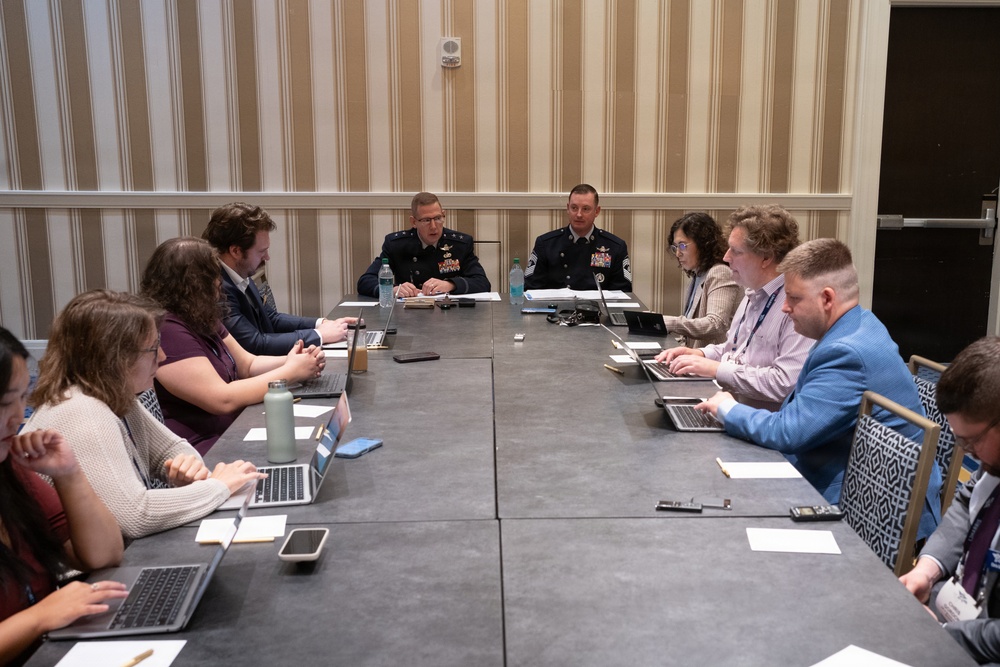
Photo By Isaac Blancas | U.S. Space Force Maj. Gen. James E. Smith, commander of Space Training and Readiness...... read more read more
 Subscribe
NATIONAL HARBOR, Md. — As the U.S. Space Force prepares to double its uniformed ranks over the next five years, Space Training and Readiness Command is setting the foundation to turn that historic expansion into ready, combat-credible space forces.
Dr. Troy Meink, secretary of the Air Force, said during a keynote address Sept. 14 at the Air and Space Forces Association’s 2026 Air, Space and Cyber Conference the military must rapidly field cost-effective combat power to keep pace with a modern technological revolution. Meink emphasized service members are the foundation of this adaptability, noting the growth of the Space Force is a direct reflection of that investment in personnel.
Maj. Gen. James E. Smith, STARCOM commander, outlined how the command will drive this growth during his media roundtable and the Growth of the Space Force panel at the conference.
“We understand the requirements behind right-sizing the Space Force, and we are fully postured to meet those goals for FY27,” Smith said. “Adding 10,000 Guardians over the next five years represents our target, with a significant portion of that growth occurring in the first year. Predictable budget resources will remain vital as we scale operations to maintain our FY27 momentum.”
Doubling the service is more than recruiting and classroom throughput; it requires experienced warfighters stepping forward to shape the force. STARCOM is actively seeking more than 200 Guardians and civilian specialists to fill vital instructor roles across officer and enlisted basic training, commissioning pipelines, initial skills training and professional military education.
The assignment demand distributes Guardian instructors to Air Force ROTC detachments nationwide, Officer Training School, located at Maxwell Air Force Base, Alabama, and the U.S. Air Force Academy, in Colorado Springs, Colorado. An increase in instructors will also support three enlisted initial skills training locations and the enlisted PME courses.
Smith emphasized that serving as an instructor or educator at STARCOM represents a foundational assignment for the service, helping create a deliberate pathway for Guardians to develop warfighting acumen, exercise mission command and advance toward mastery.
“Our success hinges entirely on our people, and recruiting top talent into instructor billets creates the combat credibility our service needs,” Smith said. “STARCOM is the crucible where Guardians are shaped and systems are proven. When experienced operators step into instructor assignments, they directly instill the space warfighting ethos that our joint force depends upon.”
STARCOM will have to onboard and qualify these cadre members rapidly to handle an incoming surge in students. In fiscal 2027, STARCOM plans to expand its Basic Military Training pipeline, located at Joint Base San Antonio-Lackland, Texas, by more than 90% to accommodate over 1,400 recruits, with subsequent initial skills courses expanding at a matching rate. Enlisted professional military education will grow by nearly 120% to train more than 1,300 students annually.
Officer accession programs will experience similar demands. OTS will scale its pipeline by nearly 600% to prepare roughly 850 Guardian officer trainees, while Air Force ROTC expects to commission approximately 300 Guardians next year, a 100% jump.
Following commissioning, new officers enter the comprehensive Officer Training Course, located at Peterson Space Force Base, Colorado, where enrollment will jump roughly 275% to more than 1,350 officers next fiscal year. Officer professional military education will eventually absorb an additional 1,600 students, representing a 330% increase.
Meeting this rapid demand also accelerates STARCOM’s push for service-tailored, Guardian unique development opportunities designed specifically for space domain challenges.
“The Marine Corps operates within the Department of the Navy, yet both services recognize that Marines require distinct training and development from Sailors,” Smith said. “The same holds true within the Department of the Air Force.
“While we currently have a great partnership with the US Air Force for many of our development courses,” he continued, “ultimately, Guardians require space-minded education and rigorous, domain-specific training to ensure combat credibility, integrate seamlessly with the joint force and protect national interests.”
STARCOM already leverages deliberate partnerships to accelerate Guardian-unique development. In January, STARCOM and Space Delta 13 partnered with Texas A&M University in College Station, Texas, to launch the Captains Leadership Course, pairing active-duty Guardian instructors with university faculty. The program has graduated more than 270 Guardians, and the Space Force recently finalized a 10-year intergovernmental support agreement to sustain the partnership through 2036.
Smith highlighted this academic alliance as a model for how STARCOM cultivates a collaborative culture across the military, industry and academia.
“Every American relies daily on space-enabled capabilities, which means our joint and coalition forces must possess the ability to operate in, from, and to space at a time and place of their choosing,” Smith said. “STARCOM touches every Guardian’s career, either in the classroom or through the operational systems and tactics we validate.
“By building positive partnerships, bolstering our development foundation, and setting high standards in our schoolhouses,” he continued, “we will continue forging the world’s most combat-credible Space Force.”
| Date Taken: | 09.14.2026 |
| Date Posted: | 09.14.2026 16:49 |
| Story ID: | 574674 |
| Location: | NATIONAL HARBOR, MARYLAND, US |
| Web Views: | 27 |
| Downloads: | 0 |

This work, STARCOM highlights plan to deliver Space Force growth, by Maj. Ryan DeCamp, identified by DVIDS, must comply with the restrictions shown on https://www.dvidshub.net/about/copyright.


No keywords found.




