
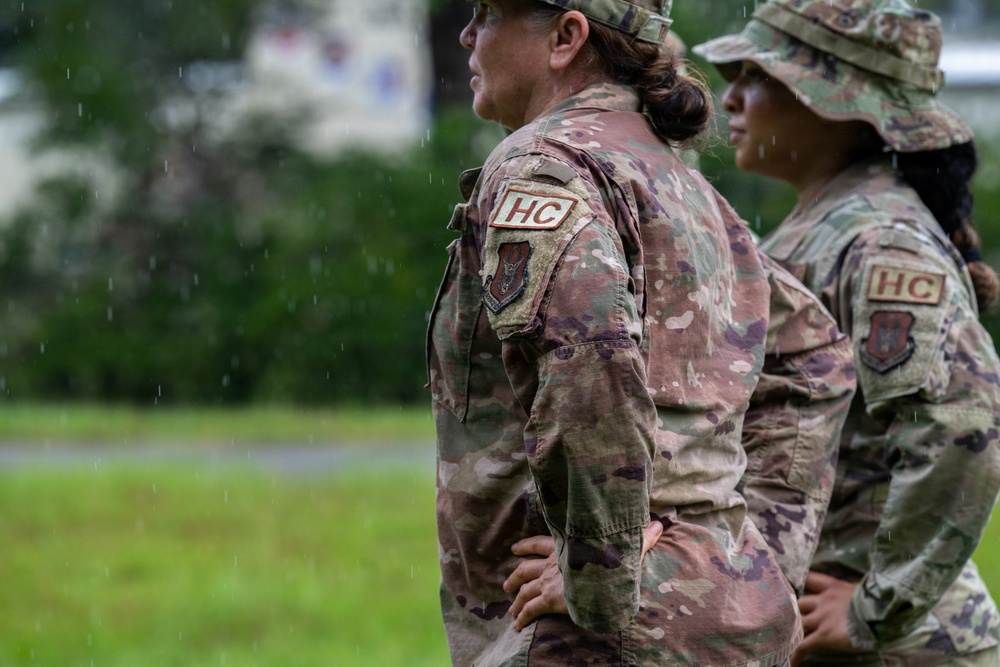
Photo By Staff Sgt. Erica Webster | U.S. Air Force chaplains stand in the rain during a field training exercise at Robins...... read more read more
 Subscribe
Reserve chaplains and religious affairs Airmen moved in teams through a field exercise, practicing tactical movements, working through counseling scenarios pulled from real cases, and rehearsing the ceremony that carries a fallen service member home. It is not the work most people picture when they picture a chaplain.
More than 120 Traditional Reservists and Individual Mobilization Augmentees arrived at Robins AFB for the Air Force Reserve Command Chaplain Corps readiness training symposium, four days built to prepare for the same wartime mission their active-duty counterparts train for full time. Two days of lectures covered the hardest terrain in the profession: moral injury, ethical drift, spiritual fitness, and trauma exposure. Then the Airmen had to carry the instruction out of the classroom and prove they could hold it under pressure. Groups rotated through eight experiential stations across the exercise, turning lecture material into practiced skill.
For the Reserve Chaplain Corps, that step from theory to practice carries a particular weight. The time they have to train for war is finite but the standard they are held to is not. What the symposium set out to prove is that the distance between the two can be closed, and that the Reserve brings something to the fight the full-time force cannot replicate on its own.
That case was not lost on Maj. Gen. Trent Davis, Chief of Chaplains of the Air Force and Space Force, who traveled to Robins AFB to watch the training firsthand.
"Spiritual readiness to me is warfighter readiness," Davis said. "People's unique, different faith backgrounds give them strength and power during those darkest of times.”
For the Airmen he came to see, the value of the week was in the doing. Chaplain (Maj.) Rafael Lantigua, a staff chaplain at HQ AFRC, helped lead the crisis and trauma counseling training. The scenarios he and his fellow facilitators built were not written for a classroom but pulled from real-life experiences.
"It's one thing to learn about pastoral care and spiritual counseling in the classroom or in seminary," Lantigua said. “Here we are taking a concept and putting it into practice, being able to iron out the wrinkles in the process of operating as a religious support team when a service member comes in asking for care. Seeing it played out has been going phenomenally well."
Chaplain (Capt.) Matthew Bell knew the difference between rehearsing the work and doing it for real. A Traditional Reservist with the 944th Fighter Wing, Luke AFB, a high school English teacher and wrestling coach in civilian life, Bell recently came home from a deployment where the training he practiced at home was tested under real conditions.
"We had lectures that talked about content, and they brought their real-world experiences to them, but it’s all culminated in us practicing it," Bell said. "So, it wasn't just theory, expectations and instructions. We’re here implementing it, and able to learn some of our limiting factors, the things we really need to work on. The fact that we got to practice it, as opposed to just talk about it, was excellent.”
Some of what waits downrange cannot be taught in a briefing room, it can only be faced. Chaplain (Capt.) Herman Klarr of the 934th Airlift Wing, who came up through the enlisted ranks as a chaplain assistant before he was commissioned, said the trauma instruction pushed the Chaplains to seek out hard experience on their own, at home, before a deployment forces it on them.
"There are a lot of people who have never seen a dead body, and we’re going to be on the front lines seeing them," Klarr said. "If the first time you see that is when you're deployed, it’s going to be hard. It’s more difficult to support everyone else, to still do the services and still minister to the people around you.”
The remedy the instructors offered was ordinary and close to home. Ride with a coroner or EMT. Visit a morgue. Introduce yourself to the county sheriff. “Do it now,” Klarr said, while there is time to do it deliberately.
The capability the symposium sharpened is not only military. It is also who these Airmen are the rest of the year. Bell teaches and coaches. Klarr is an Eastern Orthodox priest. Others in the room serve their communities as pastors, counselors, and first responders, then bring that experience back into uniform. It is the same dual fluency that defines the Reserve across every career field, and in the Chaplain Corps it runs especially deep: a Reserve chaplain has often spent years doing a version of this ministry in the civilian world before ever training for it in a combat zone. The depth is real, and the full-time force cannot manufacture it.
Building a week that could draw on all that experience and still fit a part-time schedule fell to Airmen like Master Sgt. Siana Rosado from HQ AFRC chaplain staff, who helped design and run the training.
"How can we balance the skills we bring from our civilian experience and the military knowledge and wisdom that we have?" Rosado said. "How can we leverage that into stations and digestible training blocks, so that they walk away having learned something, having networked, and having communicated with each other?”
Attendees answered to different scriptures, and a few answered to none. What held them to a single task is a principle the Chaplain Corps treats as settled: a chaplain's obligation does not depend on whether the person seeking help shares the chaplain's faith.
"This is a pluralistic environment. If I have an Airman in front of me, they might not share my faith background, but I am responsible for their spiritual fitness," said Bell. "Whatever worldview you may have, there are tools we can give you to strengthen your spiritual fitness that is unique to you. So, whether we share the same faith or not, we are going to give you everything that we can to make sure you are tackling that important pillar of spiritual fitness.”
The range was not theoretical. Klarr represents an Orthodox tradition most of the Airmen around him had rarely encountered, while Lantigua came to the Air Force Chaplain Corps as a Muslim. The point Lantigua pressed was not the distance between faiths, but the duty that closes it.
"That is one of the rich elements of the Chaplain Corps, that we are able to be in our own faith tradition but understand the richness that comes with walking side by side with someone of a different one, and navigate according to all the resources they need," said Lantigua. "Regardless of the symbol that is worn on my chest, I am able to help anybody, of a different faith tradition, of my own faith tradition, or someone of no faith at all.” A deployed Airman in crisis does not choose which chaplain is on hand, and the Chaplain Corps trains its people so whoever answers can serve anyone, regardless of their beliefs.
It builds in a second safeguard as well. A chaplain never deploys alone with each being paired with a religious affairs Airman. Klarr, who spent his early career in that enlisted role, has watched the partnership become more equal over time, especially when it comes to confidential conversations.
"Religious affairs Airmen didn't used to have privileged communication, and now they do," Klarr said. The change widens the door. An Airman who hesitates to sit down with a chaplain can speak with the religious affairs Airman in the same confidence, so that hesitation never becomes the reason someone goes without help.
Tech. Sgt. Hannah Lucas came to the symposium as an Individual Mobilization Augmentee out of Joint Base Lewis-McChord, Washington and she is, by her own account, not a religious person. At the dignified transfer station, Lucas watched Reserve chaplains go over the same scenario, each bringing the words of a different faith to the task of sending a fallen service member home. No two were alike.
"They're speaking from their heart and their religion. Each of them were different," Lucas said. "It was so good and watching them do their piece moved me. It was making me emotional, and this isn't even real. I imagined if I was that person's friend or family member on the aircraft in a real-life scenario."
If the training could move an Airman who came to it from outside any faith, it could reach the people a deployed chaplain will one day be sent to serve. This was the readiness Davis had come to see, and he found it in a space with part-time Airmen who spend most of the year somewhere else.
"It is the greatest privilege of my life to be the Chief of Chaplains," Davis said. "To see them exercising, getting ready for what might face them in the future, is an amazing experience. I hope the Chaplain Corps continues to bring what it is uniquely called on to bring, and that is fortifying that warfighter spirit, so that our warfighters in their hour of need know they have hope, and there's a place to turn.”
| Date Taken: | 08.28.2026 |
| Date Posted: | 09.15.2026 12:28 |
| Story ID: | 574583 |
| Location: | US |
| Web Views: | 13 |
| Downloads: | 0 |

This work, The work you don't see: Reserve chaplains train for the wartime mission, by SSgt Erica Webster, identified by DVIDS, must comply with the restrictions shown on https://www.dvidshub.net/about/copyright.


No keywords found.




