
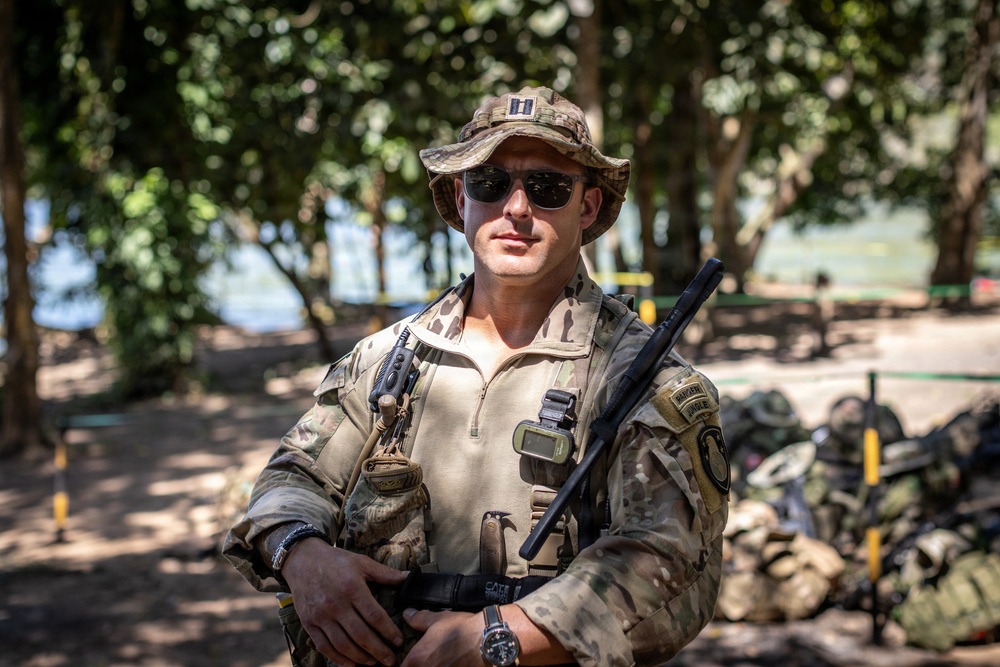
Photo By Staff Sgt. Mickey Miller | Capt. Jared Fonzi, an operations planner with the 551st Infantry Regiment, U.S. Army...... read more read more
 Subscribe
SAUCE, Peru — The jungle has a way of making even simple things complicated.
Movement slows. Equipment gets heavier. Water becomes an obstacle instead of a landmark. The environment quietly strips away assumptions about how quickly a formation should move or how easily a Soldier can accomplish a familiar task.
For U.S. Soldiers training alongside Peruvian and Chilean forces during Exercise Southern Vanguard 26 (SV26), that friction is exactly the point.
In the hills surrounding Sauce, Peru, Soldiers are learning to move, survive and operate in terrain where their Peruvian counterparts have spent years developing expertise. During the opening days of jungle warfare training, multinational formations started at various lanes including amphibious movement, survival skills and small-unit tactics designed for an environment that can punish even routine movement.
“Multiply fatigue by 10,” said Capt. Jared Fonzi, an operations planner with the 551st Infantry Regiment, U.S. Army Western Hemisphere Command, describing the physical effects of jungle operations. “The climate, the terrain, the physical exhaustion that everyone here goes through — pictures do not justify the stress and the physical fatigue.”
SV26 is a multinational exercise hosted by the Peruvian Army and designed to strengthen interoperability among participating forces while building proficiency in jungle mobility, survivability and tactical operations. For American Soldiers, participation offers something difficult to replicate at home: the opportunity to become students of a partner force operating in terrain it understands intimately.
Fonzi, a graduate of the Jungle Operations Training Course–Panama (JOTC-P), Ranger School and an infantry officer proficient with conventional U.S. tactics, said jungle warfare changes the scale at which Soldiers must think and maneuver.
“The size of the maneuvering element is far smaller,” he said. “You don’t really maneuver as a platoon, which is usually the bread and butter of U.S. operations. Here, with smaller elements — team size, squad size — you need to rely more on individual survival techniques and minimal equipment.”
That emphasis places greater importance on survival, fieldcraft and understanding the environment itself. Humidity, elevation, water obstacles, rainfall and dense vegetation are not simply background conditions.“These climate differences and natural elements are what affect the fight,” Fonzi said. That reality is also driving U.S. Soldiers to look outward for expertise.
Fonzi said U.S. forces are relying heavily on jungle warfare specialists from countries such as Peru, Colombia and Panama to understand how forces accustomed to the environment operate and which techniques might improve U.S. tactics, techniques and procedures.
The dynamic is visible throughout SV26.
Peruvian instructors are leading much of the jungle training, while U.S. instructors work alongside them and help translate techniques for American formations. Fonzi described the Peruvian approach as aggressive and immediate, often moving Soldiers quickly from instruction into practical application.
“There’s really no crawl phase here,” he said. “They’ll give a brief instruction, and then they just throw them in the water or whatever training environment they go into.”
The approach may differ from how many American Soldiers are accustomed to training, but adapting to unfamiliar methods is part of the exercise itself.
Interoperability is often discussed in terms of radios, procedures and whether two formations can communicate on a battlefield. But before any of that works, Soldiers have to understand how their partners think, move and solve problems.
Sometimes that begins with something as unremarkable as getting everyone across a body of water. There is a certain humility required in that process.
The U.S. military brings considerable capability nearly anywhere it goes. The jungle offers a useful reminder that capability and expertise are not the same thing. Sometimes readiness means arriving prepared to teach. Other times, it means recognizing when someone else has something to teach you. Southern Vanguard creates room for both.
For Soldiers operating beneath the canopy, the lessons are physical as much as tactical. “Being wet 24/7, fighting through brush, crossing water — these little things have a huge impact on how you fight,” Fonzi said.
Over the course of the exercise, those small hardships become part of a larger test: whether multinational formations can adapt together in an environment that does not care how experienced, capable or well-equipped they were before entering it.
That may ultimately be the most valuable lesson hidden beneath the canopy: Partnerships become meaningful when Soldiers learn to depend on one another before circumstances require them to.
| Date Taken: | 09.12.2026 |
| Date Posted: | 09.13.2026 14:02 |
| Story ID: | 574561 |
| Location: | TARAPOTO, PE |
| Web Views: | 36 |
| Downloads: | 0 |

This work, Southern Vanguard 2026 turns Peru's jungle into a classroom for U.S. Soldiers, by SSG Mickey Miller, identified by DVIDS, must comply with the restrictions shown on https://www.dvidshub.net/about/copyright.


No keywords found.




