Thomas Shanks Examined by Board of General Officers (2 JUN 1778)
Photo By Erin Thompson |
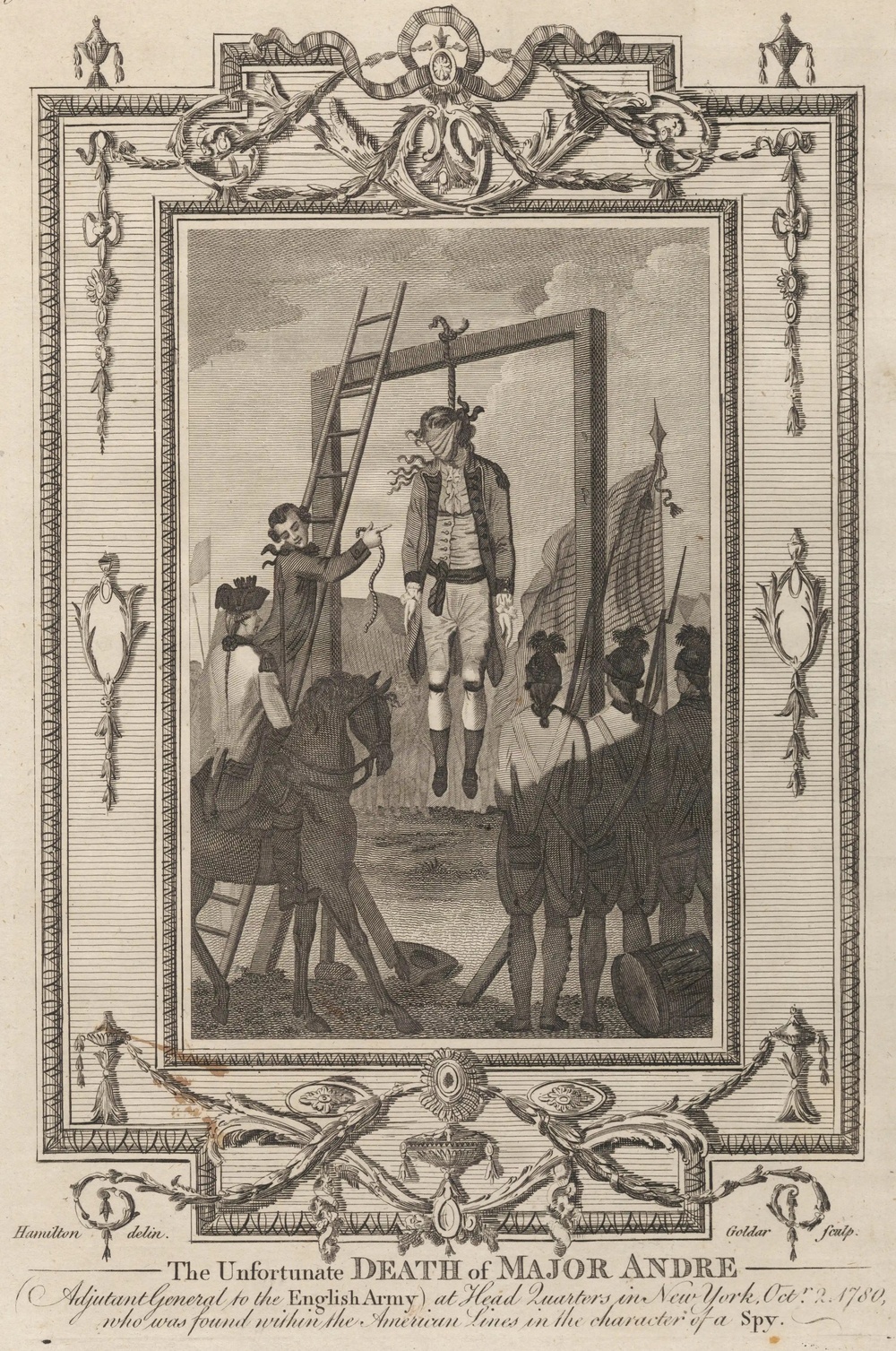
The Unfortunate Death of Major Andre (William Hamilton, 1783). Like British Maj. John......read moreread more
Photo By Erin Thompson | The Unfortunate Death of Major Andre (William Hamilton, 1783). Like British Maj. John André, Thomas Shanks was “examined” by a Board of General Officers and sentenced to death. see less
| View Image Page
Thomas Shanks Examined by Board of General Officers (2 JUN 1778)
On June 2, 1778, a fourteen-person Board of General Officers found Thomas Shanks guilty of spying for the British. Based on their recommendation to General George Washington, Shanks was sentenced to death.
The question of how to try and sentence suspected spies for the British was still causing difficulties in mid-1778. Two years earlier, the Committee on Spies was established to address this problem, and its work had resulted in the nation’s first espionage laws [https://www.dvidshub.net/news/472786/congress-establishes-committee-spies-5-jun-1776]. The committee provided the framework for trying and executing American and foreign soldiers and foreign civilians accused of spying. However, debate remained over how to try American civilians: through civil trials or courts-martial? By 1778, the question had still not been sufficiently answered. For Thomas Shanks, it resulted in an unconventional solution.
Shanks had served as a sergeant in the Pennsylvania Rifle Regiment from April to December 1776, before he was commissioned an ensign in the 10th Pennsylvania Regiment. In October 1777, he was found guilty of stealing shoes from the regimental quartermaster and was summarily discharged from service. In late May 1778, Shanks was residing in British-occupied Philadelphia when he came into the employ of Joseph Galloway, a Loyalist spymaster. Galloway tasked Shanks with collecting intelligence from the American camp at Valley Forge and secured him a pass out of the city.
Unfortunately for Shanks, upon passing through the British guardhouse, he encountered Sgt. William Sutherland, who had decided that same evening to desert the British army. Sutherland, seeing Galloway’s name on Shanks’s pass and realizing he was likely a spy, managed to delay Shanks long enough to go ahead of him to the American camp and report him to Ens. Luke Cannon of the 15th Virginia Regiment. Early the next morning, Cannon found Shanks in the camp with the pass signed by Galloway, a known intelligence agent for the British. Shanks claimed he had come to enlist and lied about his place of residence, “denying he had been into Philadelphia.” The incident was immediately reported to higher headquarters.
On June 2, 1778, Washington wrote to the Board of General Officers: “To avoid the formality of a regular trial, which I think in such a case ought to be dispensed with, I am to request you will examine him and report the result; and if his guilt is clear, his punishment will be very summary.” Unlike a court-martial or civil trial, the Board of General Officers was not legally a court of justice and thus could not adjudicate the accused. Instead, the panel of generals would send their recommendations to Washington for final judgement and sentencing. The board included fourteen well-respected generals of Washington’s staff, including Maj. Gens. Charles Lee, Benedict Arnold, Lord Stirling (William Alexander), Thomas Mifflin, Marquis de Lafayette, and Friedrich Wilhelm Von Steuben.
The same day the board was convened, it heard testimony from Sutherland, Cannon, and Shanks. Shanks told the board he “promised Mr. Galloway to come and view this camp and army” but claimed he had “only made the promise to obtain the pass” out of Philadelphia to visit his brother. This was contradicted by his presence in the camp and his lies to Cannon about his place of residence and intention to enlist in the Continental Army. The generals quickly rendered their opinions to Washington. Ten officers found Shanks guilty of spying, with “four not satisfied,” and eight recommended a sentence of death. Washington approved their recommendation, and Shanks was hanged on June 4, 1778.
Shanks’s case highlighted the continued uncertainty on the handling of civilian spies. His appearance before the Board of General Officers was certainly unusual; in fact, the only other recorded instance of the Board convening to hear an espionage case during the Revolutionary War was that of British intelligence officer Maj. John André [https://www.dvidshub.net/news/548800/british-major-apprehended-spy-23-sep-1780]. The use of such tribunals, later established as military commissions, would not become commonplace until the mid-nineteenth century.
***
Article by Erin E. Thompson, USAICoE Staff Historian. New issues of This Week in MI History are published each week. To report story errors, ask questions, request previous articles, or be added to our distribution list, please contact: TR-ICoE-Command-Historian@army.mil.

 Subscribe






