502nd CIC Detachment Provides Security on Guam (10 MAY 1947)
Photo By Erin Thompson |
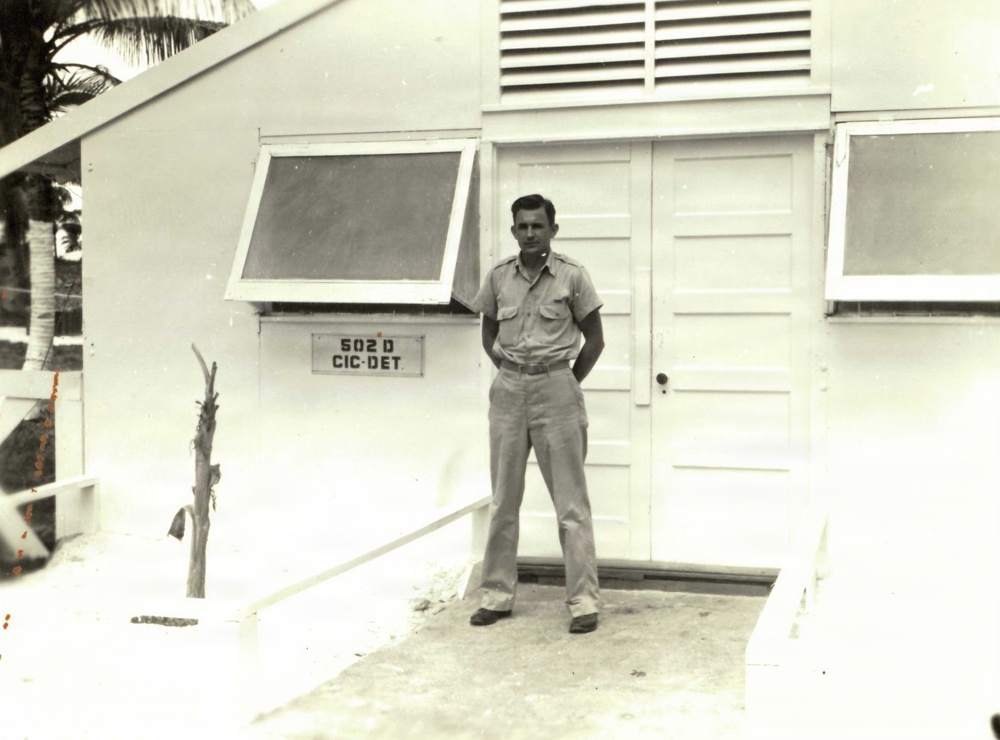
502nd CIC Detachment Executive Officer Lt. Richardson in front of detachment......read moreread more
Photo By Erin Thompson | 502nd CIC Detachment Executive Officer Lt. Richardson in front of detachment headquarters, Guam, 1948. The detachment’s offices and barracks were all built by CIC personnel between 1948–1949. see less
| View Image Page
502nd CIC Detachment Provides Security on Guam (10 MAY 1947)
On May 10, 1947, the 502nd Counter Intelligence Corps (CIC) Detachment was reactivated on Guam. Originally stood up in France during World War II, the unit had been inactive since October 1946. Once reorganized on Guam, it provided security operations for the short-lived Marianas-Bonin (MARBO) Command headquartered on the island.
The 502nd CIC Detachment was first constituted in July 1944. It was activated one month later and attached to the 2nd Armored Division during the Allied invasion of France. It would remain in Europe throughout the war and was then assigned occupation duty in Germany where it inactivated in October 1946.
Guam, the largest island in the Mariana Islands archipelago, was under American control from 1898 until it was seized by the Japanese in December 1941. The U.S. retook the island during the Battle of Guam in 1944. Due to the proximity of the Mariana and Bonin Islands to Japan, they served as an important military base of operations during and after the war in the Pacific. In January 1947, a reorganization of military forces in the Pacific led to the creation of the MARBO Command, a major Army command that oversaw activities on the islands under the direction of the Commander in Chief, Far East.
On May 10, 1947, the 502nd CIC Detachment was reactivated on Guam to oversee the specific security concerns related to military personnel and Army civilians on the island. Civilians typically served one-year tours, leading to high turnover rates. The 502nd was routinely called upon to screen employees who either had not yet received formal clearance to work in sensitive jobs or were otherwise under scrutiny by the CIC. In one case, the 502nd conducted a search of the living quarters of a civilian engineer and discovered film rolls “showing airstrips, coastline features, and the central water supply system of the islands,” as well as documents related to ongoing construction on the island. After careful interrogation by CIC agents, the engineer was relieved of his position and returned home on the recommendation that he never again be employed by the U.S. Army.
The relative isolation of the Mariana Islands led the CIC to use all manner of sources in its security operations. Amateur radio was especially useful to the agents, who asked shortwave radio operators to report suspicious broadcasts to the CIC. Near midnight on December 30, 1947, an amateur operator working in the Guam Special Services Station was contacted by another operator from Southport, Indiana, who reported a strange broadcast by “an American soldier in North China hiding from the Russians in a cave” using the identifier ACIT.
The information was relayed to the 502nd commander, Capt. Charles H. Silvester, who spent the rest of the night with the operator attempting to raise ACIT. At the suggestion of the MARBO G-2, Silvester recruited “every ham [amateur] station on Guam” to help locate the broadcast. The Far East Command G-2 in Tokyo urged the CIC to continue its efforts throughout January 1948. Although the Navy Joint Communications Commission briefly established contact during the month-long search, no further messages were ever received. Nevertheless, the investigation uncovered three Soviet stations in Korea producing large quantities of communist propaganda. Amateur operators were encouraged to keep monitoring these and other known propaganda stations for the CIC.
Despite a few instances of intrigue, the situation on Guam remained largely stable during the unit’s brief operations between 1947 and its inactivation on March 14, 1950. Over a decade later, the unit was reactivated in 1961 and consolidated with the 502d Military Intelligence (MI) Detachment (formerly the 520th CIC Detachment). Redesignated the 502nd MI Company in January 1971, this company, along with the 373rd Army Security Agency (ASA) Company, would form the nucleus of the provisional 522nd MI Battalion in 1976.
***
Article by Erin E. Thompson, USAICoE Staff Historian. New issues of This Week in MI History are published each week. To report story errors, ask questions, request previous articles, or be added to our distribution list, please contact: TR-ICoE-Command-Historian@army.mil.

 Subscribe






