
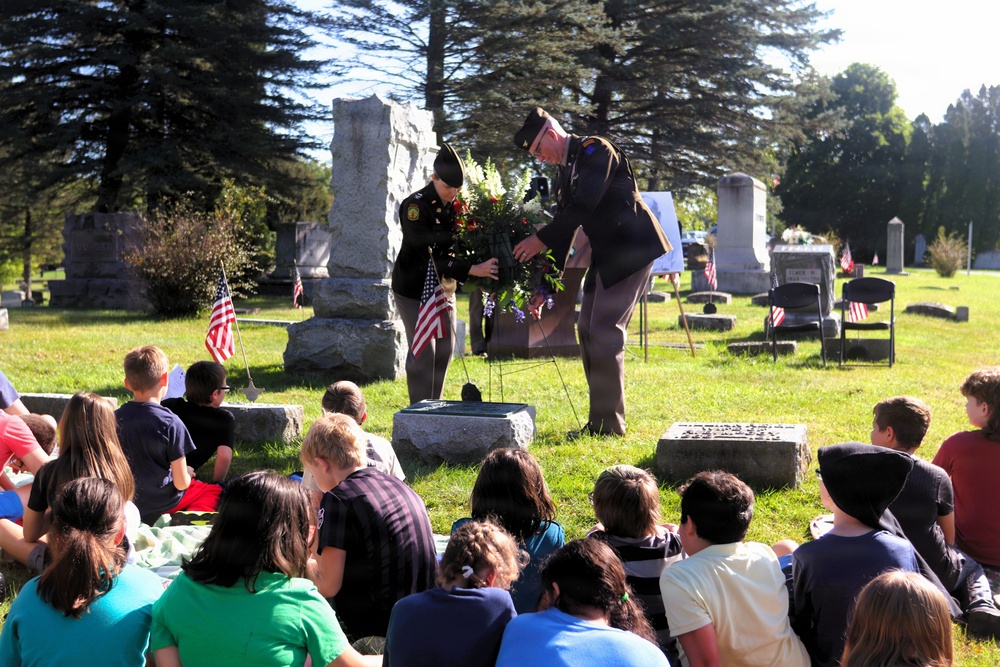
Photo By Scott Sturkol | A scene from the 2026 Maj. Gen. Robert Bruce McCoy Remembrance Ceremony is shown Sept....... read more read more
 Subscribe
Soldiers, military leaders, students, veterans, community members and descendants of the McCoy family gathered Sept. 10 at Woodlawn Cemetery in Sparta, Wis., to honor the legacy of Maj. Gen. Robert Bruce McCoy, the Wisconsin Citizen-Soldier whose vision more than a century ago helped establish what is now Fort McCoy.
The 2026 Maj. Gen. Robert Bruce McCoy Remembrance Ceremony, held at 9:30 a.m. on the north side of Woodlawn Cemetery, marked the second annual remembrance ceremony of its kind. The inaugural event was held in 2025.
The ceremony brought together the U.S. Army Garrison-Fort McCoy community and the local community to remember McCoy’s service, leadership, and vision for creating a large-scale military training area in Monroe County.
Command Sgt. Maj. James Riddle, Fort McCoy Garrison command sergeant major, served as master of ceremonies.
The event included an invocation by Chaplain (Lt. Col.) Raymond Leach of the 88th Readiness Division, the presentation of the colors by the Tomah High School JROTC Color Guard, the Pledge of Allegiance led by students from the Sparta Montessori E-2 classrooms, the National Anthem performed by Sparta High School senior Emaly Sutherland, and TAPS performed by Sparta High School senior Patrick Larson.
Col. Kurt Page, chief of staff of the U.S. Army Reserve’s 88th Readiness Division, served as keynote speaker.
Fort McCoy Garrison Commander Col. Sarah Fraticelli also addressed those attending.
Remembering a Citizen-Soldier
Page opened his remarks by reflecting on his own history with Fort McCoy, dating to 1988 when he arrived at the installation as a young private for annual training and Expert Infantryman Badge training.
He said his first experiences at Fort McCoy helped him develop an appreciation for the installation and the surrounding communities, even though he knew little at the time about the man whose vision had helped create it.
“I fell in love with this area and in love with how much this community supports the veterans and those soldiers that train at Fort McCoy,” Page said.
Page said researching McCoy’s life for the ceremony gave him a greater understanding of how much McCoy contributed to Monroe County and the military.
“This year marks 100 years since General McCoy’s passing and 100 years since the War Department put his name on what we know today affectionately as Fort McCoy,” Page said.
Robert Bruce McCoy was born Sept. 5, 1867, in Kenosha, Wisconsin. His family had a long tradition of military service, including his father, who commanded Company G of the 43rd Wisconsin Volunteer Infantry during the Civil War.
When flooding destroyed the family grain mill in 1876, the McCoy family moved to Sparta, where Robert Bruce McCoy would establish the deep connection with Monroe County that would define much of his life.
Known to friends as “Bob,” McCoy graduated from Sparta High School in 1887. He attended the University of Wisconsin, where he excelled academically and athletically, including as a pitcher and captain of the university baseball team. He later earned a law degree in 1891.
McCoy became active in numerous aspects of civic life. He opened a law practice, edited the Monroe County Democrat, served on the local Board of Education, was elected Monroe County judge in 1897, and later served as mayor of Sparta.
His public service also extended into state politics. In 1920, he was the Democratic nominee for governor of Wisconsin and received more than 200,000 votes.
“Judge, editor, school board, mayor, candidate for governor,” Page said. “Somewhere along the way, nobody ever taught Bob McCoy how to decline a request.”
From citizen to general
McCoy’s military career began when he enlisted as a private in the 3rd Wisconsin Infantry in 1885. Within a year, he received a commission as a captain.
During the Spanish-American War in 1898, McCoy led his Sparta company in Puerto Rico. During the fighting, an artillery shell exploded nearby, permanently damaging his hearing. His military service continued into World War I, when he commanded Wisconsin troops in France.
Page described McCoy's World War I service as the period that “revealed the full measure of the man.”
McCoy commanded infantry regiments during some of the war’s most difficult fighting and was recognized for his valor with the Army Distinguished Service Medal and French military honors, including the Croix de Guerre and Legion of Honor.
After returning home, McCoy continued serving veterans and fellow Soldiers. He helped establish the 32nd Division Veterans Association and eventually became a major general commanding the division.
But Page emphasized that McCoy’s most enduring contribution to the military did not come on a battlefield overseas.
“It was engineered right here, in the low pastures and jack pine ridges of Monroe County,” Page said.
A vision for military training
McCoy understood that the nature of warfare was changing, Page said. Having experienced military operations firsthand, he recognized that future armies would need expansive areas where Soldiers could conduct realistic, large-scale training involving artillery, maneuver and combined arms.
McCoy began purchasing land northeast of Sparta at his own financial risk. He eventually accumulated nearly 4,000 acres and leased portions of the property to help finance additional land purchases.
In 1905, he invited the 7th Field Artillery from Fort Snelling, Minn., to conduct 16 days of live-fire training on his ranch.
“Most landowners would write their representatives when artillery lands near their property line,” Page said. “But Bob McCoy mailed the invitation to come shoot.”
The exercise demonstrated the value of the terrain and McCoy’s concept for a large military training area.
Four years later, the War Department purchased more than 14,000 acres to establish the Sparta Maneuver Tract, laying the foundation for the military installation that eventually became Fort McCoy.
McCoy died Jan. 5, 1926, at age 58, Page said. Later that year, the War Department officially renamed the reservation Camp McCoy in his honor. In 1974, the installation became Fort McCoy.
Page noted the remarkable connection between McCoy’s original vision and the installation’s mission today.
“Today, Fort McCoy spans more than 60,000 acres and trains hundreds of thousands of total force Soldiers, Marines, Sailors, and Airmen, all of them on ground one man bought because he saw that need first,” Page said.
“Kenosha may claim his birth, Sparta claims everything after, and at Fort McCoy, we claim the land and the standard that he set that came with it.”
McCoy’s legacy continues
Fraticelli connected McCoy’s original vision to Fort McCoy's role in the region more than a century later.
“Maj. Gen. McCoy’s dream shaped Monroe County, and today it provides a home for Wisconsin’s only U.S. Army installation,” Fraticelli said.
The original approximately 4,000 acres associated with McCoy’s efforts have grown into an installation encompassing more than 60,000 acres.
Fort McCoy now supports training for the total force and provides a major economic benefit to the surrounding region. Fraticelli noted the installation has a regional economic impact of more than $1.6 billion and employs more than 3,000 military and civilian personnel.
She also highlighted the installation’s modernization and growth during the past decade, including facility improvements, training-area development, increased training and customer-support capabilities, and quality-of-life improvements for Soldiers and their families.
Fort McCoy honors McCoy’s legacy by continuing to provide a four-season training environment for military units from throughout the United States and beyond, Fraticelli said.
The installation supports more than 100,000 U.S. and international service members annually, while remaining a primary training location for Wisconsin National Guard units and an important training site for the U.S. Army Reserve.
“We are confident Maj. Gen. McCoy would be proud to see his mission continuing to impact and shape the U.S. Army and our Department of War,” Fraticelli said.
A legacy shared by a community
The presence of local students and young people at the ceremony provided a tangible connection between McCoy's generation of service and those who will carry that legacy forward.
The Sparta Montessori students led attendees in the Pledge of Allegiance, while Sparta High School students provided the National Anthem and TAPS. The Tomah High School JROTC Color Guard presented the colors.
For Page, the participation of local students and the community reflected an important part of McCoy’s legacy — the relationship between military service and citizenship.
McCoy was not simply a career military officer. He was a lawyer, educator, newspaper editor, judge, mayor, athlete, public servant, community leader and Citizen-Soldier.
His military experience led him to envision a training ground capable of preparing future generations of American service members. His willingness to invest his own resources in that vision ultimately helped transform the landscape of Monroe County.
A century after his death, that vision remains visible every day across Fort McCoy’s training areas, Page said.
Page closed his remarks by challenging those gathered to continue carrying McCoy’s example forward.
“An athlete, jurist, editor, mayor, father, general, Robert Bruce McCoy proved that a citizen in uniform can see farther than the terrain in front of him,” Page said.
“May his legacy keep driving us towards readiness, towards service, and toward the country he loved.”
The 2026 remembrance ceremony served not only as a commemoration of McCoy’s life, but also as a reminder that Fort McCoy’s history is inseparable from the history of Sparta and Monroe County.
From the acreage McCoy purchased at his own risk to the more than 60,000 acres used today, his vision continues to shape the Army's ability to train and prepare for the nation's defense.
And each September, as Soldiers, community members and young people gather to remember him, the story of the Citizen-Soldier who helped make Fort McCoy possible continues to be passed to a new generation.
Fort McCoy’s motto beginning in 2026 is “Training the Total Force and Shaping the Future since 1909.” The installation’s mission: “Fort McCoy strengthens Total Force Readiness by serving as a training center, Mobilization Force Generation Installation, and Strategic Support Area enabling warfighter lethality to deploy, fight, and win our nation’s wars.”
And Fort McCoy’s vision is, “To be the premier training center supporting the most capable, combat-ready, and lethal armed forces.”
Located in the heart of the upper Midwest, Fort McCoy is the only U.S. Army installation in Wisconsin. The installation has provided support and facilities for the field and classroom training of more than 100,000 military personnel from all services nearly every year since 1984.
Learn more about Fort McCoy online athttps://home.army.mil/mccoy, on Facebook by searching “ftmccoy,” on Flickr at https://www.flickr.com/photos/fortmccoywi, and on X (formerly Twitter) by searching “usagmccoy.” Also try downloading the My Army Post app to your smartphone and set “Fort McCoy” or another installation as your preferred base.
Fort McCoy is also part of Army’s Installation Management Command where “We Are The Army’s Home.”
| Date Taken: | 09.10.2026 |
| Date Posted: | 09.10.2026 17:30 |
| Story ID: | 574352 |
| Location: | FORT MCCOY, WISCONSIN, US |
| Web Views: | 18 |
| Downloads: | 0 |

This work, Fort McCoy honors namesake Maj. Gen. Robert Bruce McCoy during 2026 remembrance ceremony, by Scott Sturkol, identified by DVIDS, must comply with the restrictions shown on https://www.dvidshub.net/about/copyright.


No keywords found.




