
Photo By Staff Sgt. Christopher Tam | A Turkish Air Force NF-5 Freedom Fighter performs during the Egypt International...... read more read more
 Subscribe
EL ALAMEIN INTERNATIONAL AIRPORT, Egypt — The most consequential capability the United States brought to the 2026 El Alamein International Airshow was not parked on the flightline.
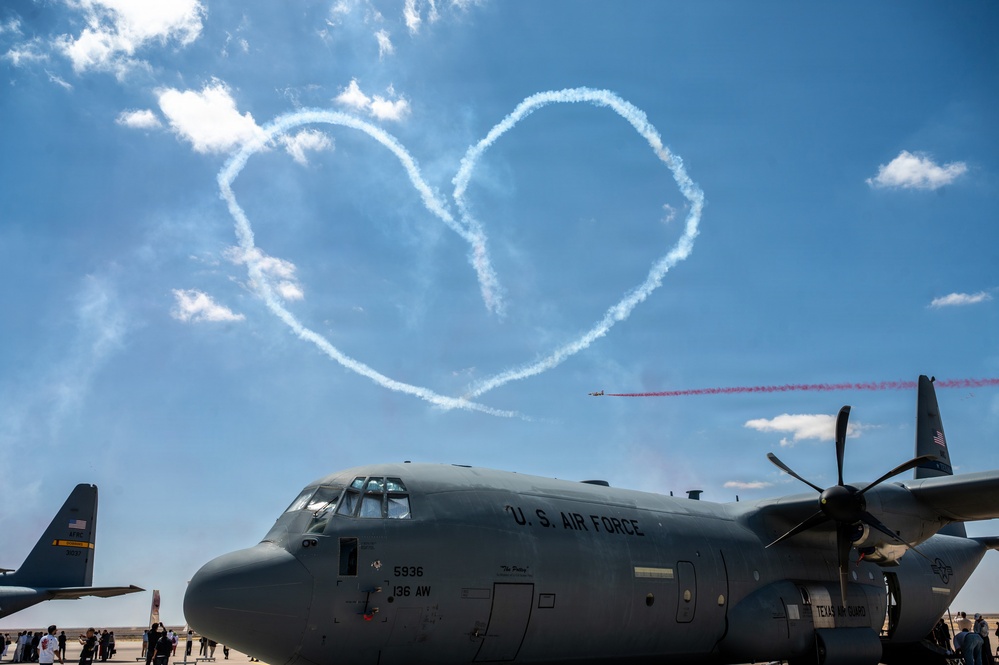
Across three days at one of Africa’s premier defense and aviation gatherings, U.S. Airmen stood alongside the A-10 Thunderbolt II, F-15E Strike Eagle, F-16 Fighting Falcon, C-130H Hercules and C-130J Super Hercules as aviation professionals, military leaders and service members from around the world moved through the American display. Conversations about aircraft quickly became conversations between old classmates, former training partners and service members who operate alongside one another across the region today.
Those interactions underscored a capability that cannot be measured by speed, range or payload: relationships built before they are required in combat.
“The first time we train together shouldn't be in battle,” said Brig. Gen. Joshlin Lewis, Texas Air National Guard chief of staff. “We have to get drumbeat reps and sets in to be a lethal combined force.”
For Lewis and the Texas National Guard, that drumbeat is sustained through the State Partnership Program, which creates recurring opportunities for Texas Guard Airmen and Egyptian forces to train and work together. From exercises like Bright Star to bringing Texas Airmen and a C-130J to El Alamein, that continuity allows relationships between individual service members to grow into institutional familiarity and trust.
For other U.S. Airmen at the show, those repetitions sometimes looked remarkably familiar.
Pilots and service members from nations including Egypt, Italy, the United Arab Emirates, Saudi Arabia, France, Bahrain, Spain, Kuwait, India, Qatar and more approached American aircrews throughout the show, exchanging experiences and building new connections. Some reunited with former classmates from U.S. training programs, friends from previous airshows or counterparts they routinely share the skies with across the region. Aspiring aviators and international service members also stopped to talk about their ambitions to train in the United States and learn alongside American Airmen.
Each interaction added another connection between forces that may one day be required to operate together with little notice.
That same dynamic extended beyond the aircraft.
Multiple times each day, U.S. Air Forces Central’s band transformed the American display into a gathering place. Students, aviation professionals and military members representing nations across the airshow crowded together for live music, dancing and conversation.
The crowds demonstrated access to the critical element of American airpower: the people behind the aircraft.
U.S. Airmen remained at their displays throughout the show, answering questions, explaining their missions and exchanging experiences with military counterparts and visitors. The aircraft drew people in, but the Airmen created the opportunity to turn interest in a platform into familiarity between people.
“Our strong presence reflects the depth of the U.S.-Egypt partnership and our longstanding cooperation across the aviation, aerospace, defense, space, and commercial sectors,” said Eric Gaudiosi, Chargé d’Affaires ad interim at the U.S. Embassy in Cairo. “We look forward to building new partnerships and expanding opportunities that benefit both our countries.”
That familiarity matters operationally.
Coalitions do not become integrated when a crisis begins. The ability to rapidly understand how another nation communicates, trains, plans and operates is built through repeated interaction long before forces are called upon to execute a mission together.
Exercises provide those repetitions in the air. Events like the Egypt International Airshow provide them on the ground.
For the United States, that makes international engagement more than an opportunity to display advanced aircraft. It creates another venue to strengthen the human network required to employ those capabilities alongside allies and partners.
The aircraft parked across El Alamein represented some of the world's most advanced aviation technology. But over three days, the American display demonstrated that technological capability alone does not create a combined force.
People do.
Every reunion between former classmates, conversation between pilots and connection between service members adds another repetition before the stakes are higher.
“When coalition forces are called to fly together, the introductions should already be over,” said Lewis.
| Date Taken: | 09.10.2026 |
| Date Posted: | 09.10.2026 13:57 |
| Story ID: | 574318 |
| Location: | EG |
| Web Views: | 24 |
| Downloads: | 0 |

This work, Beyond the Flightline: U.S. Builds Coalition Readiness at Egypt International Airshow, by Capt. Alyssa Letts, identified by DVIDS, must comply with the restrictions shown on https://www.dvidshub.net/about/copyright.


No keywords found.




