
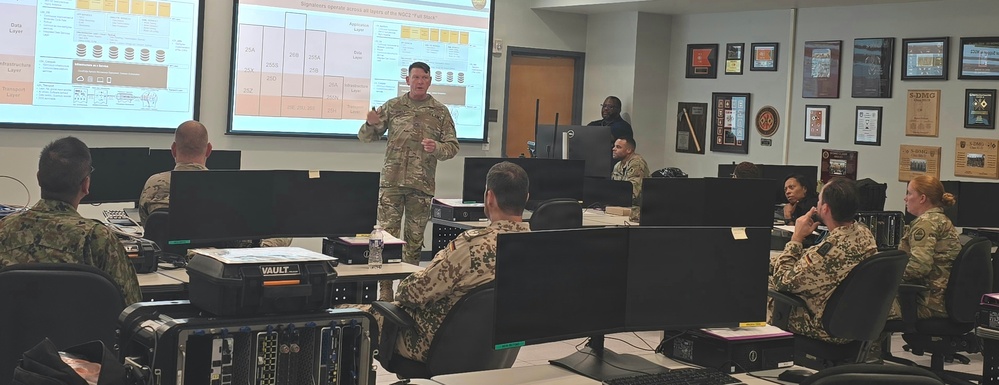
Photo By Tammy Moehlman | Chief Warrant Officer 5 Paul Sankey, U.S. Army Signal School technical director,...... read more read more
FORT GORDON, Ga. – A Soldier’s ability to fight and win is only as good as the training they receive. As more cutting-edge equipment reaches Soldiers, there is a force behind them laying the foundation – evolving and adapting to that equipment – to ensure missions are accomplished and success achieved.
The Signal-Digital Master Gunner (S-DMG) course launched in January 2011 and was preceded by pilot courses in 2010. It was designed to train information technology specialist (25B) and signal support systems specialist (25U) noncommissioned officers to serve as their commander’s expert on all digital communication systems – with an emphasis on the Warfighter Information Network-Tactical (WIN-T), the Army’s tactical network backbone at the time.
Evolve and Adapt
The S-DMG course has evolved since its inception; it’s mission very similar– yet different – from its origins. Set to begin Oct. 1, the course’s upcoming iteration directly reflects how rapidly the Signal Corps is modernizing to meet the Army’s needs. Behind it all is a team mostly comprised of training developers and NCOs, currently enrolled in a five-week S-DMG pilot course.
“This pilot is to help us validate and refine curriculum that we have spent months developing,” said Claudius Blanding, S-DMG course manager.
Signal Corps training developers and instructors have long succeeded in adapting to a continuously evolving force, but recent years have demanded unprecedented flexibility. One example of this flexibility is the length of the S-MDG pilot, which for the first time in its history has gone from being two weeks to five weeks long. Several factors have driven this change – to include the pace in which technology is evolving, an increase in the number of people being trained, and an overall shift in the type of training.
“We have aligned our priorities to take care of our communicators, because [new equipment] is getting out into the field so fast, and we got people who haven’t seen it before,” explained Lou Nagel, lead instructor. “The technology is not the capability itself; the capability is the technology plus the trained Soldier who knows how to skillfully employ it and make it work to support the warfighter.”
The current pilot has representation from all three Army components, which is instrumental in getting the course validated and will be key to setting next month’s course up for success.
What’s Next
Following the pilot course’s completion, Blanding and staff will evaluate feedback from those who were in the pilot course then convene with training developers to determine adjustments for the October S-DMG course.
“This pilot here kind of brings all everything we’ve done together to see if we are on the right azimuth to what NextGen C2 and C2 Now will look like,” Blanding explained. “We will take it all in and vet through our team so we can be ready for the October class.”
In addition to learning the latest in technology, those who go through the S-DMG course next month will be able to develop a unit training management plan that will enable their unit to “train the trainer” while directly supporting commanders.
“We have evolved to where we focus on the concepts, theories, and fundamentals, and then we apply that to something within the Army – or into the Signal Corps,” Nagel said. “For example, we don’t just teach how you configure a router; we teach how the Army uses that router … we’ve taken it and applied it, and then we not only show you what right looks like; we also show you what wrong looks like and make you fix it.”
Nagel reiterated that as the Army evolves, the Signal Corps’ ability to evolve with it is critical.
“We don’t just train; we build Signaleers,” Nagel said. “We build their confidence and empower them to take charge of their network. We save lives and protect our country’s freedoms – that’s what we do.”
Prospects
The S-DMG course is created to be a force multiplier with seven iterations offered each year. The October course is full. The S-DMG is open to Soldiers (E-5 through E-9) in the 25 Career Management Field. To be considered, one must also have a Secret clearance and successfully complete a 50-question entrance pre-test.
“When an NCO graduates from the S-DMG course, our NCOs will possess the skills needed to design unit-level training plans, manage local ‘Signal Foundries,’ and ensure that every operator in their formation maintains the standard of readiness required to win the next fight,” Blanding said.
For more information on S-DMG, contact Blanding (located on Global) or send an email to: mailto:usarmyftgordonsignalschllistsldc-fad@army.mil?subject=Signal%20Digital%20Master%20Gunner%20(S-DMG).
| Date Taken: | 09.10.2026 |
| Date Posted: | 09.10.2026 14:17 |
| Story ID: | 574308 |
| Location: | FORT GORDON, GEORGIA, US |
| Web Views: | 41 |
| Downloads: | 0 |

This work, S-DMG pilot lays foundation for Signaleers’ training, by Laura Levering, identified by DVIDS, must comply with the restrictions shown on https://www.dvidshub.net/about/copyright.


No keywords found.





