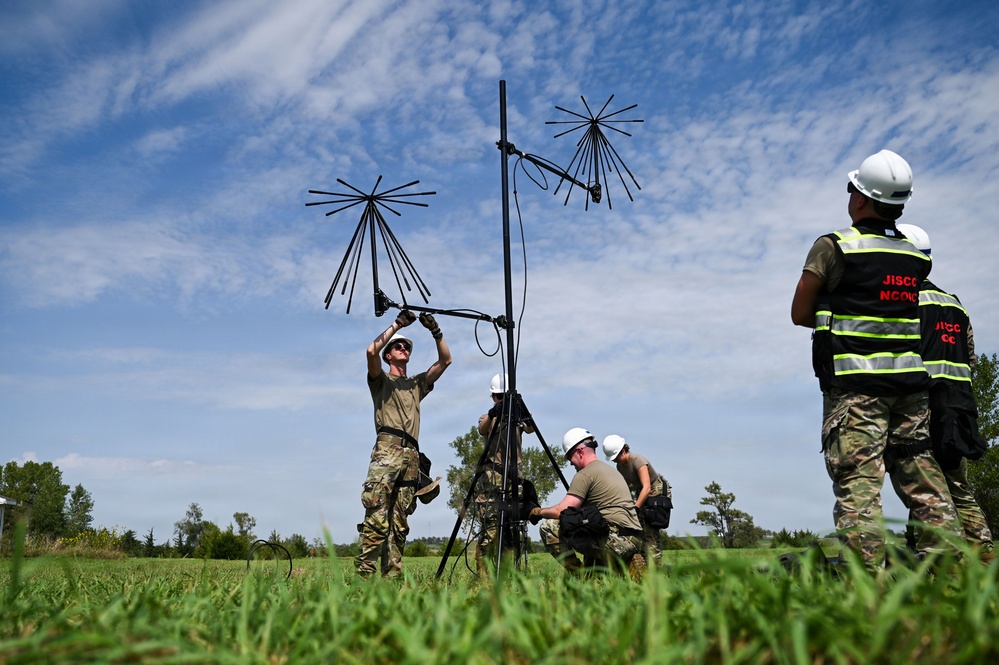
Photo By Master Sgt. Jessica Kind | Airmen assigned to the 155th Communications Squadron adjust VHF and UHF radio antennas during a disaster response exercise in Yutan, Nebraska, Sept. 2, 2026. The antennas support a cross-band communications system that allows radios from different teams and responding agencies to communicate with one another, helping establish an interoperable communications network during large-scale emergency response operations. see less
| View Image Page
Nebraska National Guard strengthens disaster response readiness during exercise
YUTAN, Neb. — Approximately 250 Nebraska National Guard Soldiers and Airmen gathered at the Atlas Readiness Center near Yutan, Nebraska, Sept. 1-3, 2026, for an annual joint field training exercise designed to strengthen the Guard’s ability to respond to large-scale emergencies.
The exercise brought together members of the Nebraska National Guard Chemical, Biological, Radiological, Nuclear and High-Yield Explosive Enhanced Response Force Package, or CERFP, a joint Army and Air National Guard team trained to respond to CBRNE incidents in support of local, state and federal agencies.
During a real-world response, the CERFP provides specialized capabilities including casualty search and extraction, decontamination, medical triage and treatment, and fatality search and recovery. The exercise allowed each of those elements, along with supporting communications and patient tracking personnel, to operate as an integrated response force.
The training placed Soldiers and Airmen in a simulated disaster environment where teams had to locate and extract casualties from a hot zone, move them through decontamination and contamination monitoring, and ultimately transfer them to medical personnel for further assessment and treatment.
To make the scenario more realistic, local role players portrayed injured casualties while moulage was used to replicate injuries responders could encounter during an actual emergency.
“Fortunately, we are able to hire some local people to come and provide acting for injured patients,” said Tech. Sgt. Andrew Wheat, 155th Medical Group, Det. 1. “They put on moulage, or fake injuries, to simulate, so that we can get more experience treating the kind of patients we would see at a large-scale disaster.”
As simulated casualties progressed through the response process, CBRNE specialists used radiation detection equipment to determine whether contamination remained and whether additional decontamination was necessary.
“The PDR-77 is used for radiation point detection,” said U.S. Army Spc. Alex Cross, a CBRN specialist with the Nebraska Army National Guard. “We move it along the skin without touching it to detect any residual radiation or contamination. That lets us know if the patient needs to be sent back through decontamination.”
Once casualties cleared decontamination, members of the 155th Medical Group Det. 1 were prepared to provide the next level of care. The medical treatment area brought together providers from several specialties, including emergency and surgical nursing, respiratory therapy, family medicine, pharmacy, pediatrics and advanced practice providers.
Together, those specialties give the CERFP the ability to rapidly establish medical treatment capabilities in an affected area when additional resources are needed.
“Essentially, we can pop up an entire ER anywhere in the United States,” Wheat said. “It gives us the ability to bring medical care directly to an affected area and provide support when local resources may be overwhelmed.”
Behind the treatment process, patient tracking personnel documented each casualty as they moved through the system. Responders scanned triage tags and identification while recording information ranging from medical status and emergency contacts to the patient’s next destination.
“Patient tracking allows us to maintain accountability throughout the entire process and make sure we know where each patient is and where they need to go next,” said Master Sgt. Sasha Zubia, operations noncommissioned officer, 155th Medical Group.
While medical and response personnel worked directly with casualties, members of the 155th Communications Squadron established the communications infrastructure needed to connect the different elements of the response.
VHF and UHF radio antennas supported a cross-band communications system capable of connecting radios used within the National Guard’s response footprint with those operated by other responding agencies. This interoperability becomes particularly important during a CBRNE response, when military personnel may be operating alongside multiple local, state and federal partners.
“It allows us to take radios from within our footprint and from other agencies, bring them all together so everybody can talk to everybody,” said Staff Sgt. Kierra Green, communications specialist, 155th Communications Squadron. “It ensures different teams and agencies can communicate effectively during a large-scale response.”
The communications team also trained with recently upgraded equipment housed within its response trailer. The upgrades allow personnel to transport their equipment and operate directly from the trailer, providing a more effective workspace while establishing and maintaining communications for the response force.
Beyond validating equipment and procedures, the exercise provided newer team members an opportunity to gain hands-on experience and build proficiency ahead of future evaluations.
“We have a relatively new crew,” said 2nd Lt. Joseph Watson, flight commander, 155th Communications Squadron. “Myself and a handful of these guys are pretty new to the team, so for some of us, this is our second or third time hands-on with the equipment.”
The exercise is one of approximately two exercises conducted by the response force each year, with one typically serving as an evaluation in which National Guard Bureau evaluators assess the team’s ability to perform its assigned mission.
The exercise also represents one part of a broader National Guard effort to maintain trained and ready CBRNE response forces capable of supporting civil authorities when local resources are overwhelmed.
Although approximately 250 personnel participated in this year’s exercise, the National Guard’s overall disaster response capability can expand significantly when additional response elements are activated.
“When combined with the additional elements of the Homeland Response Force, the total response package can include approximately 800 personnel,” Wheat said.
The annual training gives Soldiers and Airmen across multiple specialties an opportunity to practice operating as one integrated response force before those capabilities are needed during a real emergency.
Each simulated casualty, radio check, contamination scan and patient movement provides another opportunity to strengthen coordination across the team. By repeatedly exercising those capabilities together, the Nebraska National Guard works to ensure its personnel, equipment and expertise can be rapidly brought together to support local, state and federal partners and help save lives when disaster strikes.

 Subscribe






