
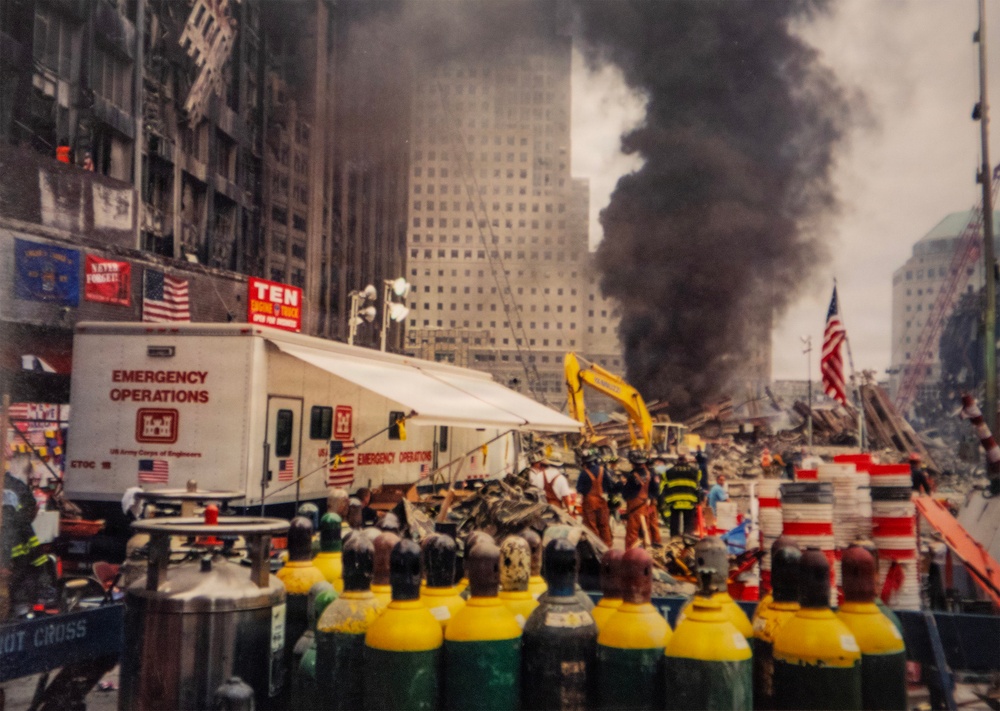
Courtesy Photo | A U.S. Army Corps of Engineers emergency operations trailer is seen near the site of...... read more read more
OMAHA, Neb. – The images of Sept. 11, 2001, are familiar to generations of Americans - the collapsing towers, the smoke rising over lower Manhattan, firefighters moving toward the devastation and the massive recovery effort that followed.
Less visible was the enormous logistical operation required to keep the disaster response moving.
The following accounts are from Marilyn Mikula and Dave Holley, two U.S. Army Corps of Engineers, Omaha District employees, who shared their experience as first recorded in December 2001 from an assignment unlike any they had experienced before.
They are among seven U.S. Army Corps of Engineers, Omaha District employees to support search and recovery efforts whose experiences are being highlighted again today as part of a short series in recognition of the 25th anniversary of the September 11th attacks. The attacks claimed 2,977 victims and required one of the largest disaster response efforts in U.S. history.
Both deployed shortly after the attacks and supported the Federal Emergency Management Agency, the New York City Fire Department and other agencies involved in the search and recovery effort.
Today, Mikula and Holley are retired from the Omaha District. Their memories, however, provide a lasting perspective on an extraordinary time in our nation’s history.
Making sure the mission could continue
Mikula worked the night shift for 19 days, often putting in 14-hour days. As a member of the Northwestern Division Logistics Planning and Response Team, she was part of a team mobilized by FEMA to provide logistical support to New York firefighters.
She worked from the Command Center of the Deployable Tactical Operations System, or DTOS, which included motor homes and semi-based trailers positioned around Ground Zero.
Her responsibilities were varied.
She answered phones, provided firefighters with supplies, dealt with problems as they arose, ensured personnel had working radios and backup batteries, escorted official visitors around Ground Zero and served as team leader for two nights.
For Mikula, the assignment was a natural extension of her Navy Reserve experience and commitment to service. “I found my new position a challenge and one that I was able to accomplish with satisfaction and pride knowing that what I did made a difference during a disaster,” she wrote in her original account.
Holley had a similar mission, although his particular responsibility centered on communications and equipment. He worked with the DTOS team from Mobile, Alabama, which included an Emergency Tactical Operations Center, Emergency Command and Control Vehicle, Emergency Support Vehicle, Regional Response Vehicle and satellite communications equipment.
His job was to make sure the technology inside those vehicles continued to function.
“My job was to make sure that the phones, fax machines, satellite copy machines, and all other equipment in these vehicles were working at all times,” Holley wrote.
At Ground Zero, keeping the equipment working was anything but routine.
“Due to the major mess that surrounded us, this was a 24/7 job,” he recalled. “We always had phone lines cut by passing cranes and falling debris.”
The Corps team worked for FEMA and supported the fire department in whatever way was needed.
“Anything they needed - from water, to generators, to flashlights, to rope — we tried to get for them,” Holley wrote.
It was a simple mission statement for an extraordinarily complicated environment: figure out what the responders needed and find a way to get it to them.
Seeing the destruction firsthand
Holley had volunteered for the assignment, but leaving his family was difficult.
“The hardest thing for me to deal with was the unknown,” he wrote.
He and his family knew little about what awaited him in New York.
“I couldn’t tell them anything, because we didn’t really know anything,” he recalled.
His family remained supportive, knowing he had a job to do. Once he arrived, however, the reality of the destruction was impossible to miss.
“I was in sheer amazement just knowing that I was looking at a 210-story building in such a pile,” Holley wrote. “The surrounding area was total destruction.”
Mikula also remembered the overwhelming scale of the response and the people who were working around the clock.
“The city totally bonded by working together, side-by-side, knowing the huge amount of work and long hours that still lie ahead for all,” she wrote.
For both, the people became as memorable as the physical destruction.
Mikula recalled hearing stories from firefighters and other workers and being moved by the courage she witnessed.
“I listened to many stories and was touched by the courage displayed by so many people,” she wrote.
A city that wanted to help
One of the strongest memories Mikula carried home was the gratitude shown by New Yorkers.
At the beginning of each shift, workers would drive into Ground Zero and see citizens lining the streets with banners and American flags.
“The gratefulness displayed by the citizens of New York to the workers of ‘Ground Zero’ was overwhelming,” Mikula wrote. “Everyone wanted to help anyway they could.”
That spirit appeared in many forms.
The Salvation Army and Red Cross provided food, drinks, warm clothing and other assistance to workers.
Celebrities also joined the effort, with actors including Harrison Ford, Joel Gray, Bernadette Peters and Candice Bergen making appearances.
Holley had his own memorable encounter with a New Yorker - this one as he was preparing to leave the city. At the airport, six hours before his scheduled flight home, a ticket agent initially couldn't find his reservation. Holley explained that his flight wasn't scheduled until 5:30.
The agent told him how grateful they were to have people like him helping in New York. Eventually, she handed him his ticket and told him to hurry to the gate.
Holley was puzzled.
“What’s the hurry? I don’t leave for six hours,” he recalled saying.
Her response: “No, you leave in 6 minutes.”
The agent had placed him in first class for the flight back to Omaha.
“That’s something I will never forget,” Holley wrote.
It was a small gesture, but it reflected something both employees saw repeatedly during their time in New York: people wanted to express their gratitude to those who had come to help.
Twenty-five years later
At the time they wrote their accounts, Mikula and Holley were describing an experience that was still fresh - the sights, the sounds, the long shifts and the uncertainty of those first weeks after Sept. 11, 2001.
Twenty-five years later, Mikula and Holley’s accounts remain a testament to the many people who answered the call after Sept. 11. As Holley put it, the assignment was ultimately defined by two things: tragedy and the opportunity to help.
“This was a very rewarding experience for me,” he wrote. “It was a tragedy, but we were able to help.”
| Date Taken: | 09.09.2026 |
| Date Posted: | 09.10.2026 12:46 |
| Story ID: | 574294 |
| Location: | US |
| Web Views: | 22 |
| Downloads: | 0 |

This work, Looking back at Ground Zero, Part 2: Personal accounts of Omaha District employees who joined disaster response following the 9/11 attacks, by Delanie Stafford, identified by DVIDS, must comply with the restrictions shown on https://www.dvidshub.net/about/copyright.

No keywords found.





