
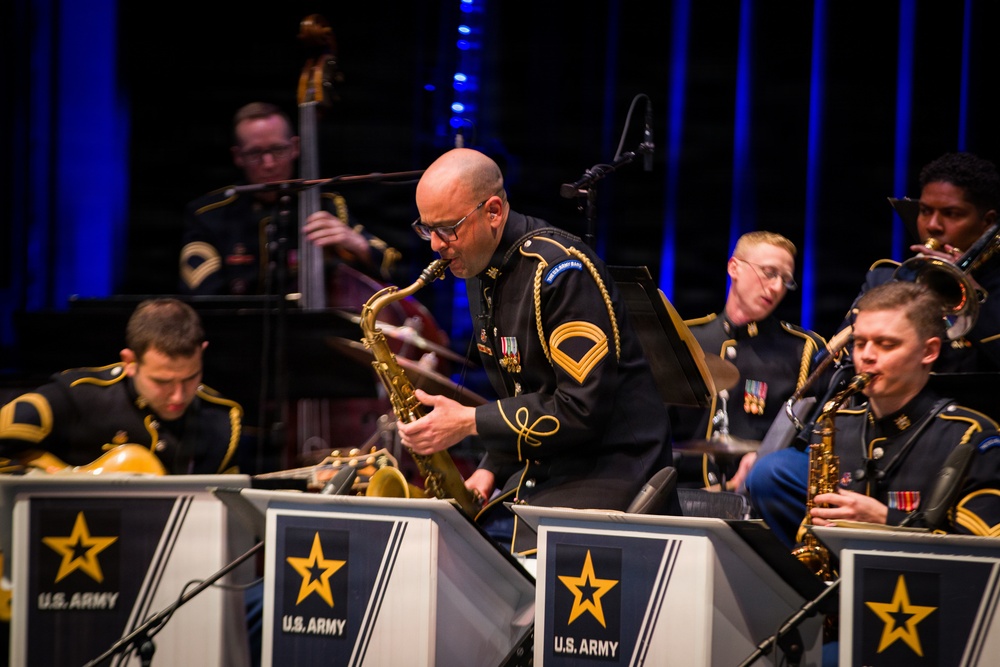
Photo By Sgt. 1st Class Gabriel Bacewicz | U.S. Army Master Sgt. Xavier Perez performs a saxophone solo at The Trump Kennedy...... read more read more
 Subscribe
by Thom Hawkins
In 1957, Miles Davis and his ensemble scored the French film “Ascenseur pour l’echafaud.” While Davis did devise some harmonic themes in advance, the music was largely improvised and recorded over only two days. The director, Louis Malle, screened relevant segments of the film for the quintet, who translated the mood into musical accompaniment. The result is hauntingly beautiful and fits the film perfectly, responding in real time to what is happening on the screen.
Garry Shields was a jazz photographer in the San Francisco Bay area photographing many of the greats in clubs, concerts and improv sessions, but now he has another job. “I started my life here as a photographer,” said Shields from his office at the Naval Surface Warfare Center, Carderock Division. “I don’t have a degree. I’m not a scientist or an engineer, but I founded one of the most effective think tanks in the Department [of War] and one of the few that crosses all services and all of government.” He’s referring to the Disruptive Technologies Laboratory, of which he is the director. “For years, I’ve been the guy in the basement who was thought of as crazy. Now they have me training people to be crazy.”
Shields hosts a regular event, “The Improv Studio,” for a cross-section of interested parties, bringing in speakers to discuss how they became persistent disruptors, agnostic to discipline—people who bring impactful changes to their work and life. These events demonstrate to participants the role that improvisation and innovation play in technological progress. For example, one guest, Lonnie Johnson, worked at the Navy and the National Aeronautics and Space Administration (NASA), and has made significant engineering contributions to solar power and batteries. Johnson is probably best known for inventing the key technologies behind the SuperSoaker and Nerf Blaster toy lines, discoveries made while working on a prototype heat pump. Another former guest, Eric Rosenthal, built his reputation by engineering audio and visual systems for news-oriented shows into a role as the vice president of research and development at Walt Disney Imagineering. Today, he runs a company that builds cutting-edge sensor and display technology for various U.S. Government agencies, including NASA, the Defense Advanced Research Projects Agency and the Office of Naval Research.
Innovation and improvisation are rarely the norm in business or government because they require releasing control over the outcome of a situation. Leadership is a difficult quality to measure, so we substitute it with management—or control. There is chance involved when we innovate and improvise, but uncertainty means not only the threat of a negative outcome, but also the opportunity for a positive one. Being prepared to respond to uncertainty in real time gives us greater agency to influence the outcome.
Collective Improvisation
In 1960, Ornette Coleman released an album that turned jazz on its head. Free Jazz: A Collective Improvisation broke away from the idiomatic mode of jazz, where musicians referenced familiar melodies. Without an assigned leader to facilitate or melodic reference points for transitions between players, musicians broke away from known methods and pushed their instruments to make new sounds. Coordination between players required heightened focus, listening not for a cue to take one’s turn to guide the musical journey, but to find a new, emergent structure as they improvised.
An 1871 essay on military strategy by Helmuth von Moltke states that “No plan of operations extends with any certainty beyond the first encounter with the main enemy forces.” Mike Tyson later pithily re-stated the idea as “Everyone has a plan until they get punched in the mouth.” Despite the oft-quoted wisdom, we prepare for war as choreography. Battle plans are drawn, doctrine meticulously detailed and equipment, weapons and software manuals issued to warfighters. Schoolhouses teach the military decision-making process as a formal structure with defined roles and responsibilities, such as analyzing the mission received and developing and evaluating courses of action. For a new officer, this construct can help learn how to think through a problem and evaluate potential solutions. Still, it is not a sustainable technique as one approaches the front lines. Time to act and standoff distance have a linear relationship—the closer one is to the action, the less time there is to think and plan.
The practice of collective improvisation is not limited to jazz. Studies of emergency response have found flaws in a hierarchical command-and-control structure, as the uncertainty and rapid change during an emergency challenge the ability to plan and adhere to hierarchy. In emergency response, unexpected circumstances call for improvisation. In other circumstances, improvisation is using ordinary items in unconventional ways to achieve outcomes.
MacGyver It
In the 1980s television series MacGyver, the title character uses his engineering know-how, his pocketknife and items he finds in his immediate environment to improvise solutions, often saving his own life and others in the process. We equip our Soldiers with more than a pocketknife, duct tape and gum. Instead, our focus is on precious solutions designed to fulfill a specific employment concept. While ensuring we have the best-equipped warfighters is a laudable goal, the particular training required to use this technology may preclude those equipped from learning to use the materiel in ways other than those for which it was designed.
Shields refers to this as creating permission structures. “We started training Marines how to build improvised systems in the field with materials that they find there. This says, ‘Hey, I don’t need a factory. I can convert the beach itself into the factory floor and fight from the beach.’ ”
Understanding the commander’s intent at the higher echelon is essential to understanding how your unit fits into the larger plan and how it impacts other units at your echelon. Likewise, knowledge of your resources—the people and things available to you—will not only inform initial planning but also build flexibility into the execution of the plan. For example, Gen. George S. Patton’s plan in 1944 was to push into Germany to defeat the Nazis; however, when the 101st Airborne Division was surrounded in Bastogne, his knowledge of his resources enabled him to modify it. He pivoted his entire Army 90 degrees, pushed for three days to rescue the 101st Airborne Division and then continued toward Germany.
Resources should be thought of in terms of what effects they can produce, and not necessarily what effects they were designed to deliver. This can only be accomplished, however, through practice and familiarity. “You must be building a repository of exposure to new novel ideas, thoughts and technologies,” Shields said. “You must expose yourself to and participate in novel experiences and take action, producing novel artifacts.” The acquisition community views these user engagements as opportunities for testing, which require adherence to strict conditions, but this approach limits broader familiarity with the equipment.
Frank Barrett, Ph.D., jazz pianist and recently retired professor at the Naval Postgraduate School, has written extensively about how jazz improvisation can serve as a template for organizational learning. He echoes Shields’ push for “permission structure,” noting that jazz musicians have given themselves freedom to make mistakes to further learning. “If past successes create routines that drive out experimentation in organizations, there is a tendency to construe errors as unacceptable,” Barrett said. If we have found a technique that works under certain circumstances, we may encode that as the way to do things, even without regard to the circumstances that made that thing a good idea in the first place. For example, the follow distance between vehicles in a convoy might be ideal for flat terrain, but not for mountains, or else it could have been suitable until an enemy decided to exploit their familiarity with our tactics to their advantage.
All That Jazz
Jazz isn’t random. Its players know their instruments—not only how they were designed to be played or were played in the past, but also how they could be played. Jazz musicians also share a common language in time signatures and phrasing. The improvisation comes in hearing the voices individually and collectively to inform how they express that language through their instruments. A jazz group, however, cannot work as an assemblage of soloists. That would be like having a discussion where no one is listening but waiting to be heard while thinking of what they’ll say when it is their turn—no synthesis, no continuity, no symbiosis.
One of the most famous jazz improvisations ever recorded is pianist Keith Jarrett’s 1975 performance in Köln, Germany. Due to a series of miscommunications and misfortunes, Jarrett arrived at the concert hall to find a poorly maintained baby grand piano in place of the Bösendorfer 290 Imperial he requested. Urged by the promoter to go ahead with the concert, Jarrett’s famous performance consists of him collaborating with this novel instrument, the art emerging from their interaction. His recruitment of this clunky piano into a partnership, and Jarrett’s willingness to listen to his scene partner, turned a would-be disaster into one of the most treasured performances in jazz history.
In jazz, no one person “owns” the performance, nor is the performance simply the sum of the individual parts. Instead, the performance emerges from the interaction between the players. In war, as in jazz, we must allow for this emergence through preparedness—practice with our instruments of battle, listening as a group and responding to the unexpected.
Conclusion
Recent acquisition reforms include establishing bridge organizations like the Defense Innovation Unit to rapidly procure and assess new technology, increased use of flexible contract approaches, and, with 2025’s Executive Order 14265, a preference for commercially developed and supported solutions. These changes express a desire for innovation and rapid diffusion of those innovations. However, this desire runs counter to military culture, with its formal hierarchy and rigid doctrine, as well as bureaucracy—both expressions of control. The same uncertainty and time pressure that challenge emergency response apply equally to tactical operations. Control is necessary at higher levels due to the military’s vast scale. However, at lower echelons, especially when operating in isolation, the hierarchy dissipates, and the doctrine becomes abstract, irrelevant to the unfolding event.
We invest billions of dollars each year in equipment, training and maintenance. Our training centers provide excellent opportunities for units to execute a plan, while established controls limit uncertainty, stifling inspiration, innovation and improvisation. We do not afford our warfighters the same luxury of familiarity that Ornette Coleman’s collaborators had with their instruments and with each other. “When we ask people to be innovative, we don’t characterize what we’re asking them to become, to be and to produce. If you want somebody to be innovative more than once, you’re talking about a change of lifestyle,” Shields said. This is why collective improvisation should be regular practice for our units—both as teams, and with equipment—as well as our enterprise.
NOTE: The views and opinions expressed in this article are those of the author and do not reflect the official policy of the U.S. Army, Department of War or U.S. Government.
For more information, contact the author at mailto:jeffrey.t.hawkins10.civ@army.mil.
THOM HAWKINS is a computer scientist with the U.S. Army Program Manager for Command and Control Data and Artificial Intelligence. He holds an M.S. in library and information science from Drexel University and a B.A. in English from Washington College.
| Date Taken: | 08.20.2026 |
| Date Posted: | 09.10.2026 11:22 |
| Story ID: | 574283 |
| Location: | US |
| Web Views: | 29 |
| Downloads: | 0 |

This work, WAR AND JAZZ COLLECTIVE IMPROVISATION IN THE BATTLEFIELD, must comply with the restrictions shown on https://www.dvidshub.net/about/copyright.


No keywords found.




