
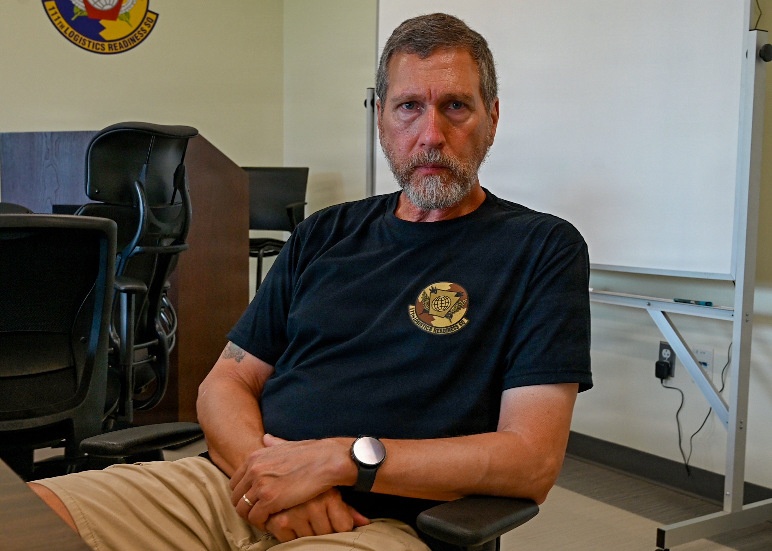
Photo By Staff Sgt. Charles Casner | Pennsylvania Air National Guard Senior Master Sgt. (Retired) Robert E. Custer III, T5...... read more read more
 Subscribe
Senior Master Sgt. Brian Curry was an A-10 Thunderbolt II crew chief at the 111th Fighter Wing.
Then a radio report changed everything.
A aircraft had struck the World Trade Center.
Curry returned to the crew chief shack and joined other maintainers around a television in the break room. They watched the smoke rising from the first tower.
Then the second aircraft struck.
“All of us at the same time, we watched the second plane hit live TV,” Curry said. The Airmen quickly realized it was not an accident.
“This is a coordinated attack,” Curry recalled one of the Airmen saying.
The installation moved to THREATCON Delta. Aircraft were repositioned across the flight line, buildings were secured and Airmen were assigned additional security duties.
“We were real-world Threat Condition Delta, I was thinking, wow, we have to react now. This is not a drill," Curry said.
Retired Senior Master Sgt. Robert Custer III was working alongside the 111th's A-10s that morning. For him, Sept. 11 began with the same sense of routine.
“We were just doing our thing, and we knew these airplanes like the back of our hand,” Custer said. “We knew our mission like the back of our hand.”
That mission soon took on a new meaning.
The 111th began preparing for a prolonged response. For Custer, that meant deployments to Afghanistan and Iraq, and years spent supporting combat operations.
“It changed everything,” Custer said.
For Chief Master Sgt. Brian Urbach, who was serving as a flightline maintainer at Tyndall Air Force Base, Florida, the attacks changed his understanding of what it meant to wear the uniform.
“I think at that point everything just became real,” Urbach said. “The definition of the job, the definition of the uniform became real at that point in time.”
The years following Sept. 11 tested that understanding.
Airmen deployed. Families adjusted to long separations. Missions evolved as the United States entered a period of sustained military operations.
Curry was a young Airman when the attacks occurred. Twenty-five years later, he sees the impact of that day through the Airmen he now leads.Some were not yet born when the attacks occurred.
“Two and a half decades have gone by,” Curry said. “Just the changes in what we've done, as a country, as a military, the deployments that we've gone on, the sacrifices people have made, it all stems from that.”
For Custer, the passage of time reinforces the importance of readiness.
“The attacks during september 11th, 2001 taught us that we need to be ready,” Custer said.
Urbach remembers another lesson from the years that followed: military service is larger than any individual.
“It wasn’t one branch fighting,” Urbach said. “It was all of us that fought together.”
Twenty-five years after Sept. 11, the Pennsylvania Air National Guard continues to serve a mission shaped by that day.
The aircraft are different. The mission has evolved. A new generation of Airmen now wears the uniform. But for those who were there, the memory remains.
For Curry, Sept. 11 is more than a date in history.
“That morning literally changed my life,” Curry said.
For the Airmen who came after, its legacy remains a reminder of the responsibility that comes with being ready for when the mission changes next.
| Date Taken: | 09.10.2026 |
| Date Posted: | 09.10.2026 10:25 |
| Story ID: | 574265 |
| Location: | HORSHAM, PENNSYLVANIA, US |
| Web Views: | 14 |
| Downloads: | 0 |

This work, When the mission changed: Airmen remember Sept. 11, 2001, by SSgt Charles Casner, identified by DVIDS, must comply with the restrictions shown on https://www.dvidshub.net/about/copyright.


No keywords found.




