
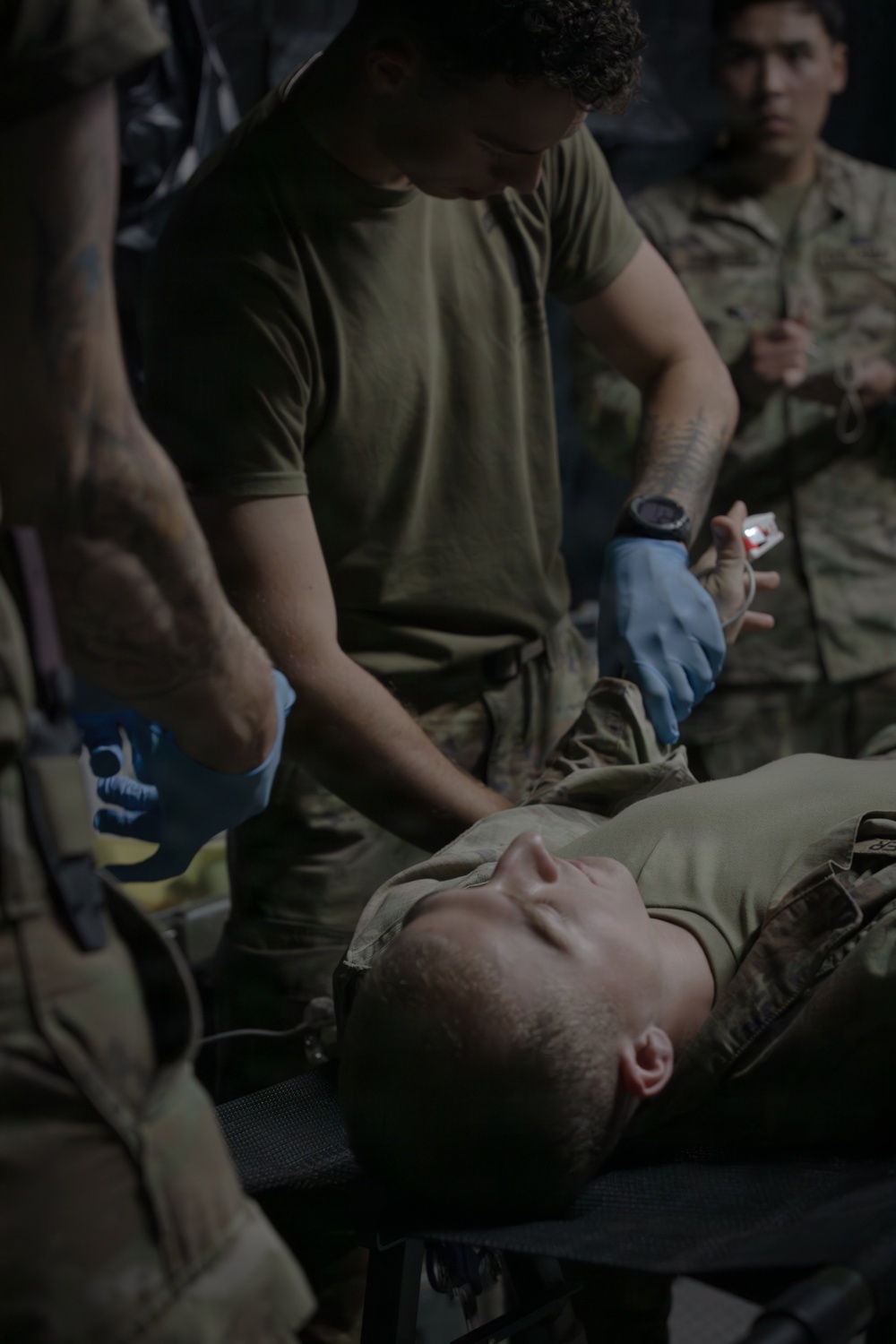
Photo By Sgt. Isaac Copeland | U.S. Army Sgt. Elijah Stringer, assigned to 725th Brigade Support Battalion...... read more read more
 Subscribe
BATURAJA, Indonesia — U.S. and multinational medical personnel performed a simulated surgical intervention and evacuation exercise during Super Garuda Shield 26 at Baturaja Combat Training Center, Indonesia, Sept. 5, 2026.
The exercise followed two simulated patients through multiple stages of care, beginning with treatment at a Role II medical facility. Role II medical facilities provide advanced trauma management, emergency medical treatment, limited patient holding and stabilization before evacuation or further care.
The simulation began with a surgical intervention by the 250th Forward Resuscitative Surgical Detachment, part of the 47th Combat Support Hospital under the 62nd Medical Brigade, before medical personnel submitted a nine-line medical evacuation request and transferred the patients to a U.S. Army crew for continued movement. In an operational environment, patients could arrive with anything from insect or snake bites, heat related illness, compound fractures, vehicle rollover injuries or gunshot wounds. Training through different simulations allows medical personnel to refine how they triage patients, determine the appropriate level of care, decide whether a patient can be treated on site, require surgical intervention or must be evacuated to a higher level of care.
“It’s given us time to rehearse with different units that are within the U.S. Army as well as our partner nations,” said U.S. Army Maj. Eric Sunwoo, an intensive care unit nurse with the 250th Forward Resuscitative Surgical Detachment. “We’re thinking through our processes, whether it’s communication systems or if it’s the actual setup of the footprint, and trying to improve on ourselves so that when we do get our real-world casualties, we can provide the best care possible.”
The exercise gave medical teams an opportunity to rehearse how they would evaluate, stabilize and respond to a wide range of injuries and illnesses before facing them in a real world emergency. For medical personnel receiving casualties at the Role II, repetition helps build proficiency and reduce uncertainty under pressure.
“The more you do it, the more proficient you become at it,” said U.S. Army Sgt. Elijah Stringer, a combat medic assigned to Bravo Company, 725th Brigade Support Battalion, 2nd Mobile Brigade Combat Team (Airborne), 11th Airborne Division. “When the time of a real patient comes, it’s not as much stress and you can just fall back on your training.”
The exercise also tested communication and transportation between different elements of the casualty care system.
Sunwoo said the teams practiced their primary, alternate, contingency and emergency communication plan while coordinating with the Air crew.
The scenario also incorporated Indonesian National Armed Forces (TNI) support. TNI personnel provided an ambulance, allowing U.S. medical personnel to learn the vehicle’s capabilities and practice loading and transporting litter patients using an unfamiliar platform.
“We’ve never used the TNI ambulances,” Sunwoo said. “But having coordinated with them, them willing to work with us, teaching us on what that vehicle capability is and then allowing our Soldiers to lift the litters into those ambulances and moving our patients as required to the helicopter, it’s a small piece of it, but even just seeing that and incorporating that into our training and our repertoire, I think is a success in this exercise.”
Although the simulated casualties were part of a U.S. scenario, personnel from partner nations observed or participated, creating opportunities to compare procedures and equipment.
Canadian Armed Forces Master Cpl. Hudson Summers said rehearsing the full process helps medical personnel rely on practiced procedures when treating an actual casualty.
“When we have a casualty and emotions start getting high, we don’t have to think so much about what we’re doing,” Summers said. “We already know exactly what we’re going to do.”
The rehearsal allowed multinational medical teams to identify differences in procedures, exchange techniques and strengthen coordination across the force, helping ensure they can deliver faster, more effective care when a real-world emergency occurs
Super Garuda Shield 26 provides participating medical forces with a controlled environment to test those systems before they are needed in an emergency. By rehearsing casualty care from initial treatment through evacuation, U.S. and partner nation personnel can strengthen interoperability, improve medical readiness and build confidence in their ability to move patients through the appropriate levels of care across a multinational force.
| Date Taken: | 09.09.2026 |
| Date Posted: | 09.10.2026 07:55 |
| Story ID: | 574251 |
| Location: | ID |
| Web Views: | 12 |
| Downloads: | 0 |

This work, Multinational Medical Teams Rehearse Casualty Care During Super Garuda Shield 26, by SGT Isaac Copeland, identified by DVIDS, must comply with the restrictions shown on https://www.dvidshub.net/about/copyright.


No keywords found.




