YUMA PROVING GROUND, Ariz. - Joint-forces students attending the Military Free Fall School are reaching new heights as they qualify in advanced high-altitude insertion techniques at one of the Army’s toughest advanced courses.
The Military Free Fall School (MFFS), located at the U.S. Army’s Yuma Proving Ground in Arizona, is an elite joint-forces institution operated by the U.S. Army John F.Kennedy Special Warfare Center and School. The school trains special operations forces in critical infiltration skills, including high-altitude low-opening (HALO) and high-altitude high-opening (HAHO) parachuting.
“We train Department of War and other agencies’ personnel to conduct airborne infiltrations,” said Sgt. Maj. Zachary Achziger, MFFS’ senior enlisted leader under the 2nd Special Warfare Training Group (Airborne).
The military free-fall program traces its roots to March 1957 when the 77th Special Forces Group at Fort Bragg, North Carolina, conducted the first basic body-stabilization free-fall course.This evolved into the formal HALO project in 1958. The official Military Free Fall School graduated its first class at Fort Bragg on Aug. 13, 1971, before moving operations to Yuma Proving Ground.
Students from across the military services master one of the most demanding skills in the military. The students learn advanced parachuting techniques and tactical infiltration methods to jump into sensitive areas undetected from altitudes up to 25,000 feet.
“This course gives an operator the skill set of airborne infiltration that allows geographic combatant commanders more flexibility on how to employ special operations forces,” Achziger said. “It gives those geographic combatant commanders options to extend their range to infiltrate someone into far away areas.”
To qualify for attendance, students must be a graduate of basic U.S. Army Airborne School, hold a designated free fall-coded position, such as special operations, select riggers, or approved allied Department of War personnel and meet strict Class 3 flight physical and medical standards for high-altitude oxygen use.
Before climbing aboard an aircraft, students begin their training by packing their main parachute, while qualified riggers pack the reserve parachutes.
Next, students learn the fundamentals of body position and stability during training in a controlled environment as they learn to fly their bodies in the Master Sgt. George Bannar Vertical Wind Tunnel.
The presence of the vertical wind tunnel, which opened at Yuma Proving Ground in early 2014, has become a crucial tool for students who attend the course.
The 16.5-foot tunnel allows students to practice maintaining a stable body position and learn how to make small adjustments with their arms and legs and, ultimately, gaining the muscle memory needed once they jump from an aircraft.
The progression is deliberate. Students learn how to control their bodies, then practice those skills in a simulated environment before taking them into the air.
“The wind tunnel allows us to give students increased time with training their free fall skills before their first jump and as a tool for remedial training,” Achziger said. “It has also increased our overall capabilities to train without having to use an aircraft.”
For Sgt. Maj. Matthew Krueger, an instructor at the school, he said that the wind tunnel is a great training tool.
“With it, the students are able to recover from tumbling much faster and gets them ready for the harder parts of the course when we introduce equipment,”he said.
After mastering the basics of free fall in the wind tunnel, the students make their first jumps with a highly skilled instructor.
During the four-week course, instructors evaluate students aircraft exit to landing on the drop zone.
Students make most of their jumps from the C-27J Spartan, a smaller cargo plane that uses the same engine as its larger cousin, the C-130 Hercules. Jumps are conducted from altitudes ranging from 9,500 to 25,000 feet, depending on the training requirement.
To qualify for the course, a prospective student must have completed at least five static line jumps, though most students have completed more.
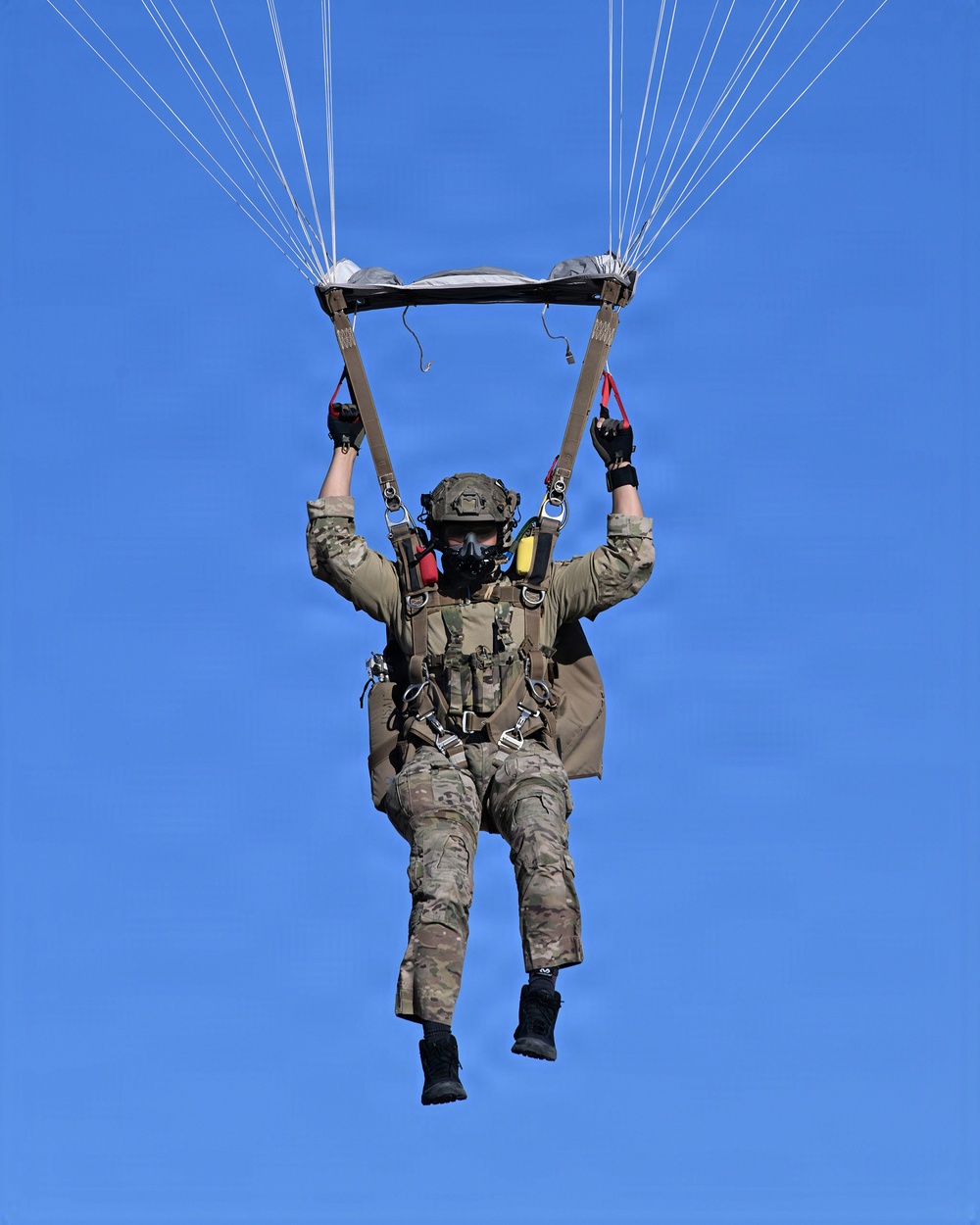
The course exposes students to a variety of equipment and conditions. They practice jumping with and without weapons and combat equipment, as well as with night vision goggles and supplemental oxygen. They conduct jumps during both daylight and nighttime conditions, requiring them to apply their skills while adapting to various wind conditions and changing environments.
“The students add one piece at a time and get evaluated throughout the course before moving to the next graded exercise,” Achziger said. “They are graded on everything - slick jumps, combat equipment, night jumps, everything.”
Achziger said that following the jumps they move into the grouping phase.
“Then they learn and train on weapons integration,” he said. “Also, during the grouping phase, students train for “stand-offs,” which include high-altitude high opening jumps during both day and night conditions.”
After jumping, students execute free-fall techniques before deploying their parachutes and descending toward Phillips Drop Zone at Yuma Proving Ground. Instructors have the ability to talk to students on two-way radios to assist them on how and where to land.
By the completion of the Basic Military Free Fall Course, students will have developed the foundation needed to conduct military free-fall operations from high altitude, while using the specialized gear required for operational missions.
The school also trains and qualifies select students for the Military Free Fall Jumpmaster Course, the Advanced Tactical Infiltration Course and the Military Free Fall Instructor Course.
Those with higher levels of free-fall experience can return to Yuma Proving Ground and attend the Advanced Tactical Infiltration Course, which focuses on HAHO, navigation, complex mission planning, and execution under canopy.
The Military Free Fall Instructor Course selects elite, seasoned operators with hundreds of jumps to earn a rare Department of War instructor rating, so that they can forge the next generation of free-fall service members.
“For Green Berets, Air Force special operations, Marine special ops and Navy SEALs, it’s a unique method to get to work,”Krueger said. “It’s a great infiltration technique, especially for an ODA [Operational Detachment Alpha] where they can exit an aircraft, fly together in a group in a standoff, and land on target ready to carry out a mission.”
| Date Taken: |
09.09.2026 |
| Date Posted: |
09.09.2026 18:57 |
| Story ID: |
574224 |
| Location: |
US |
| Web Views: |
16 |
| Downloads: |
0 |
PUBLIC DOMAIN

This work, Free fall school trains students in high-altitude infiltration, by K. Kassens, identified by DVIDS, must comply with the restrictions shown on https://www.dvidshub.net/about/copyright.

 Subscribe






