
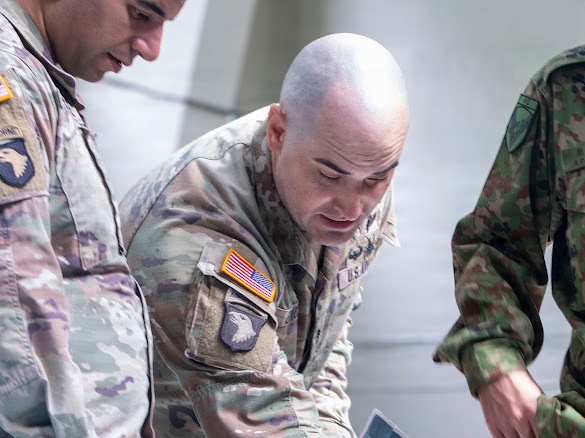
Photo By Sgt. Sherald McAulay | U.S. Army, Australian and Japanese soldiers prepare to conduct a Combined Arms...... read more read more
 Subscribe
NORTHERN HOKKAIDO, Japan— Soldiers from the 11th Airborne Division employed artificial intelligence enabled tools across the battlefield during Yama Sakura 91, a trilateral exercise with Japanese and Australian forces, demonstrating how emerging technology can increase lethality, accelerate decisions and give commanders an advantage in high tempo operations.
Set in the demanding terrain of northern Hokkaido, the exercise tested the division’s ability to fight, sustain and synchronize combat power across a multinational force. For the 11th Airborne Division, artificial intelligence was not a future concept or back office experiment. It was a battlefield enabler used to help commanders see faster, decide faster and strike with greater precision.
Across the division, AI tools supported intelligence analysis, fires and sustainment. The cumulative effect was a faster, more integrated formation able to process information at speed, reduce friction and generate combat power more efficiently.
In the division intelligence section, planners used a large language model to ingest orders, unit dispositions and enemy reporting, then brief each warfighting function in real time. That allowed the staff to move beyond stove piped inputs and operate from a shared understanding of the fight.
“The large language model ingested every order, unit disposition, and piece of enemy intelligence and then briefed each warfighting function in real time,” said LTC Joe Henderson, Division Intel Officer. “That single, holistic common operating picture allowed us to see the enemy’s effects and our own opportunities far faster than traditional methods, sharpening targeting and battle-space awareness across the division.”
That speed matters in combat. By fusing operational data into a common picture, the division was able to identify opportunities faster, synchronize effects across warfighting functions and reduce the time required to translate information into action. In a contested environment, that kind of advantage can mean the difference between seizing the initiative and surrendering it.
Within the fires enterprise, AI gave the division a faster way to assess effects and refine follow on engagements. As after-action reports flowed in from U.S., and AI tools parsed the reports, flagged damage indicators and helped staffs confirm results at a pace that manual methods could not sustain.
“AI-enabled battle damage assessment finally kept pace with the volume of after-action reports coming from three nations,” said LTC Nigel Cook, Division Fires Officer. “By automatically parsing the data and flagging damage indicators, the tools compressed the time between strike and confirmed assessment, shortened the kill chain, and increased the accuracy of subsequent fire missions.”
For fire supporters and commanders, compressed battle damage assessment means more than efficiency. It means faster confirmation of effects, quicker reattack decisions and more precise employment of combat power. By shortening the kill chain, the division improved its ability to maintain pressure on the enemy and exploit windows of opportunity before they closed.
Lethality on the battlefield also depends on whether the force can sustain momentum. To support that requirement, the division G-4 partnered with the Gallatin team to field “Navigator,” an AI application that maintained a near-real-time inventory picture, generated load plans and built logistics packages while identifying anomalies in logistics status reports.
“Navigator transformed how we manage the fight’s logistics,” LTC Jessica McCarthy Division Sustainment Officer. “By maintaining a near real time inventory picture, auto generating load plans, and building LOGPACs on the fly while flagging anomalies in every LOGSTAT, the AI cut our processing time dramatically and virtually eliminated human error. Combat units received fuel, ammunition, and rations exactly when and where they needed them — even under the high tempo conditions of Yama Sakura 91.”
In combat operations, sustainment is combat power. Units that cannot be resupplied cannot maintain tempo, mass effects or exploit success. By reducing delays and improving accuracy in logistics planning, the division strengthened its ability to keep maneuver forces armed, fueled and in the fight.
Yama Sakura 91 demonstrated that artificial intelligence is already changing how formations fight. For the 11th Airborne Division, AI improved battlefield awareness, accelerated targeting, compressed assessment timelines and strengthened sustainment. Those advantages gave the division a sharper edge in a fast moving, multinational fight.
For Soldiers, the benefits were immediate and practical: better decision-making, faster support, clearer understanding of the battlefield and more responsive systems behind the fight. In a large scale combat environment, those gains translate directly into more credible combat power and a more lethal formation.
As the Army continues to prepare for future conflict, the lessons from northern Hokkaido are clear. Artificial intelligence is no longer an experimental add on. It is a force multiplier that can help commanders generate tempo, maintain pressure and deliver combat power at the time and place of their choosing.
| Date Taken: | 09.09.2026 |
| Date Posted: | 09.09.2026 19:34 |
| Story ID: | 574216 |
| Location: | US |
| Web Views: | 65 |
| Downloads: | 0 |

This work, 11th Airborne Division uses AI to increase lethality during Yama Sakura 91, by Correy Mathews, identified by DVIDS, must comply with the restrictions shown on https://www.dvidshub.net/about/copyright.

No keywords found.




