
Photo By Scott Sturkol | Former Afghan guests who were at Fort McCoy, Wis., for Operation Allies Welcome from...... read more read more
 Subscribe
When several young Afghan women arrived at Fort McCoy on Aug. 19, they were no longer the teenagers who had stepped off buses here five years earlier.
They were now young women in their early 20s, college students living in another state, and building lives in a new country. But as they pulled up to one particular brick building at Fort McCoy, something from their past came rushing back.
“The energy in the car totally changed,” said Jane Donaldson, a Tomah, Wis., business owner who accompanied the women on their return visit. “Because that’s like a very distinct memory for them.”
The building was part of the Fort McCoy facilities where the young women had lived during Operation Allies Welcome, the six-month humanitarian mission that brought approximately 12,600 Afghan guests to Fort McCoy beginning Aug. 22, 2021.
Five years after their arrival, several women had returned to the installation for the first time. Their visit offered something unusual — a chance for people who experienced Operation Allies Welcome as teenagers to see Fort McCoy again as adults — and to see a place that once represented uncertainty and transition from an entirely different perspective.
“It perhaps gave some closure to that particular time, just to see it again,” Donaldson said. “You know how when you go back and see something … it gives you a newer perspective.”
From Afghanistan to Wisconsin
The women were among thousands of Afghans evacuated from their country in 2021 as part of Operation Allies Welcome. According to the Feb. 25, 2022, end-of-mission report by the Fort McCoy Public Affairs Office, Fort McCoy began receiving Afghan guests Aug. 22, 2021, and ultimately supported approximately 12,600 people during the mission. More than 4,000 people representing 35 federal, state, local, non-governmental, and volunteer organizations participated in the operation.
The women who returned to Fort McCoy in August 2026 were teenagers when they lived here. Donaldson said the women came from Afghanistan’s Bamyan region, an area she described as having a particularly difficult history for women and girls.
“They’re in their early 20s,” Donaldson said. “So, they were babies or born … after we started building back the government. So, they had a very different experience than their mothers who were there during the height of Taliban.”
Donaldson said that experience shaped the young women and their hopes for the future.
“These young women … are so much the hope for Afghanistan,” she said.
The women eventually received scholarships and continued their education at universities in the United States. Donaldson said other young women from the same group went to colleges in several states.
For two of the three who returned to Fort McCoy, however, their connection to the place where their American journey began remained.
A connection that began during OAW
Donaldson’s involvement with the Afghan guests began during the operation. She said she traveled to Fort McCoy once or twice a week for the duration of the mission, working with women and children at one of the community centers established throughout the temporary Afghan guest area.
It was there that Donaldson developed relationships with several young women. One woman became an important connection. Donaldson described her as a “fabulous interpreter” who also served as a leader among the women.
Donaldson said the group included approximately 144 women who had been sponsored by the Cindy McCain Humanitarian Initiative. Her involvement with Afghanistan also predated Operation Allies Welcome by nearly two decades.
Donaldson said she traveled to Afghanistan in 2003 while living in France and worked with a French-Afghan group during the constitutional convention process.
She later returned to Boston University for three months to study international public health and said that, because of her experience in Afghanistan, she frequently focused on the country during her studies.
Later, while living in Paris, Donaldson said she helped host 30 of Afghanistan’s 69 female parliamentarians for a week, taking them to the French Senate and National Assembly. Those experiences gave Donaldson a longstanding connection to Afghanistan and its people.
That connection took on a new meaning when thousands of Afghans arrived at Fort McCoy in 2021.
When a military installation became home
For the Afghan guests, Fort McCoy was never intended to be a permanent home. It was a staging and processing location while they waited for documentation, family connections, and resettlement opportunities.
Donaldson said that distinction is important when people today ask what happened to the approximately 13,000 Afghans who were at Fort McCoy.
“They are everywhere,” Donaldson said.
She explained that some people stayed only a few weeks while others remained for most or all the six-month operation.
“A lot of these folks … had connections in the U.S.,” Donaldson said. “And they were just waiting for those people to connect with them and get their visas done. And then they were out of here.”
The Fort McCoy Public Affairs Office reported in February 2022 that the final Afghan guests departed the installation Feb. 15, 2022. But Donaldson's connection with some of the young women did not end when they left.
She continued communicating with several of them, occasionally talking with them by phone and maintaining connections with others who had also become involved with the women during their time at Fort McCoy.
A community reaches out
Donaldson said the connection between the Afghan guests and people in the surrounding communities became one of the most memorable parts of the OAW experience. She emphasized that she was far from the only person who became involved.
“It’s not just me,” Donaldson said. “There were several people that really connected with these young women.”
Tomah residents organized efforts to make the women feel welcome. Donaldson recalled a project in which women from Tomah assembled makeup bags for Afghan women and girls. Some people questioned whether makeup was an important thing to provide during such a massive humanitarian operation.
But Donaldson said the response from the women showed otherwise.
“When they gave out the makeup, it was so exciting for them,” she said. “I don’t know, it made them feel good about themselves.”
She said the effort was one of many examples of people in Tomah looking for ways to make the Afghan guests feel welcome.
“There are just some phenomenal women in Tomah,” Donaldson said.
The effort also reflected a larger community response to the mission.
According to the Fort McCoy’s end-of-mission reporting, local organizations, churches, businesses, volunteers and other community groups provided assistance and donations during the operation.
A difficult beginning
Donaldson remembers that the early days of OAW were chaotic. She said she was working approximately 12-hour days during the first week or so of the operation, often answering phone calls from people wanting to donate clothing and other supplies.
“I was a suitcase lady at the end of the day,” Donaldson said, recalling the hundreds of suitcases and other items involved in the effort.
The early response also included people trying to figure out how they could help.
Donaldson recalled seeing a large truckload of watermelons at the Tomah farmers market and wondering how the fruit could be delivered to Fort McCoy. She also worked with the armory in Sparta, Wis., which accepted some donated items.
Inside Fort McCoy, meanwhile, personnel were building the infrastructure needed to support thousands of people who had arrived with very little.
Donaldson recalled that many of the Afghan guests had left their country with virtually nothing.
“All of the 13,000 of them left their country with nothing,” she said. “They just loaded on a plane and left.”
News reports from the time document the enormous scale of the response, including food, medical care, education, recreation, and other support. The installation ultimately provided approximately 87,000 vaccinations, established 12 informal schools conducting approximately 70 classes per day, and helped connect more than 100 female Afghan university students with scholarship opportunities.
Seeing Fort McCoy again
The women did not initially return to Wisconsin specifically to revisit Fort McCoy. Donaldson said two of the women were coming to the Minneapolis area because a cousin was getting married.
They flew into Minneapolis and then traveled to Tomah to visit Donaldson and others who had become friends with them. Donaldson asked whether they wanted to return to Fort McCoy. They did.
The process of arranging the visit was much easier than she expected. Donaldson said she was unsure what paperwork the women might need and wondered whom she could contact at Fort McCoy. But the visit came together quickly.
“They had the plan to come up to … Minneapolis,” Donaldson said. “So, they decided to come. They flew into Minneapolis and then they drove down to Tomah to see us. And to go toward the base.”
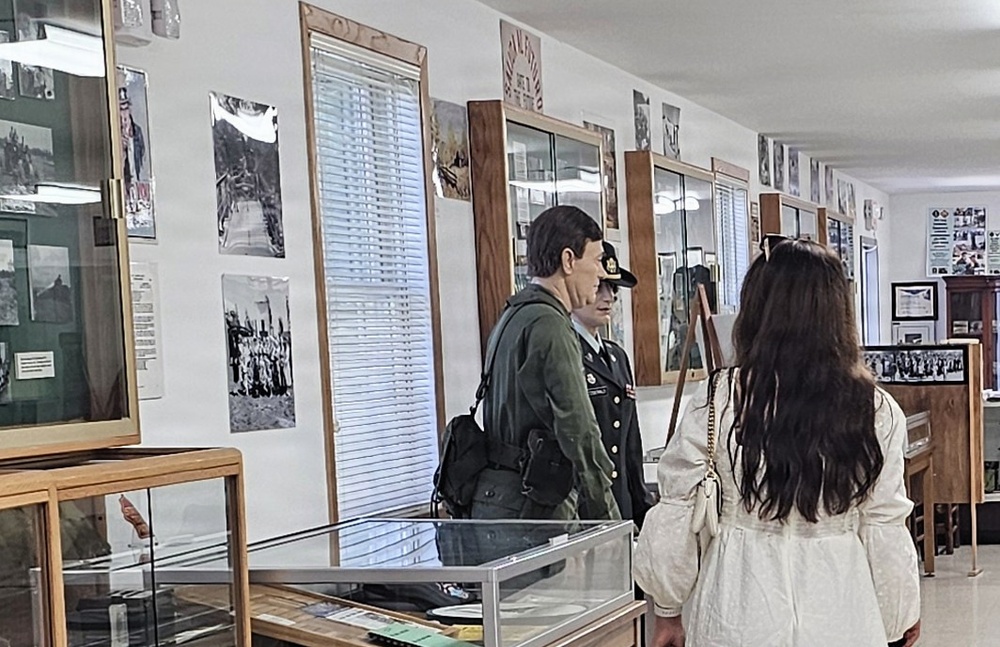
Once they arrived at Fort McCoy, Donaldson said the women were fascinated by the installation’s history as they went through the Fort McCoy History Center and the Fort McCoy Commemorative Area. But their strongest reaction came when they reached the brick building where they had lived as teenagers.
“When we pulled up to the building, the brick building, the energy in the car totally changed,” Donaldson said.
The women did not go inside, but Donaldson said simply seeing the building was emotional for them.
“They were fascinated with the history of it,” she said. “It was emotional.”
For Donaldson, the reaction illustrated how much the experience had stayed with them. Five years earlier, the building had been part of an unfamiliar military installation where they had arrived after an extraordinary journey from Afghanistan.
Now they were returning as college students.
A day beyond the gates
The return visit did not end at the Fort McCoy building. Donaldson said the women also spent time exploring the area, stopping for ice cream in Baraboo, Wis., and later taking a boat ride on the Mississippi River.
The river trip became one of the highlights of the day.
“It was a riot,” Donaldson said. “It was just so much fun.”
The women saw bald eagles and experienced the Mississippi River from a friend’s boat. For women who had once lived inside a restricted portion of Fort McCoy and had little opportunity to see the world immediately outside the installation, the day offered a dramatically different experience.
Donaldson said that when the women first lived at Fort McCoy, they often did not know where they were.
“They really didn’t see outside of their restricted area on base,” she said.
She recalled that many guests arrived and departed by bus, sometimes at night or while they were sleeping.
“So, who knows what they actually saw,” Donaldson said.
Their return was different. This time, they were not arriving as evacuees. They were visitors. They were able to see Fort McCoy, visit with people who had helped them and experience some of the surrounding region.
And they were able to return to a place that had been an important stop in their journey.
Five years, a different perspective
Operation Allies Welcome ended at Fort McCoy in February 2022. History shows that the final guests had departed and that the installation’s six-month humanitarian mission had concluded. Five years later, the mission has become part of Fort McCoy’s history.
The installation now preserves that history through its Fort McCoy History Center, where an Operation Allies Welcome exhibit helps tell the story of the people who lived and worked here during the operation.
For Donaldson, however, OAW has never simply been history. It remains connected to people she knows. She continues to communicate with several of the young women. She said another friend has traveled to Arizona to visit some of them, while one of the young women has traveled to New York to visit a friend’s daughter.
Their lives have spread across the country. Their families, however, remain a long distance away. Donaldson said the women’s mothers and sisters remain in Afghanistan, and she hopes that one day they will be able to join them in the United States.
For now, the women who returned Aug. 19 were able to revisit one small but significant part of their journey. Donaldson described Fort McCoy as “a brief respite on their journey.”
But five years later, the visit showed that the brief stop had left a lasting impression.
“I think for a lot of people to get exposed to their culture, it was” meaningful, Donaldson said.
The experience worked both ways. The Afghan guests encountered a part of America they had never expected to see. The people of Fort McCoy and the surrounding communities encountered young women whose lives had been dramatically altered by events thousands of miles away. And some of those connections lasted long after the buses left Fort McCoy.
As the women stood outside the brick building where they once lived, they were no longer simply Afghan guests awaiting the next step in an uncertain journey. They were college students. They were young women building new lives. And for a few hours, they were visitors returning to a place that had once been temporary — but had become part of their story.
For Donaldson, that was perhaps the most meaningful part of the visit.
“It was good for them,” she said. “It perhaps gave some closure to that particular time.”
Five years after Operation Allies Welcome began at Fort McCoy, the mission’s statistics remain impressive. But the return of these women offers another way to understand what happened here in 2021 and 2022. The mission lasted six months. The memories lasted much longer.
| Date Taken: | 09.09.2026 |
| Date Posted: | 09.09.2026 15:54 |
| Story ID: | 574198 |
| Location: | FORT MCCOY, WISCONSIN, US |
| Web Views: | 24 |
| Downloads: | 0 |

This work, Five years later, Afghan guests return to Fort McCoy that became part of their journey, by Scott Sturkol, identified by DVIDS, must comply with the restrictions shown on https://www.dvidshub.net/about/copyright.


No keywords found.




