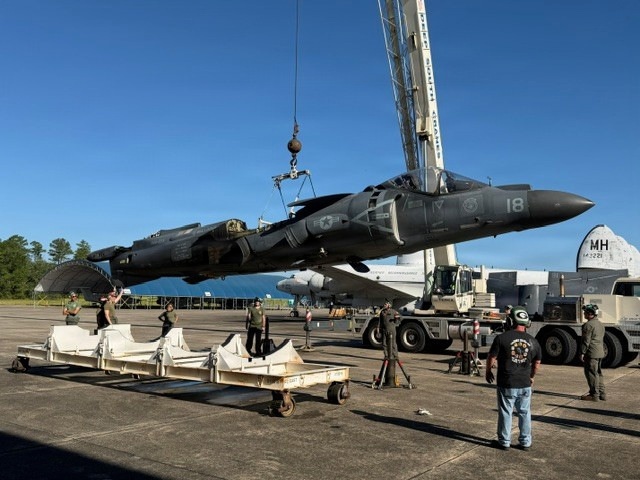
The U.S. Marine Corps’ last produced AV-8B II+ Harrier traveled to Naval Air Station Pensacola, Florida, for its final mission this July. BuNo 166288 was demilitarized and made safe for display prior to departure by truck from Marine Corps Air Station Cherry Point, North Carolina, and will remain on static display at the National Naval Aviation Museum in Pensacola.
BuNo 166288 was delivered by Boeing in September 2003 and logged over 5,800 flight hours over the years, deploying on multiple L-Class ships and land-based sites in support of combat operations.
The aircraft’s final mission and destination was organized by Pablo “Louie” Sanchez, AV-8BV/STOL Attack Program Office (PMA-257) Assistant Program Manager for Logistics (APML) and Harrier Museum Task Force Lead.
Sanchez, a retired Marine Corps gunnery sergeant who has worked on the AV-8B program since 1989 as a mechanic and later a civilian within the program office, emphasized the importance of preserving the platform’s history.
“Each aircraft has a story and BuNo 166288, being the last USMC-produced Harrier, seemed fitting to find its final home in the National Naval Aviation Museum,” Sanchez said.
The Harrier is a single-engine, vertical/short takeoff and landing (V/STOL) ground-attack aircraft. It’s 55-year service in the U.S. Marine Corps began in 1971 with the British-built AV-8A. The platform evolved significantly in 1985 when the Marine Corps transitioned to the American-built McDonnell Douglas AV-8B Harrier II. For over four decades, the AV-8B Harrier II+ served as the cornerstone of the Marine Expeditionary Unit’s Aviation Combat Element. Operating afloat from amphibious assault ships and ashore from austere forward bases, these versatile aircraft provided vital close air support for Marines on the ground worldwide.
“The arrival of the final produced AV-8B Harrier II+ at the National Naval Aviation Museum marks the end of an extraordinary chapter in Marine Corps aviation,” said Bonnie Town, National Naval Aviation Museum. “The National Naval Aviation Museum is deeply honored to preserve this historic aircraft as a lasting tribute to the extraordinary chapter of Marine Corps aviation history it represents.”
In addition to residing at the museum, the aircraft’s previously removed F402-RR-408 engine will be displayed on a separate stand. The axial-flow, twin-spool turbofan engine features counter-rotating compressors and was specifically engineered to vector thrust. This revolutionary design enabled V/STOL capabilities and in-flight power nozzle breaking – a phenomenal engineering feat.
Several squadrons operated the Harrier over its 55-year tenure, but Marine Attack Squadron (VMA) 223, the Bulldogs, was the last, completing the platform’s final official flight June 3.
As the final Marine Corps squadron to operate the AV-8B, VMA-223 commanding officer Lt. Col. John Cumbie sees the Pensacola museum display as a permanent tribute to the entire Harrier community.
“Leading this squadron through the final operational phases of the legendary AV-8B Harrier and steering our transition to the F-35B Lightning is the honor of a lifetime,” said Cumbie. “Maintaining and operating the Harrier required tireless dedication and adherence to the highest professional standards—a testament to our aviators, maintainers, and support Marines alike.”
Maj. Eric Scheibe, the squadron’s executive officer, said those high professional standards were essential for managing the unique operational demands of vertical-flight technology.
“The challenge of operating and maintaining the platform required a tight-knit culture of professionalism from the pilots to the maintainers and support personnel,” said Scheibe. “As we move forward to the F-35 transition, that culture and professionalism of Marine fixed-wing attack will live on in the individual Marine.”
For the VMA-223 Bulldog maintainers tasked with reassembling the aircraft at NAS Pensacola, the mission is deeply personal.
“After 10 years of dedication to the AV-8B Harrier platform, I am sad to see it go,” said Staff Sgt. Christian Regueira. “Working on this aircraft has been a personal blessing to me.”
The transition of the AV-8B to a static museum piece is a reflective moment for the entire Harrier community, but Gunnery Sgt. Bradley Birchfield viewed the assignment as the opportunity of a lifetime.
“As an AV-8B maintainer, by placing these legacy aircraft into the National Naval Aviation Museum it is the perfect end to my Harrier career,” said Birchfield.
While the Harrier’s close air support chapter may be closing, the transition to fifth-generation stealth fighters ensures the future of Marine aviation remains highly lethal. The solid foundation set by the Harrier community—from development to sustainment—will support the F-35B Joint Strike Fighter program for decades of future. The F-35B replaces the AV-8B Harrier with increased sensors and speed and is increasingly effective in maintaining air dominance by delivering integrated sustainment capabilities to remain mission ready anytime, anywhere—a capability paved by decades of Harrier lessons learned.
| Date Taken: |
09.09.2026 |
| Date Posted: |
09.09.2026 16:03 |
| Story ID: |
574196 |
| Location: |
US |
| Web Views: |
17 |
| Downloads: |
0 |
PUBLIC DOMAIN

This work, Last produced USMC Harrier completes its final mission, by Megan Wasel, identified by DVIDS, must comply with the restrictions shown on https://www.dvidshub.net/about/copyright.