
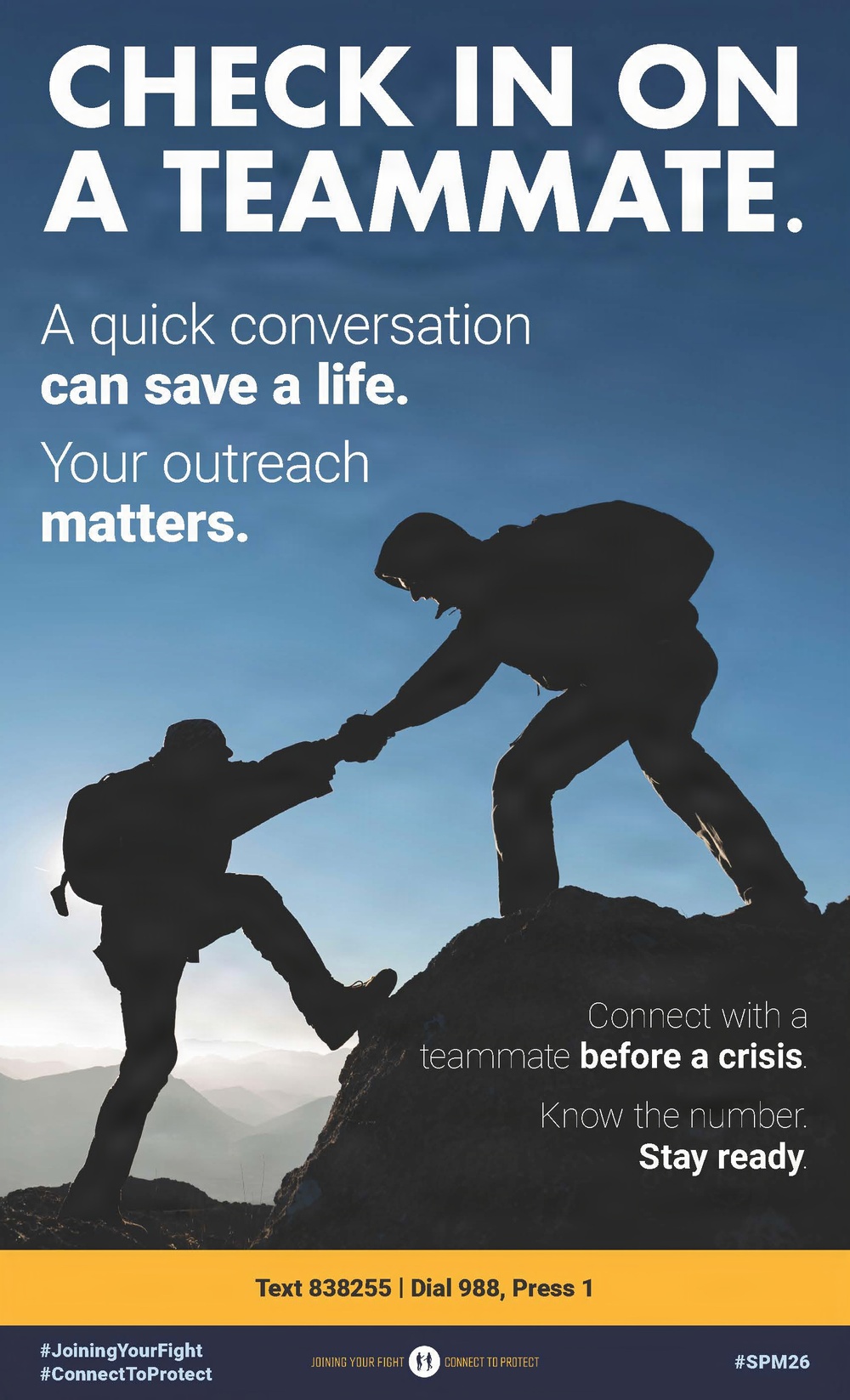
Courtesy Photo | Suicide prevention help and education are readily available at Walter Reed National...... read more read more
 Subscribe
By Bernard S. Little Walter Reed National Military Medical Center, Hospital Communications
Suicide prevention help and education are readily available at Walter Reed National Military Medical Center 24/7 for service members, families, other beneficiaries of the Military Health System (MHS) and staff members.
Walter Reed joins military communities around the globe in observing Suicide Prevention Month during September as part of the Department of War's 2026 campaign, “Joining Your Fight: Connect to Protect.” The campaign reinforces suicide prevention and response, which are vital components of optimizing the performance of the Total Force and readiness.
“Walter Reed provides multiple pathways for suicide prevention and support, including emergency and crisis response, mental healthcare, counseling, peer support, resilience services, chaplain support, training, and command outreach,” said U.S. Army Maj. Ajus Ninan, of Addiction Treatment Services, Directorate of Mental Health at Walter Reed.
U.S. Army Chaplain (Maj.) Young H. Kim, chaplain clinician and resource manager in the Department of Pastoral Care (DPC) at Walter Reed, agreed. He added that DPC staff works with other agencies across the medical center and DOW in support of suicide prevention, including Military and Family Support Center (also referred to as Military and Family Readiness Center, or Fleet and Family Support Center -- FFSC), National Intrepid Center of Excellence, inpatient and outpatient mental healthcare services, Military OneSource, Psychological Heath Resource Center, the inTransition Program, and others.
“There are also numerous resources available within the National Capital Region,” Kim said. “There is an on-call duty chaplain available 24/7 to respond to any staff or beneficiaries for any crisis that are contributing factors to suicide.”
The DPC also offers the quarterly workshops Applied Suicide Intervention Skills Training (ASIST) and safeTALK (Suicide Alertness for Everyone: Tell, Ask, Listen, [and] KeepSafe). “These workshops can also be provided at any time upon request,” Kim shared. He described the ASIST workshop as “an immersive, two-day interactive course designed to teach suicide first-aid.”
He said safeTALK is a half-day suicide alertness training facilitated by DPC to teach participants how to recognize signs of suicide and connect individuals to life-saving resources.
“There is also service-specific suicide prevention training available anytime upon request by tenant units,” Kim said. “DPC staff chaplains also offer spiritual resiliency training on various topics in partnership with the Partial Hospitalization Program (PHP) every Friday at 10 a.m.”
Preventing suicides
“One of the most effective ways to prevent suicide is to instill resiliency skills into our staff members and beneficiaries at Walter Reed to help cope with life’s challenges before they become contributing factors to suicide,” said Kim. “The Army and Navy offer workshops and retreats for service members and their families to promote effective life skills and enhance healthier relationships through CREDO -- Chaplains Religious Enrichment Development Operation, and BSRT -- Building Strong and Ready Teams, programs which are offered quarterly.”
Ninan added that suicide prevention services offered at Walter Reed also include the FFSC’s Suicide Awareness and Prevention/ACT Training. ACT stands for Ask (directly about suicide), Care (by listening without judgment and demonstrate concern), and Treat (by immediately connecting the individual to appropriate help).
“This training helps participants identify warning signs, respond to individuals who may be at risk, and locate available support resources,” Ninan explained.
“The FFSC also provides life skills education that help strengthen protective factors and address stressors before they develop into a crisis,” Ninan said. Topics covered during the classes include stress and anger management, communication and relationship skills, parenting, conflict resolution, team building, grief and loss, work-life balance, goal setting and time management.
FFSC classes are routinely scheduled and can also be offered at command locations on request, Ninan added. Commands and individuals should contact the FFSC at 301-319-4087 for dates, registration, and unit-specific training requests.
Ninan added that REACH (Resources Exist, Asking Can Help), a Defense Suicide Prevention Office facilitator-led suicide-prevention training is available online at https://www.dspo.mil/Home/Tools/REACH/.
Also, the Uniformed Services University’s (USU) Consortium for Defense Psychology (CDP) offers recurring online suicide-prevention education for mental healthcare providers, prescribing providers, and mental health technicians (MHTs), said Ninan. For more information about the CDP, visit https://cdp.usuhs.edu/training-schedule.
‘Suicide is complex’
“Suicide is complex and generally does not result from one event, one diagnosis, one job, one deployment, or military service alone,” Ninan stated.
Someone unexpectedly saying goodbye, giving away possessions, suddenly putting affairs in order or making final arrangements, warrants attention, Kim explained. If someone begins seeking access to firearms, medications or other potentially lethal means, experiencing sudden anger or violent outbursts, displaying little concern for the safety of oneself or others, these are likely indicators that a person may be in crisis and are experiencing suicidal thoughts. “Some clear indicators also include if someone is talking or writing about a wish to die, suicide, or hurting themselves.”
“Some indicators that may not be obvious include expressing feelings of hopelessness, feeling trapped, displays or expressions of guilt and/or shame, feeling like a burden, withdrawal and isolation from others, reckless and impulsive behavior, increased substance abuse, and significant stressors, including relationship, financial, health and/or work challenges, and any loss-related difficulties (death, job, etc.),” Kim added.
“What we teach at the ASIST workshop is that these are ‘invitations’ for others to be caring enough to explore,” Kim said. “Anything can be an invitation of a person with thoughts of suicide for others to approach and explore what that invitation is all about. It’s better that someone explore an invitation and confirm it’s not suicide than not explore and face the consequences of losing someone to suicide.”
Ninan agreed, adding, “Most, but not all, people who die by suicide exhibit warning signs. Do not wait for certainty. If something does not seem right, check in and ask directly.”
He urged people to ask those for whom they have a concern, “Are you thinking about killing yourself?” “Are you thinking about ending your life?” “Do you have a plan to hurt yourself?”
“Asking directly about suicide does not put the idea in someone’s head. A supportive conversation can help the person express what they are experiencing and get help,” Ninan said.
“Care, remain calm, listen without judgment, express concern, and tell the person that help is available,” Ninan said. “Do not leave the person alone. Call 911 if there is immediate danger, if a weapon is present, if a suicide attempt is occurring, or if the situation is potentially life-threatening. Call 988, then press 1, or text 838255 for the Veterans/Military Crisis Line. Escort or connect the person to emergency care, a medical professional, mental healthcare provider, chaplain, trusted leader, or qualified crisis support, and continue to check in after the immediate crisis.”
“Be a listening ear with non-judgmental attitude to assure the person that they are not alone and that you care and help is available,” Kim agreed.
Don’t wait; suicide is preventable
“Don’t wait until you encounter someone thinking about suicide to gather various resources,” said Kim. “We can get closer to building safer communities if more people learn to identify and assist those who may be at risk of suicide before they act. Lifeguards can only be effective if they are right by the person drowning. Suicide caregivers are most effective if they are close by and available for the person with thoughts of suicide to reach out in time of need. CPR is taught for the very purpose of being prepared and able to apply immediate first-aid measures to resuscitate someone who stops breathing until the paramedics arrive to help. Suicide first-aid like ASIST (Applied Suicide Intervention Skills Training), can be taught and are very effective in preventing suicide.”
“Suicide is preventable,” added Ninan. “It’s a shared responsibility among leaders, supervisors, peers, families, chaplains, medical professionals, mental healthcare providers, counselors, and community members. All have a role in reducing the stigma and helping people seek support early. No one should face a crisis alone.”
Key contacts for suicide prevention and emergency contact include:
| Date Taken: | 09.09.2026 |
| Date Posted: | 09.09.2026 13:32 |
| Story ID: | 574181 |
| Location: | US |
| Web Views: | 33 |
| Downloads: | 0 |

This work, Suicide prevention – Help available at Walter Reed, by Bernard Little, identified by DVIDS, must comply with the restrictions shown on https://www.dvidshub.net/about/copyright.

No keywords found.




