
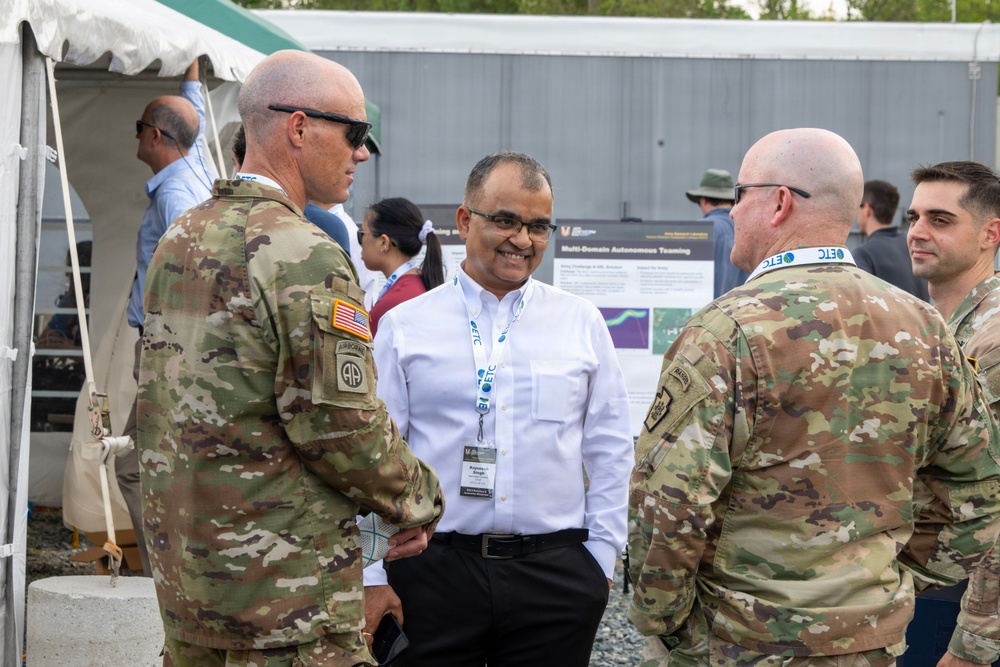
Photo By Michelle Vorloeper | ARL's Dr. Rajeesh Singh discusses autonomous research with two Soldiers at Autonomy...... read more read more
By U.S. Army DEVCOM Army Research Laboratory Public Affairs Office
GRACES QUARTERS, Md. – Army scientists and partners showcased significant scientific research to advance new technologies in artificial intelligence, autonomy and robotics that are designed to improve Soldier-autonomous teaming while protecting Soldiers in hazardous environments, increasing lethality and improving operational efficiency.
The U.S. Army Combat Capabilities Development Command, known as DEVCOM, Army Research Laboratory highlighted research advancements in real-time autonomous communications and teaming across multiple robotic systems and achieving cross-cutting multi-system integration Aug. 27 at Autonomy and Robotics Day, held at ARL’s Research Robotics Research Collaboration Campus in Grace’s Quarters, Md. Partners in industry, academic and government worked alongside ARL counterparts and served key role as research collaborators.
ARL’s acting director, Kimberly G. Ploskonka, who hosted the day’s event, emphasized the value and priority placed on collaborative partnerships and the combined effort plays in accelerating progress across AI and autonomy research innovation, as she welcomed distinguished guests.
“Artificial intelligence, robotics, autonomous systems are going to fundamentally change how we protect American citizens in the years ahead,” said U.S. Rep. Johnny Olszewski, D-Md., in his opening remarks at the event. “We know that means investing in research, supporting the people…and ensuring that groundbreaking ideas move from the lab and into the hands of the individuals who actually need them and use them.”
Translating those groundbreaking ideas into operational capabilities begins with experimental science.
"We conduct fundamental research to advance the science of intelligent systems for disruptive innovations," said Dr. Rajneesh Singh, associate chief of ARL’s Information, Autonomy and Teaming Sciences Division and the event’s organizer. "These breakthroughs represent monumental progress in integrating AI and autonomous systems into Army operations. We are moving towards a future where human-machine teams communicate and operate seamlessly, allowing warfighters to focus on critical decision-making while autonomous systems handle complex, dangerous tasks without human intervention.”
Key research showcased include:
Intelligent Soldier-Robot Teaming: ARL is exploring sophisticated systems that allow Soldiers to command autonomous teams in real-time, natural language instruction.
Tactical Tasking for Autonomous Multi-Agent Execution enables air-ground autonomy teams to plan and execute missions based on operator intent. This methodology significantly reduces the cognitive burden on Soldiers and streamlines communication. This research bridges the gap between human instruction and robotic perception, allowing platforms to accurately interpret and execute orders and share information via real-time semantic maps.
Layered Perception and Responsive Command for Soldier-Autonomous Teaming introduces an adaptable AI framework that improves Soldier-robot interaction, allowing complex, open-ended instructions that can be used for single robots or teams of autonomous systems. This infrastructure enhances situational awareness and reduces Soldier workload, enabling robots to map unknown areas, assess battle damage and operate in communications-denied environments.
Agentic Air-Ground Teaming focuses on natural language autonomous systems for aerial and ground robotic platforms. These systems communicate, execute and coordinate tasks in real-time with minimal human input, protecting Soldiers during hazardous material retrieval and reconnaissance missions.
The Distributed Information for Enhanced Squad Lethality, or DIESL program, enables a hands-free, "weapons-up" posture for Soldiers. Autonomous systems automatically respond to Soldier actions, creating a more lethal and survivable human-machine team even in degraded network environments by accelerating decision-making.
Enhanced Situational Awareness and Multi-Domain Operations: ARL's research provides Soldiers with a more complete understanding of the battlefield environment.
Autonomous teaming allows unmanned aerial vehicles to assist unmanned ground vehicles in safe navigation by scouting for threats and enabling UGVs to modify routes. This methodology enhances front-line situational awareness and increases operational tempo in hazardous environments.
Intelligent Target Detection and Tracking at the Edge utilizes an intelligent sensor system to analyze sensor feeds at the edge of the network. This approach reduces the resources needed for continuous monitoring, informing decision-making without requiring internet.
Swarm Robotics for Increased Lethality and Survivability: ARL is pioneering the use of autonomous swarms to overwhelm adversaries and protect Soldiers.
Multi-Agent Teaming and Swarm Tactics investigates scientific autonomy solutions that enable autonomous groupings, or swarms to assign and execute tasks independently following a human directive. This advanced software enhances lethality by overwhelming adversaries with coordinated, intelligent and expendable autonomous units.
Simulation, Modeling and Analysis for Predictive Autonomous Behavior integrates multiple layers of robotic and mission-level simulation into a single workflow. This approach allows researchers to rapidly modify scenarios and evaluate robotic responses to terrain, sensor inputs and threat conditions before expensive live testing, significantly reducing development time and cost. In terms of next steps, for some of these technologies, research will continue to study scaling possibilities or technologies’ effectiveness in different operational environments.
ARL will continue the research of scaling possibilities or technologies’ effectiveness in different operational environments. Other research will lead to technology transitions to government or academic partners for further maturation for Soldiers, while other technologies will transition to industry leaders for rapid scalable commercial adoption and deployment.
Learn More: https://arl.devcom.army.mil/r2c2/r2c2-how-to-work-with-us/
ABOUT ARL
DEVCOM ARL is the Army’s sole fundamental research laboratory serving as the nexus of science between the military,academiaand industry. Operating under the U.S. Army Futures and Concepts Command and the U.S. Army Transformation and TrainingCommand, ARL executes globally recognized research to accelerate delivery of war-winning, disruptive technologies for tomorrow’s Army.
For information, visit theArmy Research Laboratory website.
| Date Taken: | 09.09.2026 |
| Date Posted: | 09.09.2026 12:42 |
| Story ID: | 574175 |
| Location: | US |
| Web Views: | 27 |
| Downloads: | 0 |

This work, Army scientists reveal integration, communication advancements in autonomy innovations for the future Soldier, must comply with the restrictions shown on https://www.dvidshub.net/about/copyright.


No keywords found.





