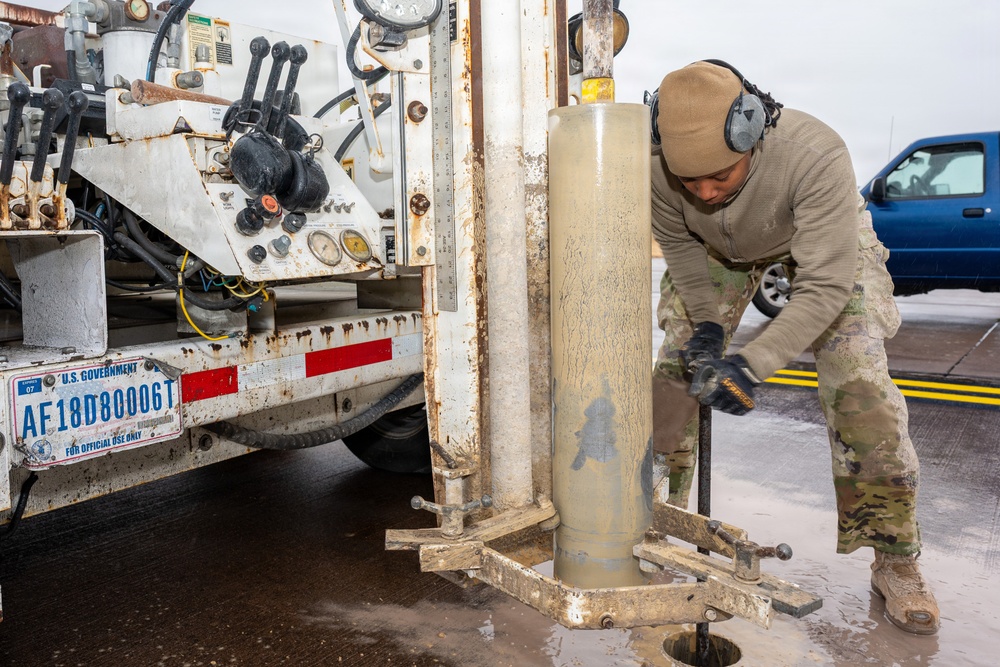
RAF FAIRFORD, England — The bed of a pickup truck grew heavier with each stop. Cylinders of pavement lay stacked across the tailgate, their freshly cut edges revealing dark bands of asphalt and lighter layers of aggregateand concrete normally hidden beneath RAF Fairford’s flightline. Nearby, water and gray slurry pooled around a drill as it cut through another section of the surface.
Members of the Air Force Civil Engineer Center’s Airfield Pavement Evaluation Team pulled the core free, documented it and loaded it into the truck before moving on. Throughout September 2026, the five-person team repeated the process across the base as part of a comprehensive assessment of the installation’s airfield infrastructure.
Led by U.S. Air Force Capt. Andi Brown, AFCEC Airfield Pavement Evaluation Team officer, the team worked to provide Fairford with a current understanding of its capabilities.
“Our main goal when we perform a comprehensive evaluation of an airfield is to provide that base with an updated picture of the capability of their pavement to make strategic decisions on whataircraft they can safely operate there and for how long,” Brown said.
The assessment combined several forms of testing. Structural tests measured how the surface responded under simulated aircraft loads, while a visual survey documented cracking, wear and other signs of deterioration. Testing on the runway also assessed conditions that could contribute to hydroplaning.
Core sampling gave the team a look beneath the surface. Approximately 60 to 70 samples were planned, with additional locations selected when something warranted a closer look. The cores generally revealed between 25 and 30 inches of pavement under the flightline.
The results allowed AFCEC to determine the loads the airfield could safely accommodate while giving Fairford’s civil engineers data to guide future maintenance and repairs.
“That information gets fed to them to appropriately plan for what the future looks like,” Brown said.
That planning directly contributes to the 501st Combat Support Wing’s readiness. Fairford’s ability to receive and support aircraft is a key part of the Pathfinder mission, and maintaining the infrastructure beneath those operations helps ensure the installation can respond as mission requirements change.
Comprehensive airfield pavement evaluations typically occur every 12 years at active-duty installations. Fairford’s assessment took place roughly two years ahead of that cycle, providing a current picture of its capabilities as operational demands continue to evolve.
Long after the testing equipment leaves Fairford, the findings will continue to shape how the airfield is maintained. That preparation helps ensure the next time Pathfinders are called to support an aircraft, an operation or a rapidly changing mission, the infrastructure beneath it is ready too.
| Date Taken: |
09.08.2026 |
| Date Posted: |
09.09.2026 11:16 |
| Story ID: |
574169 |
| Location: |
US |
| Web Views: |
19 |
| Downloads: |
0 |
PUBLIC DOMAIN

This work, A Look Beneath Fairford’s Flightline, by SrA Adam Enbal, identified by DVIDS, must comply with the restrictions shown on https://www.dvidshub.net/about/copyright.