
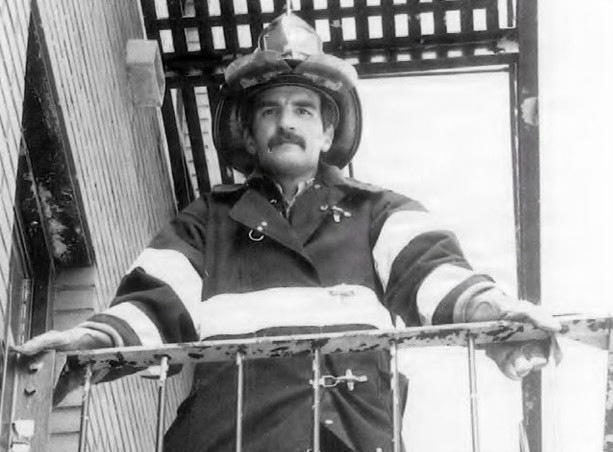
Photo By Erin Thompson | On Sep. 11, 2001, New York Fire Department Fire Marshal (FDNY) Ronald P. Bucca gave...... read more read more
 Subscribe
On Sep. 11, 2001, New York Fire Department (FDNY) Fire Marshal Ronald P. Bucca gave his life while responding to the attacks on the World Trade Center. At the time, Bucca was also an Army reservist serving as operations chief of the 3413th Military Intelligence (MI) Detachment out of Fort Totten (Queens), New York.
Ron Bucca was not on a path to the Intelligence Community until a near-fatal fall in 1986 changed his course. He was a paratrooper in the U.S. Army Special Forces and a firefighter for FDNY’s Rescue 1—a special operations rescue company. While attempting to rescue a fellow firefighter trapped in an apartment building, he fell five stories and fractured his spine. Bucca somehow survived and was nicknamed “The Flying Fireman,” but his paratrooper days were over.
In 1989, he left the Special Forces to pursue all-source intelligence as an Army reservist and, in 1992, he was promoted to FDNY fire marshal. In February 1993, Bucca witnessed the aftermath of terrorism for the first time when terrorists trained in an Al-Qa’ida-associated camp bombed the World Trade Center’s North Tower. The blast killed six people and injured more than a thousand. Bucca, as FDNY’s fire marshal, investigated the incident.
Later that year, Bucca joined the 3413th MI Detachment and began supporting the Defense Intelligence Agency’s (DIA) counterterrorism mission—mainly through weekend work from New York. Using DIA’s intelligence reports, Bucca’s team analyzed and tracked incidents of domestic and international terrorism. Gary Greco, chief of DIA’s Terrorism Warning Division, said: “[By 2001] Some of the guys in the reserve units, Ron being one of them, had actually been working on the terrorism problem set longer than some of the analysts we actually had working full-time.”
In the late 1990s, Bucca also joined the Federal Bureau of Investigation’s Joint Terrorism Task Force (JTTF) as a representative of the FDNY. This provided him with insight into terrorism investigations and allowed him to collaborate with personnel from other organizations and agencies. The more Bucca learned, the more steadfast he believed that another terrorist attack in New York was looming. As part of his duties, he educated first responders about the dangers and encouraged them to develop biological and chemical terrorism response plans. But then in 2000, FDNY’s seat on the JTTF was removed.
In the months before 9/11, Bucca reportedly brought home an unclassified link chart showing Al-Qa’ida’s network and participated in a Joint Security Operations Command counterterrorism exercise. In August 2001, he was attending annual training at the Defense Intelligence Analysis Center in Washington, D.C., when he spoke to Greco about where Al-Qa’ida could strike next. “He was very adamant that they would come back to the World Trade Center,” said Greco. Bucca was so convinced that Al-Qa’ida would return to the towers that he had a blueprint of the World Trade Center at home and would regularly stop there to chat with people in the building.
About three weeks later, Bucca’s premonitions became his reality. On Sep. 11, 2001, he responded to the call of another attack on the World Trade Center. The 47-year-old climbed to the 78th floor of the South Tower and attempted to rescue victims in the impact zone of United Airlines Flight 175 before the tower collapsed. Bucca and battalion chief Orio Palmer are believed to have made it higher than any other first responders in the towers on 9/11—confirmed only by Palmer’s radio calls. “On 9/11, I would contend that [Ron] was the only person running into those buildings that actually knew what he was running into,” said Greco. Bucca remains the only FDNY fire marshal to die in the line of duty.
For his sacrifice, Bucca was awarded the Soldier’s Medal. In 2003, the Army’s theater-level detention facility in Iraq was renamed Camp Bucca in his honor, and in 2005, the DIA Joint Intelligence Task Force-Combating Terrorism created the Warrant Officer Ronald P. Bucca Award to recognize the military member who provided the most outstanding contributions to the office’s counterterrorism mission. Finally, in August 2026, Bucca was awarded the Office of the Secretary of War Medal of Valor, the highest civilian award presented by the Department of War.
This abbreviated version of the article, “Defense Intelligence Agency Reservist Made it His ‘Mission in Life’ to Save New Yorkers from 9/11 Attack," (https://www.dia.mil/News-Features/Articles/Article-View/Article/3903249/defense-intelligence-agency-reservist-made-it-his-mission-in-life-to-save-new-y/) was used with permission from DIA; condensed and with added honors by Erin E. Thompson, USAICoE Staff Historian. New issues of This Week in MI History are published each week. To report story errors, ask questions, request previous articles, or be added to our distribution list, please contact: TR-ICoE-Command-Historian@army.mil.
| Date Taken: | 09.09.2026 |
| Date Posted: | 09.09.2026 11:11 |
| Story ID: | 574166 |
| Location: | US |
| Web Views: | 29 |
| Downloads: | 0 |

This work, MI Reservist Saves New Yorkers (11 SEP 2001), by Erin Thompson, identified by DVIDS, must comply with the restrictions shown on https://www.dvidshub.net/about/copyright.

No keywords found.




