DSCU Concludes 2026 Cyber Law and Hybrid Warfare Course
Photo By Jasmine Garcia |
Participants in the Defense Security Cooperation University’s Cyber Law and Hybrid......read moreread more
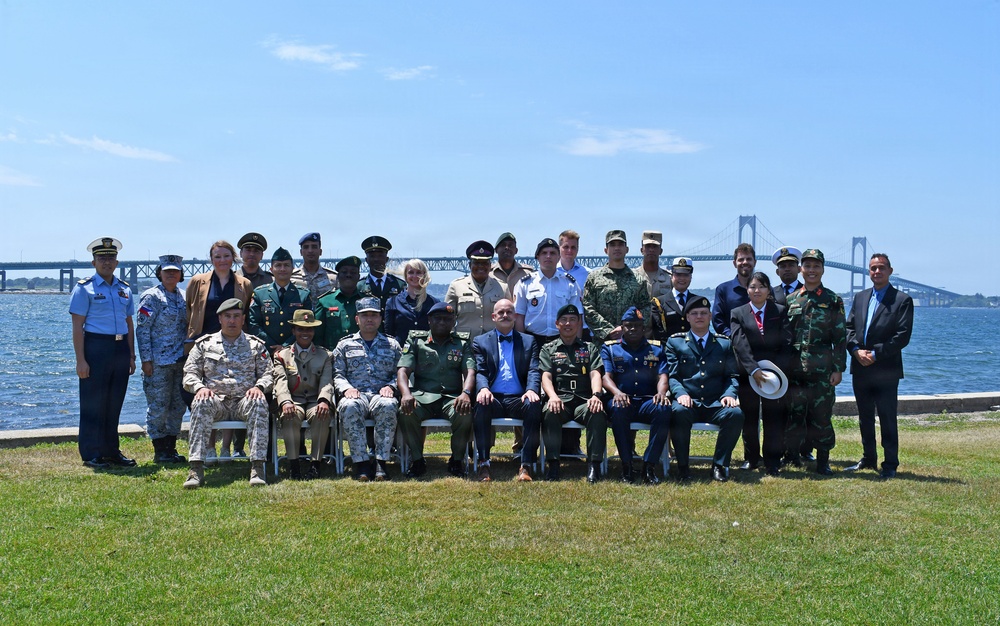
Photo By Jasmine Garcia | Participants in the Defense Security Cooperation University’s Cyber Law and Hybrid Warfare Course pose for a group photo in Newport, RI, July 20, 2026. The course provided students with opportunities to apply law to cyber and hybrid warfare scenarios. (Courtesy Photo) see less
| View Image Page
DSCU Concludes 2026 Cyber Law and Hybrid Warfare Course
Newport, R.I. — Twenty-seven military officers and civilian defense professionals from 20 partner countries graduated July 23 from the Cyber Law and Hybrid Warfare Course, concluding a four-week program focused on the legal frameworks governing global cyber operations and critical infrastructure defense.
Administered by the Defense Security Cooperation University (DSCU), at its Newport campus, the course examined the legal and policy aspects of cyber operations in international and domestic contexts. Participants explored topics including the foundations of cyber law, hybrid warfare concepts, and international law as it applies to cyberspace.
The curriculum combined interactive case studies with expert briefings from U.S. Cyber Command, the Cybersecurity and Infrastructure Security Agency, the United Nations Office of Counter-Terrorism, the Department of War General Counsel’s office, and many others.
"The most valuable parts of the course were those that integrated technological, legal, and strategic perspectives related to cybersecurity, cyberspace conflicts, and emerging technologies," noted one participating international professional. "The exchange of experiences with participants from different countries was essential to understanding diverse perspectives, strengthening international cooperation, and developing collaborative approaches to future technological and legal challenges."
In today's complex security environment, understanding the legal aspects of cyber operations is critical. As state actors and organized groups exploit new technologies, the practical application of international law to full-spectrum cyber operations has become a foundational requirement for combined readiness. By aligning terminology, processes, and legal concepts, partner nations are better equipped to collaboratively address operational challenges and develop cohesive international agreements.
“DSCU’s Cyber Law and Hybrid Warfare (CLHW) course is vitally important today, as it directly addresses the highly sophisticated and global threats that exploit gray-zone vulnerabilities and digital infrastructure to undermine global stability,” said Robert J. Passerello, the Cyber Law Course Director.
Passerello noted that by establishing a shared legal and operational understanding of these complex challenges, the course acts as a force multiplier for international security cooperation. This shared baseline allows partner nations to coordinate defense strategies, share critical threat intelligence, and collectively uphold international norms in cyberspace.
“The unique benefit of this program lies in its delivery by distinguished practitioners from the U.S. government alongside expert guest lecturers from partner countries,” Passerello said. “Their multifaceted professional perspectives equip international colleagues with an unparalleled framework to proactively defend their sovereign interests and secure the collective digital commons.”
The course also included field studies in Massachusetts, New York, and Washington, D.C.
The 27 graduates of the 2026 CLHW cohort now return to their respective countries prepared to translate these academic legal concepts into real-world operational success in the cyber domain.