
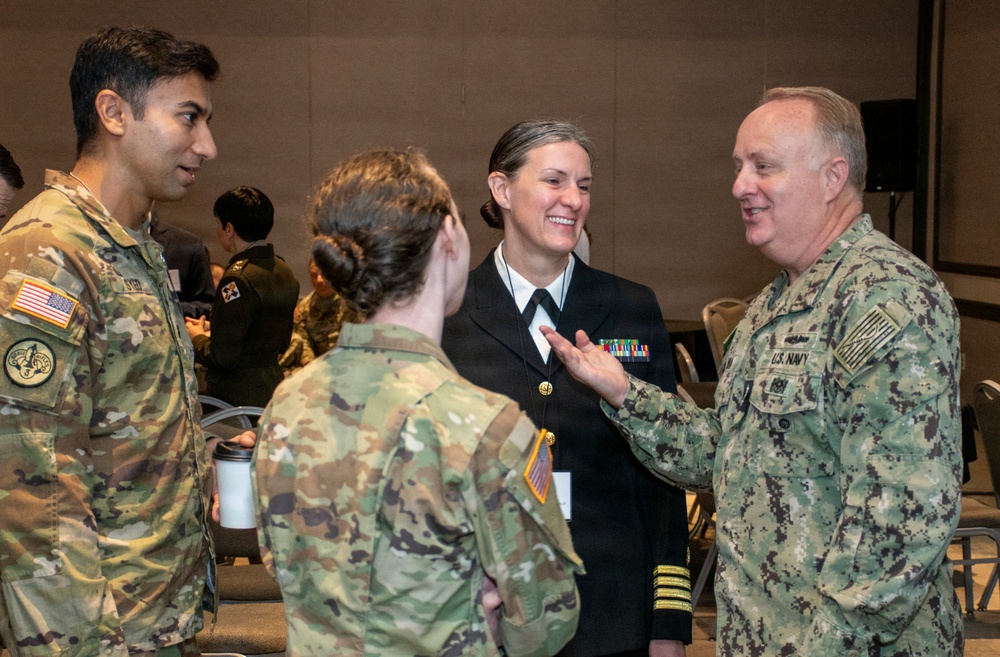
Photo By Robert Hammer | Navy Vice Adm. Darin Via, director of the Defense Health Agency, speaks with emerging...... read more read more
 Subscribe
To a cohort of emerging military healthcare leaders at the 2026 Tri-Service Chapters Annual Scientific Meeting, Defense Health Agency Director Navy Vice Adm. Darin K. Via positioned the agency as a source of “problem solvers and solution providers” to optimize combat support in generating and sustaining global warfighter readiness.
In his remarks at the meeting in Bethesda, Maryland, Aug. 26, Via called upon future leaders across the military healthcare enterprise to own risk, solve problems at the right level, and focus on ensuring service members are medically ready for the future fight.
“Military medicine faces a more complex future than it did during the wars in Iraq and Afghanistan,” Via said. “The enemy has changed the tactics on us, and we have to adapt,” in delivering care to warfighters.
The joint medical education conference is hosted by the American College of Physicians for military internal medicine professionals, including physicians, residents, fellows, and other healthcare professionals.
Via said since the first day he became director of the agency, his goal was to make “the entire DHA a combat support agency.”
His viewpoint shapes how DHA leaders will measure success, Via said, emphasizing the agency must look beyond healthcare delivery and ask how each part of the system supports combat power. He noted his fiscal year 2027 campaign order will finalize “the plan to deliver my four strategic priorities” — the agency’s “North Star” in optimizing operational medical readiness.
“To achieve our North Star, DHA should be synchronized and data-driven to deliver decisive warfighter support,” Via said.
Via stressed DHA needs to find ways to return the warfighter to the fight more quickly.
He described studies of musculoskeletal injuries finding gaps between healing and nondeployability, saying the insights offer a “chance to return more people to the fight faster.”
“We have to deliver the readiness of the warfighter,” Via declared.
He tied this goal to better access to care, faster referrals, and clearer measurable outcomes on meeting the mission, mobilizing leaders to use data to find root causes of illness or injury instead of only treating symptoms.
Via referenced the vital work of Dr. Jesus Caban, DHA’s chief data and analytics officer, and his team to make data more accessible, using artificial intelligence to translate a wealth of information into useful knowledge quickly. He noted this data and access to the Joint Medical Planning Tool, a computer-based simulation tool that models patient flow from point of injury through more definitive care, which can help predict casualties, support treatment and evacuation decisions, and guide supply and resupply in future battles — enhancing medical warrior currency across the enterprise.
In his intent to give network and military hospital and clinic leaders more authority to make and execute decisions, Via underlined, “Everyone should feel empowered to solve the problems at their lowest level. Period.”
“Find the root cause, identify solutions, execute and learn,” he said, while urging leaders to challenge assumptions: “Be willing to speak truth to power.”
Leaders should push risk up the chain, not down it, he added: “It is taking risk at the right levels … if we’re going to take the risk, I’m happy to own the risk.”
He highlighted plans to strengthen support for combatant commands and casualty receiving facilities. DHA is working to set requirements for medical supplies in the fight, using planning tools to estimate casualty needs, and expanding spaces inside military hospitals and clinics currently used for other purposes.
“We’re going to get those opened up. We’re going to get them functional. We’re going to have them ready,” he said.
Aligning with his warfighter-first focus, Via briefly mentioned working with the Joint Trauma System to optimize the military’s trauma learning system, ensuring the joint force can adapt faster to modern battlefield threats. JTS plays a critical role in delivering joint warfighting capabilities through unified trauma clinical care standards and data-driven medical logistics.
“We are also going to stand up a Joint Warfighter Health System — we're going to learn from the JTS. We’re going to use those same models to drive mental health, TBI (traumatic brain injury), and infectious disease,” he said. “We’re going to use the same continuous, data-driven process improvement to keep and save warfighters and keep them in the fight.
He closed by emphasizing the role of military medical leaders in battlefield success and ensuring all beneficiaries receive the high-quality healthcare they deserve.
“You all will save more lives on the future battlefield … you will keep more fighters in the fight, and that is how we will win the war.”
| Date Taken: | 09.08.2026 |
| Date Posted: | 09.08.2026 14:20 |
| Story ID: | 574098 |
| Location: | US |
| Web Views: | 35 |
| Downloads: | 0 |

This work, ‘North Star’ of Defense Health Agency is data-driven to deliver decisive warfighter support, declares director, by Robert Hammer, identified by DVIDS, must comply with the restrictions shown on https://www.dvidshub.net/about/copyright.

No keywords found.




