
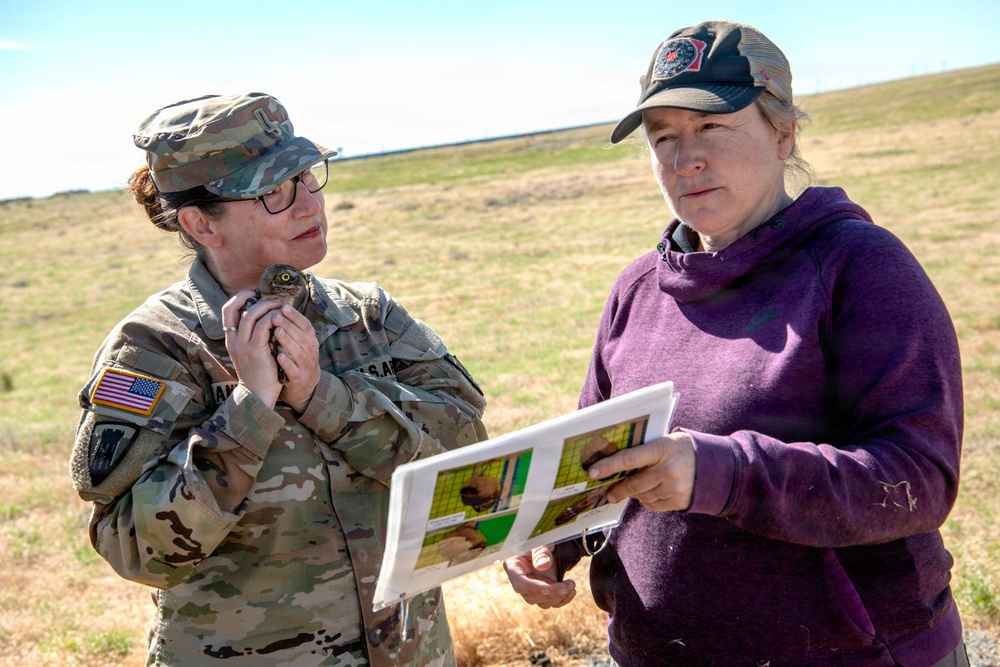
Photo By John Hughel | Janet Johnson, Natural Resources Manager for the Oregon Military Department, shows a...... read more read more
 Subscribe
Etched into the landscape and spaced in a strategic grid across miles of sagebrush steppe, 1,001 concrete “igloos” rise above the arid high-desert plains. Built in 1941, in the lead-up to WWII, they were used to store munitions until the end of the Cold War. Their presence still leaves a permanent mark on the geography and history of this region of Eastern Oregon.
Nestled among these long-forgotten fortified bunkers lies another kind of refuge: hidden underground shelters built to safeguard and revive the vulnerable Western Burrowing Owl populations that call this land home.
The former Umatilla Chemical Depot, officially closed in 2012 as part of the Department of Defense Base Realignment and Closure process, still has more than 200 miles of roads, many of the original military post buildings, machine shops, and warehouses, and 40 miles of unused railroad tracks. Recently, new training facilities and military accommodations have been constructed. These updates are now part of the Rees Training Center (RTC), which uses 7,500 acres of the original 16,000-acre site.
On a warm, windy afternoon on June 10, Rhande Shaw leads a group of volunteers and military service members as they hike to a small hilltop after driving several miles along a series of roads from the operations hub at RTC, which still extends to the former depot boundaries where numerous igloos still stand. There, anticipation quickly gives way to discovery as they locate one of the 29 ingenious artificial burrow sets, constructed from recycled juice barrels, corrugated pipe, and buckets. The juxtaposition of these durable shelters against the open landscape stands out as the group scans the horizon, eager for a glimpse of an adult owl taking flight.
Shaw is a Natural Resources Program Manager for the Oregon Military Department. Her team manages the Oregon Army National Guard's military training lands statewide, caring for forests, grasslands, high-desert plains, rivers, estuaries, and wildlife-rich wetlands. She is now focused on helping the Burrowing Owls that migrate through this land by explaining how they travel, hunt, and build their homes in burrows. This area also has a long history of people moving through it. Just north of where the group stands, Lewis and Clark led the Corps of Discovery along the Columbia River in 1805-1806, and Oregon Trail settlers followed during the great migration era from 1843 to 1860.
“On the land that is now part of the Rees Training Center, we maintain 29 artificial burrows, and we have already been here in May to conduct the first check on these burrows,” she said as the group inspected the first stop of the day. “The males return early to secure the best burrows to attract a mate; often that’s in February or March. This is important because the population of coupled owls has grown to over a hundred just a couple of years ago.”
The Confederated Tribes of the Umatilla (Cayuse, Umatilla, and Walla Walla), which traded with the Lewis and Clark expedition more than 220 years ago, are now using 4,000 acres set aside from the former depot lands to support conservation and maintain the remaining 55 artificial burrows. TheColumbia Development Authority has taken over the remaining area and plans to redevelop it.
“All of this has been an ongoing recovery process since 2008, before the depot was officially closed and the land divided, when the Army’s wildlife manager could identify only four pairs of nesting owls,” Shaw said. “As the number of owl pairs continues to rise, so does the number of owlets each year.”
The recovery of the owl population began with assistance from the Global Owl Project, established by David “DJ” Johnson in response to a 2007 request from Don Gillis, then OMD’s natural resources manager, who sought to understand the causes of the owl population's decline, which was on the brink of collapse.
The natural burrows had begun to disappear over time as badger burrows were lost after decades of military development and fence construction. Having used wooden crates to create artificial burrows, “DJ” turned to recycled containers from Tree Top, a Washington-based applesauce and juice company.
Johnson’s team constructed four sites, each with two burrows. Female owls selected one burrow to lay eggs, while males used the other to store prey such as mice, insects, and small snakes. The initial expectation was to attract four owl pairs, one per site. However, nine nesting pairs were observed in the first year, and the number rose to 32 the following year.
“The system in place now is designed to last 10 to 15 years and can be relocated if military training areas change or if we see that the burrows are no longer attracting owls to their current locations,” Shaw said. “These are some of the advantages of artificial burrows. Their design allows us to study the owls with minimal disturbance to their shelter.”
Each juice barrel is equipped with a small pail attached to the top, which researchers lift to access the underground chamber. The entrance tubes for the owls are positioned just above ground, measuring 10 to 12 feet in length and nearly 6 inches in diameter, and lead to the nesting and food storage area. The female typically lays seven to twelve eggs and incubates them for about four weeks. During this time, the male provides food for the female. After the eggs hatch, both parents feed the offspring until they reach approximately three months of age.
Shaw and the volunteers examined three shelters, each offering insight into the developmental progress of its burrow. At the first location, they found two eggs, both nonviable. The second shelter contained two nestling owls, estimated to be 23 days old. Shaw and Jon Bloom, a Natural Resource Specialist with the Oregon Military Department, referenced a laminated booklet featuring photographs depicting various growth stages to estimate the owls' ages. Based on this assessment, they concluded that the owls were just over halfway to maturity, as Western Burrowing Owls require 42 days to reach adulthood.
“Over time, the data we have collected has helped track the growth of the owls here at Rees Training Center,” Bloom said, noting that the owls are no longer being banded. “Many of the owls still have the bands, and we record them, but the emphasis continues to focus on the overall habitat and the conditions of the burrows.”
This week, many of the volunteers are Oregon National Guard Soldiers conducting their annual training at RTC. They have each signed up to help out and to get to know the training lands they share with the owls. The soldiers are excited to shovel sandy soil around the burrows and to learn more about these birds of prey.
“What a great opportunity to introduce our Soldiers to the owls while they are here for annual training. This is a chance for them to understand all aspects of the training area here at Rees (Training Center),” said Janet Johnson [no relation to DJ Johnson], a Natural Resources Manager for the Oregon Military Department.
On June 11, Johnson was leading a mixed group of soldiers and civilian volunteers on a morning excursion to check several burrows. As the group arrived, one of the adult owls was perched near the burrow's entrance on a small hill. It took flight as the group left their vehicles, circling the area before disappearing into the distance. Pointing out the entrance, Johnson described the rock pile buildup there as a way to keep predators out.
“Inside the nest chamber, we have also put in a steel mesh so predators cannot enter through the bottom,” Johnson said as she began to remove several baby owls from the open chamber. “The number one thing we want to accomplish with these artificial burrows is to grow the population.”
When the owls are placed in a separate bucket, they emit a long, rattling hiss. Johnson said the sound mimics a rattlesnake's warning rasp, signaling to predators that a dangerous snake could be nearby. After a while, the owls grow calm, allowing the volunteers to gently hold and observe them. In the chamber, the remains of their meals are inspected: fragments of insects, bits of a lizard, and tiny bones of mice, small rodents, reveal what has been sustaining these birds.
“On average, these birds can live from six to eight years,” she said. “In 2024, we had a bumper crop of babies, 102 pairs. So this has been a huge success, and this is the most successful nesting colony for growing owls of its kind in the United States.”
The group gently passes the small birds from hand to hand, their bright yellow eyes noticing every movement, and their intricate, beautiful, speckled brown-and-white plumage providing effective camouflage among the brown sagebrush and other vegetation of the native habitat. Their camouflage patterns and colors, in many ways, resemble the configuration of the soldiers holding them.
Just a few weeks earlier, soldiers assigned to the 442nd Engineer Utilities Detachment were conducting pre-deployment training for a yearlong deploymentto theHorn of Africa. They were on the dry riverbed portion of the training range, outside the maintained burrowing area, when a heavy machine operator spotted an owl perched near a potential natural nest burrow. They halted operations in the area, notified range control to report the owls, and immediately roped off the site.
“The soldiers knew exactly what to do when they saw the activity and called in to range control,” Johnson said. “This was not a good area for owls, so we needed to check whether the nest had eggs.”
Until they lay eggs, they are not protected under the Migratory Bird Act, so it was important to see whether the nest now contained eggs. Shaw and Bloom set up a game camera outside the area and then used a burrow camera to see if anything was in the chamber. With no signs of nesting, they collapsed the chamber to have the owls move out of the area.
“The state of Washington has listed them as a threatened species, but Oregon has not, and for now they are not on the federal species list. That’s where the DoD wants to keep them,” Johnson said, explaining why it’s important to keep the species common. “We need to keep our training lands free of restrictions, which means more paperwork, consultations, and restrictions. My number one job is to make sure that training can continue into perpetuity and without restrictions.”
With the summer nesting period coming to a close, the OMD Environmental team was busy checking on the remaining active nests, even as severe wildland fire throughout the state and region threatened the habitat and strained food supplies for the owls.
“We had 99 fledglings on the OMD property this year. This is a slight decline in survivorship compared with 2024, but we know survivorship ebbs and flows,” Shaw said after reviewing the data in late August. “Fires did not affect the owls on the depot, and it is always something we worry about.”
When reviewing the numbers, Shaw noted that the 99 fledglings from the 29 maintained OMD/RTC side had an 81.25 percent success rate. This was calculated as the total number of nests that fledged at least one chick, divided by the total number of nesting attempts, giving a productivity rate of 3.4 fledglings per breeding pair.
“There are a few theories that could account for this, from warmer winter temperatures to a lower prey base during peak hatching times, but these are just educated guesses, Shaw said, taking into account the drier and warmer weather in the first part of 2026. “I think the biggest impact was the warm and dry winter going into spring in the region.”
The tireless efforts to protect burrowing owls continue. When natural nesting spots are scarce, these artificial burrows have offered these remarkable birds a lifeline. With careful placement and ongoing care, these man-made homes have boosted nesting success, increased occupancy, and helped secure the future of the burrowing owl population in the western part of the country.
| Date Taken: | 08.31.2026 |
| Date Posted: | 09.04.2026 20:35 |
| Story ID: | 574024 |
| Location: | HERMISTON, OREGON, US |
| Web Views: | 22 |
| Downloads: | 0 |

This work, The Rees Training Center continues its efforts to preserve Western Burrowing Owl colonies, by John Hughel, identified by DVIDS, must comply with the restrictions shown on https://www.dvidshub.net/about/copyright.


No keywords found.




