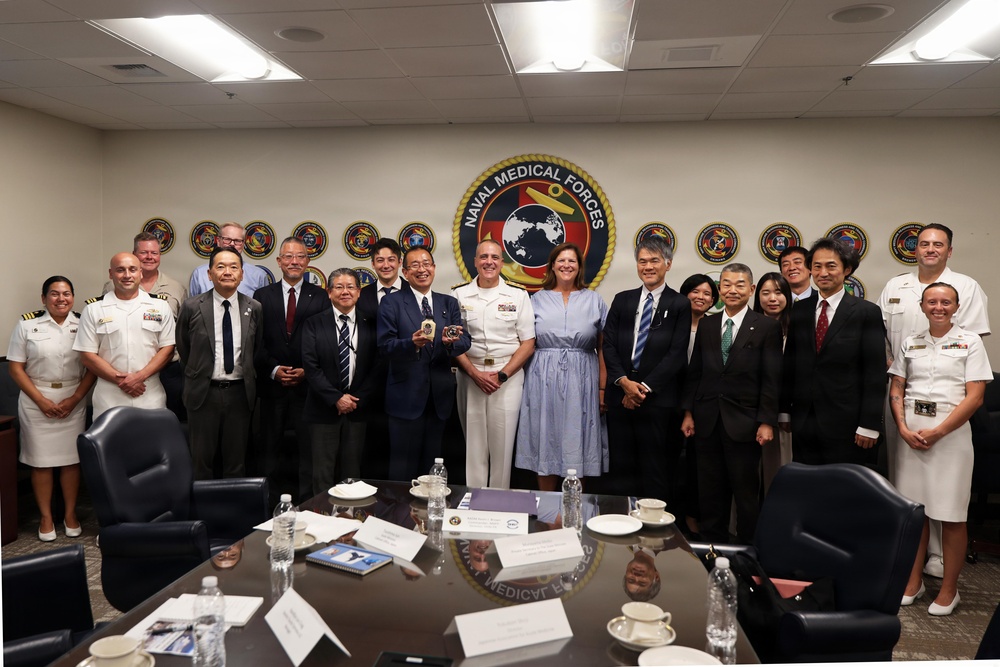
Naval Medical Forces Pacific hosted a senior delegation of Japanese government and officials, clinical leaders and academic researchers Aug. 25, 2026, to deepen bilateral medical collaboration and examine the operational requirements of maritime healthcare across the vast Indo-Pacific region.
Led by Jun Tsushima, state minister of the Cabinet Office of Japan, the delegation met with NMFP leadership to exchange expertise on shipboard medical doctrine, underway clinical training, emergency response integration and the future architecture of afloat hospital platforms.
Rear Adm. Kevin Brown, commander of NMFP and director of Defense Health Network-Pacific Rim, provided the delegates with an overview of the command’s expansive area of responsibility. Central to the command’s mission is the preparation and sustainment of a ready medical force capable of rapidly mobilizing from shore to operational theaters, including deployments aboard the hospital ship USNS Mercy.
"The vast majority of our doctors, nurses, corpsmen and clinical support specialists work daily within our shore hospitals and clinics delivering routine patient care,” Brown said. “When a crisis emerges and the USNS Mercy receives operational tasking, we draw those ready deployable medical teams from our medical treatment facilities to perform life-saving care in theater while keeping our military treatment facilities prepared to receive returning casualties.”
For Japanese leadership, cultivating maritime medical capability represents both an urgent humanitarian requirement and a vital defense priority. Tsushima explained that while Japan's health care system is highly effective in executing medical responses on land, its experience in delivering care at sea remains limited. Because Japan is surrounded by water and frequently impacted by natural disasters such as earthquakes, tsunamis and typhoons, he emphasized the critical importance of developing shipboard medical capabilities to support emergency care.
During the discussion, delegates explored the operational trade-offs between large floating hospitals and smaller, specialized vessels. Brown outlined current U.S. Navy modernization concepts, highlighting the ongoing requirement for agile, shallow-draft platforms capable of delivering Role 2 damage-control resuscitation and stabilization close to contested waters, alongside future long-term planning to replace aging 1980s-era converted tanker hospital ships with modern Role 3 afloat medical capabilities.
Addressing questions from Yoichi Koida of the Japan Institute for Health Security, Brown noted that the strategic geography of the Pacific dictates the evolution in combat casualty care and medical evacuation doctrine.
"Over the past 30 years, our ability to move life-saving surgical teams near the point of injury and evacuate casualties through an uncontested medical evacuation system was the greatest contributor to combat survival rates," Brown explained. "However, in a conflict across the Pacific, we might not always have the luxury of uninterrupted command of the air and sea, or continuous electronic communications. Planners are exploring various concepts, including leveraging highly mobile, agile afloat medical platforms capable of delivering immediate damage-control surgery in communications-suppressed environments."
Clinical workflow was also a central focus of the exchange. John Rotruck, chief medical officer for Defense Health Network-Pacific Rim, highlighted essential design lessons from current operations, recommending that future hospital ship configurations maintain casualty receiving, trauma resuscitation, advanced radiology, surgical suites and intensive care units on the same deck to eliminate vertical patient transport for critically injured individuals.
“Keeping all the most critical parts of the care pathway on the same deck of the ship allows a natural flow of care,” Rotruck said.
Brown also emphasized the Pacific Partnership mission as a proven framework for ongoing coordination between military planners, civilian medical systems and partner nations, recommending Japanese participation in early-stage joint planning cells.
Concluding the exchange, Tsushima expressed strong interest in expanding future bilateral cooperation between the United States and Japan across maritime medical response missions. He emphasized that growing opportunities for joint training, sharing operational experience, and learning from each other will ensure both nations are better prepared to preserve life during natural disasters and complex emergencies.
NMFP provides oversight for 10 Navy Medicine Readiness and Training Commands (NMRTC) on the West Coast and Pacific Rim that train, man and equip medical forces, primarily in military treatment facilities. Globally, NMFP oversees eight research laboratories that deliver research expertise in support of warfighter health and readiness. Additionally, NMFP manages the Naval Expeditionary Medicine Warfighter Development Center (NEMWDC), which plays a critical role in preparing medical teams for expeditionary and operational environments.
| Date Taken: |
09.04.2026 |
| Date Posted: |
09.04.2026 19:00 |
| Story ID: |
574022 |
| Location: |
SAN DIEGO, CALIFORNIA, US |
| Hometown: |
SAN DIEGO, CALIFORNIA, US |
| Web Views: |
28 |
| Downloads: |
0 |
PUBLIC DOMAIN

This work, Naval Medical Forces Pacific and Japanese delegation expand bilateral maritime medicine cooperation, by Arsenio R. Cortez Jr., identified by DVIDS, must comply with the restrictions shown on https://www.dvidshub.net/about/copyright.