
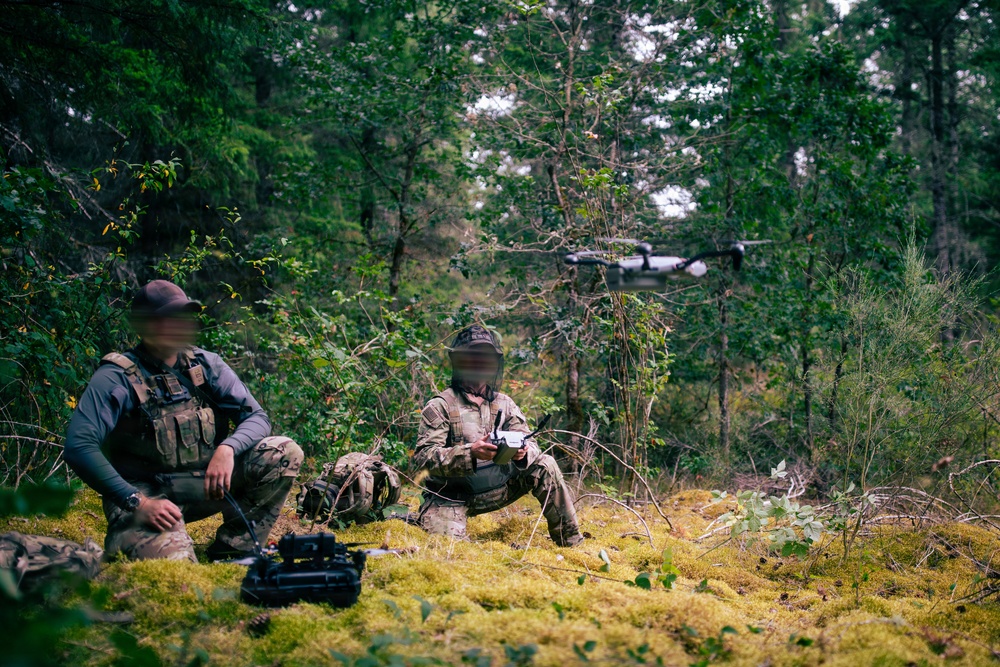
Photo By Staff Sgt. John Bae | Green Berets assigned to 1st Special Forces Group (Airborne) launch a Skydio X10 drone...... read more read more
 Subscribe
ANNISTON, Ala. — Fifteen teams of highly trained Green Berets representing units across 1st Special Forces Command (Airborne) arrived in Alabama with five days to prove how effectively they could integrate rapidly evolving technology into complex tactical problems. When the competition ended, Soldiers representing 1st Special Forces Group (Airborne) came out on top.
1st SFG(A) earned top honors during the first-ever 1st Special Forces Command (Airborne) Best Drone Team Competition, held Aug. 24-28 at Fort McClellan and Clarke Range Complex in Alabama. Through the five days of competition, teams navigated a series of tactical problem sets, including rural and urban lanes designed to challenge how competitors integrated small, unmanned aircraft systems into realistic operational scenarios. For 1st SFG(A), the story of the competition began before a drone ever left the ground.
Prior to the event, 1st SFG(A) identified an Operational Detachment Alpha, their equipment requirements, and began conducted training on Joint Base Lewis-McChord, Washington. Through the planning and training cycle the ODA identified gaps in capabilities, and staff across the Group worked to push last-minute procurements to place the required equipment into the hands of the operators. The effect of that effort was not lost on the team.
“We wouldn’t have been successful without the last-minute procurements Group pushed through for us,” the team sergeant said following the competition.
That connection between operators identifying a requirement and an organization responding quickly enough to meet it reflects a challenge extending far beyond a single competition.
Unmanned systems are evolving rapidly, and so are the ways Soldiers employ them. Maintaining an advantage increasingly requires formations to identify what works, resource it quickly, develop proficiency, test it under realistic conditions and distribute what they learn before either the technology or the threat changes again. The Best Drone Team Competition was designed with that process in mind.
Participating organizations fielded both Special Forces operational teams and robotics-focused elements, bringing together unmanned systems practitioners, tactical leaders and key staff elements from across 1st SFC(A). The competition served as an opportunity to exchange tactics, techniques and procedures, and drive proficiency across the formation.
A drone alone does not create a tactical advantage. Its value depends on the ability of Soldiers to understand its capabilities, recognize where it fits within a larger operational problem and employ it effectively alongside the other tools available to them.
Teams were evaluated not only by their ability to fly unmanned aircraft, but on their ability to solve problems. Competitors had to adapt to changing conditions, determine how available systems could support their objectives and integrate those capabilities into tactical decision-making.
For 1st SFG(A), while winning the competition validated the proficiency of the Soldiers who competed, what happens after the competition will prove even more important. In post-competition guidance, Col. Ronald J. Hudak, commander of 1st SFG(A), described the competitors as “good people taking disciplined initiative and getting results.”
His guidance quickly moved beyond recognizing the accomplishment and toward determining how the Group could capture and distribute what its Soldiers had learned.
The competitors’ experience will now help inform future training across 1st SFG(A), with efforts focused on sharing lessons and best practices, developing hands on instructional products and examining options for increasing baseline tactical unmanned-systems proficiency throughout the formation. The goal is not simply to maintain a handful of highly skilled drone operators; it is to make their knowledge transferable.
“These are some of our best [Soldiers],” said Brig. Gen. Joseph Wortham, commander of 1st Special Forces Command (Airborne), “they stare at the UxS problem day in and day out and they do so in a very tangible, tactical way.”
The result was a first-place finish, but that is only the most visible outcome. The more enduring measure of success will be what happens when the lessons brought home from Alabama move beyond the Soldiers who earned it.
As 1st SFG(A) incorporates their experience into training across the formation, an achievement belonging to one team can become knowledge shared across many. In an operating environment where technology can change faster than traditional training and acquisition cycles, the ability to identify a need, resource it, learn quickly and adapt may ultimately matter far more than any place on a leader board.
| Date Taken: | 09.03.2026 |
| Date Posted: | 09.03.2026 18:47 |
| Story ID: | 573957 |
| Location: | ANNISTON, ALABAMA, US |
| Web Views: | 30 |
| Downloads: | 0 |

This work, 1st SFG(A) Wins Drone Competition Highlighting Rapid Transformation to Increase Lethality, by SSG Dwayne Bryant, identified by DVIDS, must comply with the restrictions shown on https://www.dvidshub.net/about/copyright.


No keywords found.




