More than 10,000 troops took part in military training at Fort McCoy during August 2026, making the month another significant period of activity at the installation as Army Reserve, Air Force Reserve and National Guard forces conducted a wide range of readiness missions.
According to Fort McCoy’s Directorate of Plans, Training, Mobilization and Security, or DPTMS, the month’s training included large-scale collective exercises, military police training, medical and sustainment operations, Air Force A-10 weapons training, aviation operations and a major domestic-response exercise.
The variety of missions demonstrated Fort McCoy’s ability to support multiple training requirements and military services simultaneously while providing realistic environments for units preparing for a broad range of operational missions.
One of the largest training efforts was the 86th Training Division’s Warrior Exercise-Regional Medic 2026, which extended from late July into early August.
Thousands of Army Reserve Soldiers, along with Joint, Total Force, and multinational participants, took part in the exercise. According to Maj. Jon Dahl, public affairs officer for the 86th Training Division, Warrior Exercise-Regional Medic 2026 provided rigorous, challenging and demanding collective training designed to replicate multi-domain environments and large-scale combat operations.
The exercise combined the traditional Warrior Exercise with Regional Medic training, allowing combat-support, combat-service-support and medical organizations to train simultaneously within a common operational scenario.
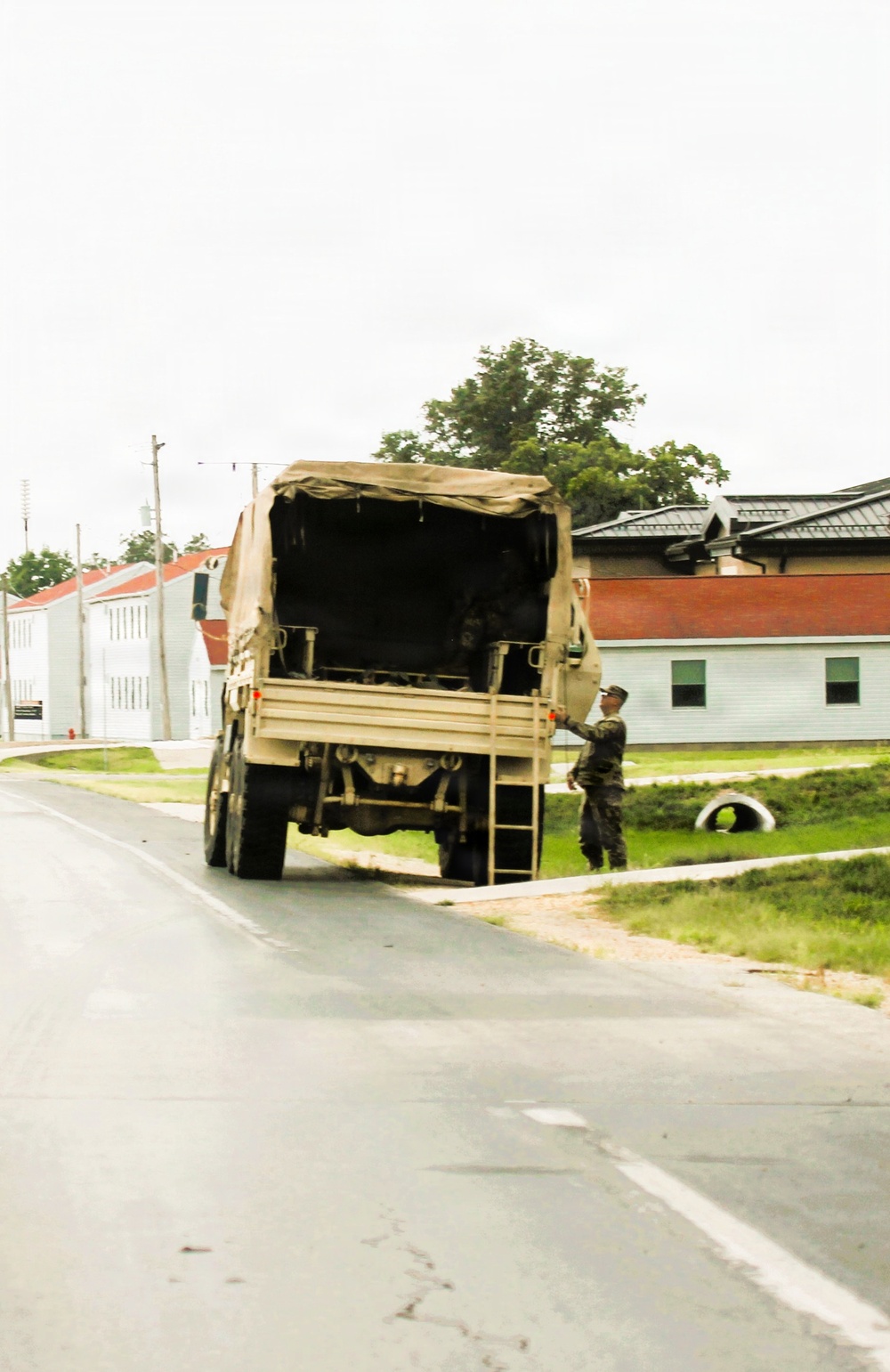
The 86th Training Division's August photo coverage showed Soldiers conducting dismounted tactical operations, tactical vehicle and convoy operations, mounted weapons training, casualty response, medical operations, sustainment activities and other collective-training tasks.
Training scenarios challenged Soldiers in areas including mission command, tactical decision-making, communications, force protection, engineer operations and chemical, biological, radiological and nuclear response.
Medical elements trained alongside maneuver and support organizations, conducting casualty triage, emergency treatment, casualty movement, medical evacuation and other battlefield medical tasks.
The exercise also incorporated CBRN-response training, with Soldiers responding to simulated contamination scenarios, using protective equipment, recovering casualties and conducting decontamination procedures.
Modern battlefield considerations were also incorporated into the exercise, including training related to unmanned aircraft threats.
The Warrior Exercise-Regional Medic 2026 training demonstrated how Fort McCoy's combination of maneuver areas, ranges, specialized facilities and support infrastructure allows units with different missions to operate within the same realistic training environment.
Other military organizations continued training at Fort McCoy throughout August.
The 327th Military Police Battalion conducted nearly three weeks of training before completing its training period Aug. 19. Soldiers conducted a variety of physical and tactical training events, including confidence-course and litter-obstacle-course training, as well as medical-related instruction.
From Aug. 17–21, Air Force Reserve A-10C Thunderbolt II aircraft from the 303rd Fighter Squadron at Whiteman Air Force Base, Missouri, returned to Fort McCoy for specialized training.
According to Fort McCoy DPTMS officials, pilots conducted bombing training during the week, including low-level missions toward the installation’s impact area. The training provided significant flight time while allowing pilots to maintain and sharpen skills associated with operating the A-10 in a realistic environment.
Fort McCoy’s large impact area, extensive airspace and varied terrain provide an environment where A-10 crews can practice low-level flight profiles and air-to-ground weapons employment. The training also demonstrates the installation's ability to support Air Force Reserve requirements within an Army-managed training environment.
Later in the month, Fort McCoy supported Patriot ’26, conducted Aug. 24–29 in conjunction with Volk Field Combat Readiness Training Center.
Approximately 1,000 Airmen and Soldiers from National Guard units representing 35 states participated along with federal, state and local agencies. Fort McCoy provided training areas and facilities for scenarios focused on domestic-response readiness, emergency response and interagency coordination.
Kentucky National Guard UH-72 Lakota helicopter crews were among those participating at Fort McCoy, conducting aviation training that included medical-evacuation and hoist operations in areas where aircraft could not safely land.
The month also included additional specialized readiness activity involving Red Dragon and Joint Task Force-Port Opening training, as well as use of Fort McCoy’s simulation capabilities. Those capabilities include the Reconfigurable Vehicle Tactical Trainer, Engagement Skills Trainer, Virtual Clearance Training Suite, and Medical Simulation Training Center.
Together, the August training events illustrate the breadth of Fort McCoy’s role as a Total Force training center, garrison officials said.
The installation is not simply a location where units conduct field exercises. Its training mission encompasses live-fire ranges, maneuver areas, airspace, aviation facilities, simulation systems, medical training facilities, classrooms, barracks, dining facilities, maintenance areas and other infrastructure needed to support large numbers of troops.
That training mission also contributes directly to the region's economy.
Thousands of service members training at Fort McCoy require food, lodging, transportation, fuel, supplies, maintenance and other services. The installation's operations also generate requirements for construction, facility maintenance, equipment, materials and other goods and services, creating opportunities for businesses and workers throughout the surrounding region.
Fort McCoy's latest published economic-impact figures show the installation generated an estimated $1.6 billion in economic impact during fiscal year 2024, with more than $398 million in workforce payroll, operating costs and other expenditures.
Training activity is an important part of that economic impact because visiting units bring personnel and equipment into the region while relying on Fort McCoy and surrounding communities for goods and services.
History shows the installation’s continued investment in infrastructure further strengthens that training and economic role. Projects involving barracks, training facilities, utilities, roads and other infrastructure help Fort McCoy accommodate the evolving needs of military units while supporting construction and contracting activity.
During fiscal year 2025, Fort McCoy supported training for 109,962 military personnel, demonstrating the installation’s established role in supporting high-volume training for Army Reserve, National Guard, active-component and other military organizations.
August’s more than 10,000 training participants represent another significant contribution to that annual mission.
For Fort McCoy personnel, supporting that activity requires coordination across DPTMS and numerous installation organizations responsible for ranges, airspace, facilities, logistics, safety, communications, transportation, medical support and other services.
From Soldiers preparing for large-scale combat operations, to military police sharpening specialized skills, Air Force Reserve pilots conducting weapons training and National Guard forces preparing for domestic emergencies, the month demonstrated the range of missions Fort McCoy can support.
It also demonstrated the connection between military readiness and the communities surrounding the installation.
Every training rotation helps prepare service members for future missions while bringing economic activity to the region and possibly reinforcing Fort McCoy’s role as one of the Upper Midwest's most important military installations.
Fort McCoy’s motto beginning in 2026 is “Training the Total Force and Shaping the Future since 1909.” The installation’s mission: “Fort McCoy strengthens Total Force Readiness by serving as a training center, Mobilization Force Generation Installation, and Strategic Support Area enabling warfighter lethality to deploy, fight, and win our nation’s wars.”
And Fort McCoy’s vision is, “To be the premier training center supporting the most capable, combat-ready, and lethal armed forces.”
Located in the heart of the upper Midwest, Fort McCoy is the only U.S. Army installation in Wisconsin. The installation has provided support and facilities for the field and classroom training of more than 100,000 military personnel from all services nearly every year since 1984.
Learn more about Fort McCoy online at https://home.army.mil/mccoy, on Facebook by searching “ftmccoy,” on Flickr at https://www.flickr.com/photos/fortmccoywi, and on DVIDS at https://www.dvidshub.net/unit/FMPAO. Also try downloading the My Army Post app to your smartphone and set “Fort McCoy” or another installation as your preferred base.
Fort McCoy is also part of Army’s Installation Management Command where “We Are The Army’s Home.”
| Date Taken: |
09.03.2026 |
| Date Posted: |
09.03.2026 17:16 |
| Story ID: |
573950 |
| Location: |
FORT MCCOY, WISCONSIN, US |
| Web Views: |
18 |
| Downloads: |
0 |
PUBLIC DOMAIN

This work, Thousands train at Fort McCoy during busy August; exercises, annual training bring troops to post, by Scott Sturkol, identified by DVIDS, must comply with the restrictions shown on https://www.dvidshub.net/about/copyright.

 Subscribe






