
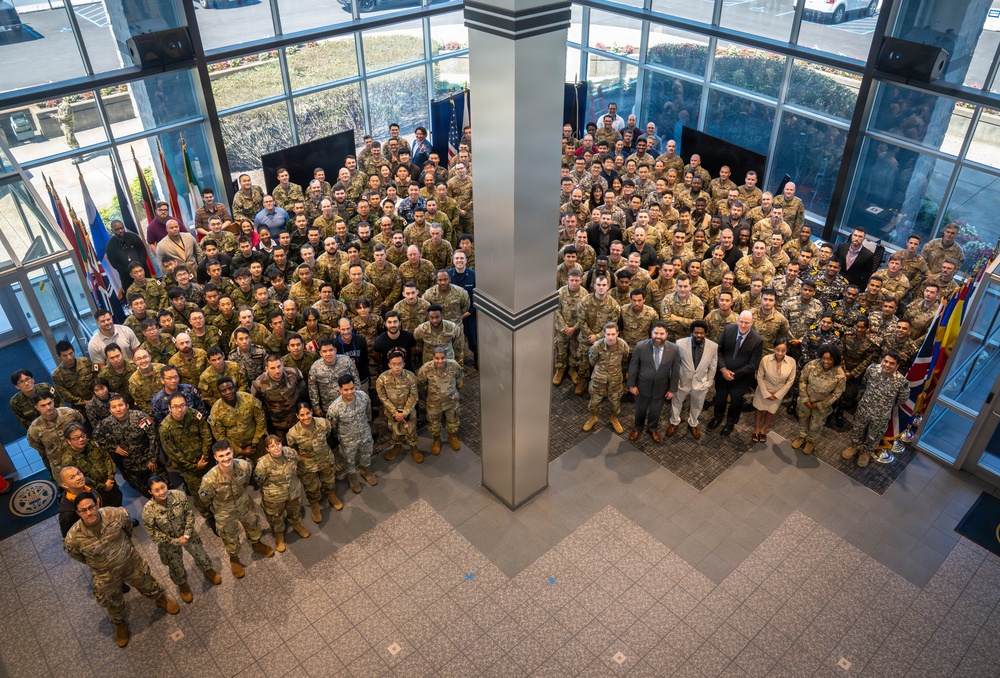
Photo By Chief Petty Officer Kyle Steckler | 260731-N-RG472-1302 (July 31, 2026) SUFFOLK, Va. – Participants of U.S. Cyber...... read more read more
 Subscribe
U.S. Cyber Command Public Affairs
SUFFOLK, Va. — U.S. Cyber Command concluded its 13th annual multi-national exercise CYBER FLAG on July 31, 2026, following nearly three weeks of intense, cyber-focused training and simulated malicious cyber threats alongside global partners and allies.
This year’s iteration of CYBER FLAG enabled more than 600 personnel from over 20 nations to develop a common approach to cybersecurity threats in a digital terrain.
The exercise concluded in conjunction with the command’s 6th annual Multi-National Symposium (MNS), which took place July 30-31, was attended by senior officers from more than 20 countries and featured in-depth discussions on issues facing the cyber landscape in an ever-evolving and expanding domain.
U.S. Army Gen. Josh Rudd, commander, U.S. Cyber Command, director, NSA, and chief, Central Security Service, spoke during the symposium and emphasized the importance of multi-national training and preparedness during exercises like CYBER FLAG.
“We never fight as a single service,” said Rudd. “I wear an Army uniform, but I think and act like a Joint warfighter. As a community, as a nation, as a world, we've never fought alone. What's going to keep our respective nations safe from cyber threats, what's going to keep us ahead of the challenge, the pace and the adversaries, is this group of like-minded partners coming together to solve hard problems.”
Rudd also commented on the specific relationships established and maintained during events like the MNS, remarking that trust is not established during times of crisis.
“Trust comes with time,” said Rudd. “It's got to be established. You have to get to know each other. You have to spend time with each other. Sometimes that happens by choice, and sometimes it happens because a crisis moment has hit, and it's forced us all together. The more that we can stay ahead of the crisis inflection point, the better prepared we are to leverage our individual strengths. The real power that each of us brings to the table is the unique perspective, the unique culture, the unique aspect of history and viewpoint, as well as the skill sets, talent and ability to solve problems differently. If we duplicate effort, we're missing part of the strength of a multilateral effort. When we recognize respective talents and ability to solve different parts of the same problem, when we harness it, manage it, coalesce it, and then integrate it, that's really the magic behind partnerships.”
The Honorable Katie E. Sutton, Assistant Secretary of War for Cyber Policy and Principal Cyber Advisor to the Secretary of War, spoke virtually during the symposium, where she highlighted the 2026 National Defense Strategy’s shift toward flexible realism and emphasized burden-sharing with allies to counter global cyber threats.
"I've had the opportunity to attend CYBER FLAG for several years and the value provided by this event, bringing together our most important partners, has grown and become a pillar of how we operate as a collective community,” said Sutton. “This exercise has been a great example of showing how cyber can be foundational in achieving these important partnerships."
U.S. Army Maj. Gen. Stephanie Ahern, J5 director of Plans and Policy at U. S. Cyber Command, opened the MNS, setting the stage by focusing on the opportunities presented by gathering military cyber leaders from around the world.
“I appreciate the opportunity to be able to learn with everyone here,” said Ahern. “These are extremely challenging times. There are active conflicts ongoing in multiple places around the world. Just within the cyber domain, there is daily confrontation. As we're responding to malicious cyber actors attacking our network or undermining us in the information space, we also have to train for the current cyber landscape and for where cyber is going.”
Ahern specifically highlighted the importance of working together with other nations, using the symposium and CYBER FLAG exercise as examples of working side-by-side.
“This is why CYBER FLAG and the multinational symposium are so important,” said Ahern. “All of us need to secure and defend our networks and to make our networks ‘hostile terrain’ to those who shouldn't be there. We are going to be stronger together, and that is why we are here – so we can share the lessons, the insights, and adapt quickly.”
The symposium included panels featuring cyber experts from all around the globe and covered topics including artificial intelligence, capability integration to enhance training and exercises, and multi-domain operations with a focus on cyberspace. Additionally, symposium attendees participated in several small-group discussions designed to elicit feedback and conversation between nations.
“It’s these types of small-group forums, as part of the larger symposium, that provide one of the best opportunities to listen and hear different perspectives from cyber leaders from all over the world,” said Canadian Army Brig.-Gen. Keith Osmond, J7 director of Force Development at U.S. Cyber Command. “Collectively, we learn from each other’s experiences, perspectives, the unique challenges that our respective teams are facing, and the creative ways that we each tackle them and the different solutions we find. There's just such immense innovation and creativity in this space, and it's extremely valuable to learn from all the experience in this room.”
Similar to years past, this year’s symposium included participants that extended beyond the traditional Five Eyes partners (United States, United Kingdom, Canada, Australia, and New Zealand) to include representatives from nations across Asia, Europe, the Americas, Africa, and the Middle East.
CYBER FLAG itself began on July 13. During the exercise, on-site and virtual cyber operators worked together using real-world offensive and defensive cyber tools and tactics to detect, identify, isolate and counter adversarial presence on fictional networks inside the simulated internet space known as the Persistent Cyber Training Environment.
This year, exercise administrators expanded their use of AI in an effort to better emulate the scenario’s fictional adversary.
“We understand that we need to stay ahead of the malicious actors using AI, so we're using AI to better emulate them,” said Logan Reyes, a member of U.S. Cyber Command’s Cyber Adversary Tactics Office, and CYBER FLAG’s Opposing Forces lead. “In using AI during CYBER FLAG to emulate adversaries, we’re not only providing the exercise training audience a more realistic scenario, we’re also learning to anticipate real-world tactics malicious cyber actors could use. We can do both at the same time, and that’s been a big focus of this year’s exercise.”
CYBER FLAG continues to bring together foreign nations and partners, enabling the sharing of experiences and technical expertise to enhance collective cyber capabilities and defenses against shared cybersecurity threats.
“If success is measured by the degree of interest, energy and dedication of the exercise participants and support staff then it is fair to say that both the CYBER FLAG exercise and the Multinational Symposium were resounding successes this year,” said Osmond. “The planners have already begun thinking about how to make it more realistic and challenging for next year and while many would say that this year’s events were the best ones yet, there is a high degree of optimism that next year’s will be even better.”
| Date Taken: | 07.31.2026 |
| Date Posted: | 09.03.2026 10:55 |
| Story ID: | 573887 |
| Location: | SUFFOLK, VIRGINIA, US |
| Web Views: | 26 |
| Downloads: | 0 |

This work, USCYBERCOM conducts annual Cyber Flag exercise, gathers military cyber leaders for Multi-National Symposium, must comply with the restrictions shown on https://www.dvidshub.net/about/copyright.


No keywords found.




