
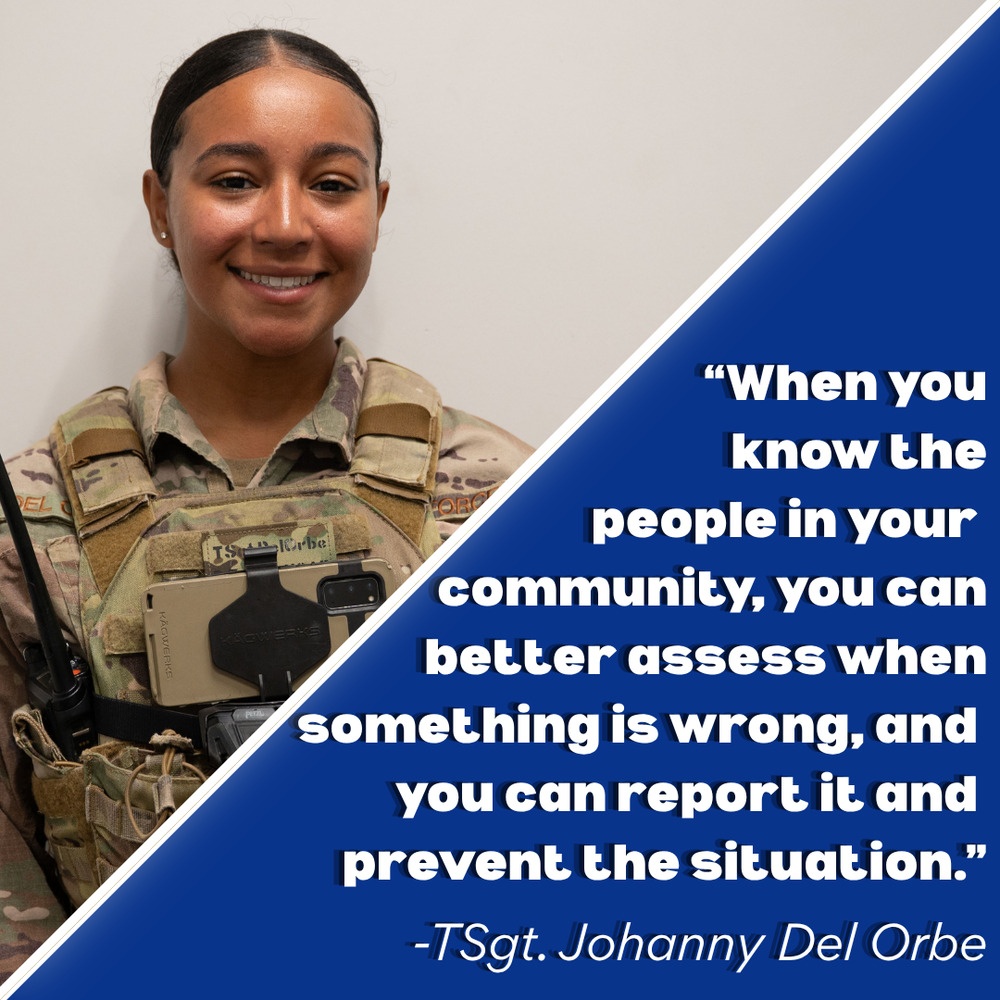
Photo By Staff Sgt. Victoria Nuzzi | A graphic of U.S. Air Force Tech. Sgt. Johanny Del Orbe, 39th Security Forces Squadron...... read more read more
 Subscribe
Airmen across the Department of the Air Force are constantly reminded to stay vigilant: "If you see something, say something." Behind every call to emergency dispatch or local investigators is a coordinated response that actively safeguards installations, personnel and operational readiness.
Now assigned to the 39th Air Base Wing, four U.S. Airmen from the 39th Security Forces Squadron and a special agent from Air Force Office of Special Investigations Detachment 522 drew upon experiences from previous duty stations to demonstrate why vigilance matters at Incirlik Air Base.
At the Gate
Base defense begins at the installation boundary, where early detection of abnormal behavior stops security threats before they cross the perimeter.
While stationed at Ramstein Air Base, Germany, Senior Airman Tyrone Donald experienced how quickly a routine gate check can escalate. While conducting access control, an uncredentialed individual approached the gate to visit an on-base restaurant. Donald immediately noticed the individual appeared fidgety and visibly nervous.
"I tried to explain as politely as I could that she could not come on base without credentials, but she was getting more agitated," Donald said.
After several minutes of discussion, the situation peaked when the individual suddenly attempted to run the gate. Donald and a fellow Defender acted instantly, activating the emergency active vehicle barriers to stop the vehicle before apprehending the suspect.
"As Defenders, our job is to defend the base and protect its people and assets, but that is not just our responsibility," Donald said. "It is up to all of us. I encourage every Airman to keep their eyes open and contact security forces whenever something does not seem right."
In the Community
Proactive community reporting provides equal value.
While stationed at the U.S. Air Force Academy, Colorado, Staff Sgt. Jeremy Huber witnessed how a single phone call from an observant community member led to a major security interdiction.
Huber was dispatched after someone notified the Base Defense Operations Center of a suspicious individual lingering near the pass and registration office. After locating the individual and requesting identification, Huber discovered the man was a foreign national on a government watchlist.
"He had a valid visa, but when I ran his passport through our system, it turned out he was suspected of attempting to gain access to different military installations," Huber said. "We immediately contacted OSI, and they came and escorted him away."
The incident remains Huber’s go-to example of why community reporting is essential for base defense. "We would rather you call about something, and it turns out to be nothing, rather than it be something and you said nothing, putting the installation at risk," Huber emphasized.
Physical security checks and routine patrols also rely heavily on community input to address hazards quickly. While stationed at Lackland Air Force Base, Texas, Tech. Sgt. Leo Anderson III responded to a call after an observant witness saw someone throw a backpack over the perimeter fence. Defenders immediately secured the area and established a cordon.
"We had one of our military working dogs sniff the bag and alert, so we brought out Explosive Ordnance Disposal to inspect it," Anderson said. "It turned out to contain a BB gun.” “Even though it was not an explosive device, I always tell people that if something feels wrong, report it to BDOC. You never want to be the person who saw something and said nothing."
Community policing also plays a vital role in domestic safety and welfare checks.
While conducting a housing patrol at Joint Base Pearl Harbor-Hickam, Hawaii, Tech. Sgt. Johanny Del Orbe noticed a resident who appeared distressed and was being blocked from entering her home.
Del Orbe and her flight chief investigated the residence, challenged an uncooperative occupant and secured the scene after discovering hazardous conditions. Del Orbe safely escorted a child from the house and stayed with them until Family Advocacy Program personnel arrived.
“I share stories like that to encourage people not to be afraid to get to know those around them," Del Orbe said. "When you know the people in your community, you can better assess when something is wrong, and you can report it to prevent a situation from going too far.”
Among Wingmen
Vigilance is equally critical within daily work centers, where early intervention can resolve security concerns while helping Airmen facing personal crises.
While assigned to Shaw Air Force Base, South Carolina, Special Agent Wade Davis’s office received a report from an Airman concerned that a coworker was showing potential insider threat indicators, including uncharacteristic hostility and attendance issues.
OSI and unit leadership conducted an inquiry and discovered there was no malicious intent. Instead, the Airman was experiencing a severe personal crisis. Recognizing the issue early allowed the command to help and connect the member with inpatient medical care.
"The moral of the story is that if you see your coworkers struggling or acting abnormal, you need to question it," Davis said. "It might be an insider threat, or it might just be someone struggling, so you always need to keep your eyes open."
Across every duty station and operational environment, proactive communication remains the cornerstone of base defense.
For the 39th Air Base Wing, the experiences shared by these Defenders and AFOSI investigators highlight a consistent theme: prompt reporting protects the installation, supports fellow wingmen, and safeguards the mission.
| Date Taken: | 09.02.2026 |
| Date Posted: | 09.03.2026 09:25 |
| Story ID: | 573875 |
| Location: | TR |
| Web Views: | 26 |
| Downloads: | 0 |

This work, Stories of effective awareness: how past lessons protect the 39th ABW, by SSgt Victoria Nuzzi, identified by DVIDS, must comply with the restrictions shown on https://www.dvidshub.net/about/copyright.


No keywords found.




